Why do we attend legal industry events?  What makes them worth our time? Valuable blue sky remains.


Earlier this month I participated in the Inspire.legal conference in New York City.  Because Inspire.legal was sufficiently different than any other legal industry event I have attended, I began ruminating on the question “why?”

The matrix above, which reflects industry events I have attended over the the last 15+ years, and thus excludes those I have no firsthand knowledge of, provides a framework for my answer. Despite this limitation, I am likely in the 99th percentile of breadth of conference attendance. So let’s give it go.

My analysis breaks down into four parts:

  1. The vertical (Y) axis, which is type of format.
  2. The horizontal (X) axis, which is diversity of perspective.
  3. Why Inspire.legal is in a box by itself.
  4. The valuable blue sky that remains.

1. Type of Format

The vertical (Y) axis reflects the event format, moving from traditional talking head panels to an more interactive format to team-based classroom learning.

Talking Head Panels.  The most obvious takeaway is that talking head panels is a very common format.  Why is that? The most likely answer is that a portion of attendees prefer it that way, as it puts them (us) in control.  Attendees can attend the programming they want, spend most of the time networking in the hallways, or take time off without anyone noticing. Conference organizers may also prefer it because it’s a proven economic model — panels of experts attracts attendees; the opportunity to speak attracts the experts; and the format routinely qualifies for CLE credit.  It’s stable and generally does not require a lot of care and feeding to work.

Interactive Formats.  As we move up the Y axis into more interactive formats, we have large number of events.  Two events, the NALP Annual Education Conference and the Professional Development Institute (PDI), stand out because the vast majority of slots are filled by RFPs in which one of the key selection criteria is interactive teaching methods.

Most of the interactive format events, however, tend to be private and invitation-only.  In addition to numerous academic workshops where I get attend because I’m an academic, I’ve have the opportunity to attend roundtables designed for managing partners (several based on size, geography, prestige), general counsel, law firm COOs/EDs, law firm marketing, law firm KM professionals, and law firm talent management (several based on geography and recruiting / PD / diversity). The value of these formats is candor, enabling attendees to learn how counterparts are handling similar challenges and, hopefully, what works.

Significant New Learning.  The top Y-axis category is “Significant New Learning.”  Based on my experience, the only programing that fits this bill is offered by Harvard Law’s Executive Education Program.  These programs tend to be immersive 4-5 day programs where attendees — primarily law firm partners from elite firms and general counsel from major companies — are tasked with learning new knowledge and skills within a team-based environment.  Drawing upon the highly interactive business school case method, Harvard Law has developed an outstanding library of real-world cases to support this program.  HLS and HBS professors divide up the majority of teaching duties.

Most people who attend HLS executive ed call it “transformative,” which raises the question, “why is this type of programming so rare?”  The tuition is high and the opportunity cost of time away from clients and the office is even higher.  That said, a strong case can be made that this type of executive ed nonetheless leads to a significant ROI. See Henderson, “Milbank’s Big Bet,” AmLaw Daily, May 11, 2011; Henderson, “An Update on Milbank’s Big Bet,” LWB, Nov. 13, 2013.

2. Diversity of Perspective

The horizontal (X) axis reflects the diversity of perspectives, moving from professional silos to some diversity of perspective (mix of allied professionals and non-practicing lawyers in P3 roles) to significant diversity (GCs, law firm leaders, legal ops, legal tech, NewLaw, deans, regulators, law students).

Professional Silos. They exist because they are comfortable. During times industry calm, they also provide a way to exchange useful technical and operational information.

Some Diversity of Perspective.  But the last decade or so have been been particularly calm. I think that is why are are seeing the the proliferation of programming in the middle category, “Some Diversity in Perspective.”  More and more conferences are creating panels that bring together clients and service providers in ways that create a real exchange of ideas. Likewise, at many middle category conference, there is a growing realization that the practice of law is becoming increasingly multidisciplinary.  Thus, more allied professionals are put forward not only as technical experts, but true industry thought leaders and business leaders. Slowly, the silos are coming down.  What is so often missing from these conferences, however, are law firm partners.  See Post 054 (Jae Um noting that BigLaw partners aren’t at the industry conferences because they are busy servicing clients to hit this year’s numbers).

Significant Diversity of Perspective.  Note that the “Significant Diversity of Perspective” category comes with an asterisk.  What does this mean?  A handful of times over the last several years, I’ve been in a room that reflected significant diversity of perspective.  Yet, in hindsight, it’s obvious that all three events — all convened, at least initially, in the 2011-2014 time period — were magnets for innovators and early adopters seeking to make sense of a legal industry where traditional business models were foundering.  Thus, while participants came from a wide range of industry roles and experiences, attendees were highly self-selected based on their  innovator and early adopter status, albeit this typology was new to the legal field. Cf. Post 033 (discussing creation and attendees at inaugural Forum on Legal Evolution).

According to diffusion theory, innovation becomes more likely as we move from the left to the middle and right side of the graph. This is because professional silos are too insular in see beyond established ideas and hierarchies. (Everett Rogers relied upon the technical term homophily to describe this problem.)  Yet, as a group becomes more heterophilous, the sharing of potentially valuable ideas requires more effortful communication.  This conundrum is depicted in the chart below (from Post 020) shows the condrunum.

In most social systems, only innovators and early adopters are willing to pay the price of learning challenging new ideas and concepts during this mid- and late portions of their careers.  Cf. Randy Kiser, Soft Skills for the Effective Lawyer ch. 9 (Cambridge 2017) (in conclusion to his book, observing that for many lawyers, the disinterest in learning begins as early as law schools).

3. Why Inspire.legal is in a box by itself

Christian Lang

Inspire.legal is in the center box by itself.  This happened because the event’s founder, Christian Lang, made the decision of dumping traditional talking panels in favor of “Unpanels” where attendees drive the content.

Unpanels are part of the Unconference movement.

I attended my first Unconference in April 2017.  It was put on in Washington, DC by Vox.com.  To get an invite, I had to write an blurb that showcased what I might bring to a future-oriented policy conference where the attendees drove the content. Somehow I made the cut. Out of roughly 500 attendees, I was definitely a 1-percenter on the age spectrum — very few Boomers. That did not matter to me, however, because I was there on my own dime to try to understand the Unconference format.

Unconferences are ideal for broad groups of stakeholders who are passionate about change and frustrated with the constraints of the status quo.  At an Unconference, those those without fancy credentials and titles can steal the show based on the force and clarity of their ideas.

To the best of my knowledge, Inspire.legal was the first application of the Unconference format to the legal industry vertical.  Hosted at beautiful New York Law School on the Friday following ALM’s LegalWeek — a smart move by Christian — the event was extremely well attended by a demographic that was relatively diverse by age, experience, and role within the industry. (The underrepresented groups were line partners from law firms and legal departments lawyers.)

What made Inspire.legal both worthwhile and unique was how the Unpanel format leveraged the diversity in the room. Rather than giving all the airtime to established experts, we got to hear from people based upon how much they cared about a problem. In the session I ran on “Who should pay for the training of the next generation of legal professionals?,” we heard from deans, law students, law professors, current and former law firm associates, law firm PD and learning professionals, founders of legaltech companies, legal journalists, KM directors, and many others.

Our Unpanel created the rules of engagements using green, yellow, and red index cards, which seemed to work well.  Far from an echo chamber, we heard sharp and reasoned disagreement. If we had been running a tape recorder and truly had the time and resources to solve the “who pays” problem, our session would have been a profoundly valuable focus group.

4. The valuable blue sky that remains

Although ideas are fun and valuable, what is missing from the legal industry landscape is programming that supports deep, cross-disciplinary learning of the kind that can produce a competitive advantage for attendees and their organizations.  When and if that happens, expect the format to grow and eventually influence the entire social system.

The constraints, however, are formidable.

  • Cost to produce.  Immersive learning programs are very expensive to design and run.  Where does the seed capital come from?
  • Cost to attend. Sure, there is tuition/registration fees. But likely the bigger cost is time away from work and clients. This why line lawyers and law firm and legal department leaders are unrepresented at conferences that emphasize innovation — the demands of their jobs make new learning extremely costly.
  • Educated incapacity.  This is a term coined by military strategist Herman Kahn. As Kahn notes, “The more expert—or at least the more educated—a person is, the less likely that person is to see a solution when it is not within the framework in which he or she was taught to think.” See Herman Kahn, “The Expert and Educated Incapacity,” Hudson Institute (June 1979). Thus, multidisciplinary collaboration and learning is high value, but it comes at the price of letting go of comfortable old ideas.

Fortunately, chapter 9 of Diffusion of Innovations (5th. ed. 2003) provides some insight on this situation. Rogers breaks down diffusion systems into two types: Centralized and Decentralized.

Centralized Diffusion Systems, depicted below, are common in circumstances where a powerful central authority (e.g., government agency, corporation, trade association) has a strong interest in spurring innovation.

Adapted from Everett Rogers, Diffusion of Innovations fig. 9-1 (5th ed. 2003)

The centralized system applies to the diffusion of hybrid seeds during the first half of the 20th century. See Posts 008 and 020 (providing history). Farmers lacked the technical know-how to invent and use hybrid seed. Yet, for reasons of national security, the U.S. Department of Agriculture had a strong interest in increasing domestic agricultural yields.  Thus, the technology was invented by university-trained agronomists and shared with farmers through agricultural extension services funded by various federal, state, and local agencies. Through trial and error, personnel from the extensive services discovered the value of focusing on opinion leaders to speed up the process of adoption. Over the last half-century, this has proven invaluable in a variety of real-world contexts, particularly in the area of public health.

In contrast, Decentralized Diffusion Systems, depicted below, is what happens when a social system lacks a formal structure to solve system-wide problems.

Adapted from Everett Rogers, Diffusion of Innovations fig. 9-1 (5th ed. 2003)

The primary challenge of a decentralized systems is that social systems may lack technical skills and knowledge to properly vet new solutions, which could lead to various false starts and maladaptations. See Rogers at 398-99 (discussing disadvantages and risk factors of decentralized diffusion systems); see also Post 051 (Jae Um discussing blame game and sloppy “because lawyers” narratives). I think this is where the legal industry finds itself, circa 2019 — for the good of clients and the broader legal system, we need to embrace new disciplines and methodologies, yet none of this is part of lawyers’ formal training.

To my mind, the solution is find ingenious ways for lawyers and allied professionals to spend more time the blue sky portion of the matrix above. This requires the creation of an empirically validated body of knowledge and teaching methods that are (a) highly time efficient for busy, high-level professionals, (b) high-impact (you can start using what you learned the following week, and (c) highly scalable, which enables the highest possible quality to be delivered at the lowest possible cost.

In effect, the combination of quality, cost, and user experience serves a role similar to a centralized diffusion system. A profession worthy of self-regulation will figure out how to make this happen.


IFLP is proud to collaborate with the above list of innovators and early adopters.


Later this month, the Institute for the Future of Law Practice (IFLP, or “I-flip”) will celebrate its one year anniversary. Before that, it was just an idea in the minds of a few dozen lawyers, legal educators and allied professionals.  In the fall of 2017, this “Group of 40” participated in a needs analysis. There were two questions: Is an intermediary organization needed to align the interests of law schools, legal employers and clients around the educational requirements of 21st century law practice?  And if so, could such an organization become a viable nonprofit operating company?

The Group of 40 concluded that the period of industry-wide discussion and debate, which began in earnest after the 2008 financial crisis, had run its natural course.  It was time to start building the future. Thus, an organization like IFLP was worth a try.

The Group of 40 endorsed the creation of a skills bootcamp in spring 2018 for a group of roughly 25 students. A key feature would be paid internship employment for every admitted student. By hiring students, IFLP employers would be signalling the value of IFLP training. Eventually the rest of the market would catch on.  In a nutshell, that was the model.

Initially IFLP’s only assets were relationships, albeit that was huge. In November of 2017, Cisco Systems committed to six paid 7-month internships ($300,000+ in salaries). Northwestern Law committed classroom space for the inaugural bootcamp.  In addition to hiring IFLP grads, Chapman and Cutler and Elevate Services agreed to provide year-one operating capital (later Quislex provided additional founding sponsor support). A wonderful group of professionals agreed to serve on our volunteer board. Another dozen-plus industry leaders agreed to serve as volunteer instructors. All this happened because of a network of professional peers with significant history and a reservoir of trust.

Drawing upon this foundation, IFLP was brought into this world on January 16, 2018 as a Delaware nonprofit nonstock corporation. A few days later, we launched a website and started recruiting employers. Before we had a checking account, we were interviewing students for the bootcamp. See Post 043 (announcing launching of IFLP); Post 046 (providing an early days account).

The inaugural bootcamp went well. We faithfully collected metrics on all of it. In the fall of 2018, as we began to plan for 2019, we finally had the bandwidth to create a logo and refresh the website with content that reflected our longer-term aspirations.

As we approach our one year anniversary, IFLP is immensely grateful to the above roster of 2019 IFLP employers. These are the legal industry’s innovators, early adopters, and opinion leaders.  To fill all the employment slots, IFLP will be running skills bootcamps in Boulder (Colorado Law), Chicago (Northwestern), and Toronto (Osgoode Hall) for 75 to 90 students. We have room for approximately ten additional employer slots before we hit maximum capacity. Our existing funnel of prospective employers is likely to yield that. Likewise, in 2019 we are fortunate to have 18 participating law schools, see list on IFLP website, with plans to add more in 2020.

As the title of this post suggests, this is an update on IFLP.  I have time to write it because the IFLP board and leadership team has done a very good job of building an infrastructure that can scale. As of today, our expansion is on schedule.  Below I will do my best to describe the organization’s current activities and future plans.  The good news is that we are building a big tent for those wanting to co-create a better future.


For the pre-history of IFLP, including the indispensable role of the Colorado Law’s Tech Lawyer Accelerator (TLA) Program, see Henderson & Linna, “Is Your Organization Building a World-Class Talent Pipeline?,” Law.com, Aug. 31, 2018; see also Post 018 (discussing TLA during the summer of 2017).


Mission

IFLP’s core mission is to align the interests of law schools, law students, legal employers and other industry stakeholders around the knowledge, skills and training needed by 21st century legal professionals. What makes this mission so important is the relentless growth of complexity in a highly regulated, interconnected and globalized world.  Without a bigger toolbox, legal services will continue to become unaffordable to a larger proportion of clients.

This pressure is most acute at two ends of the legal spectrum: PeopleLaw, where a growing share of ordinary citizens are forgoing legal services, see Post 037 (data on declining PeopleLaw sector); Post 042 (legal services shrinking portion of CPI basket); and large organizational clients, where legal need is racing ahead of legal budgets, see Post 022 (CLOC focused on this problem); Post 041 (Legaltech focused on this problem); Post 053 (rise of NewLaw focused on this problem); Post 055 (Godfather of legal ops joining Baker McKenzie to solve this problem); Post 069 (Microsoft legal dept focused on this problem).

For both clients and lawyers, the increase in legal complexity is experienced and, therefore, framed as a cost problem.  Yet, it’s really a problem of lagging productivity. The increased volume of complexity requires lawyers to find ways to accomplish more per unit of effort. Otherwise, the lawyers are priced out of a job. Cf. Henderson, “The Legal Profession’s ‘Last Mile Problem,'” Law.com, May 26, 2017 (legal industry is hindered by lack of business models that reliably reward efficiency).

IFLP is designed to serve the entire legal profession, as evidenced by this graphic, which organizes IFLP employers by sector. Yes, law firms, law departments, legaltech and NewLaw are supporting IFLP, but nearly 20% of our employers are public service organizations.

T-shaped curricula

In the most practical sense, IFLP is trying to accelerate the development of T-shaped legal professionals. See diagram to right. For lawyers, law school and law practice provide a deep foundation of substantive legal knowledge and skills. The T-shaped legal professional is created by adding a working knowledge of other disciplines, such as data, process/project management, technology, design and business principles.

The legal profession’s future is lawyers and allied professionals working side by side to cost-effectively solve very difficult problems. Cf. Ron Friedmann, “A Multidisciplinary Future to Solve Legal Problems,” Prism Legal (Mar. 2018). T-shaped curricula make these collaborations more effective and fruitful.

Someday the type of curricula offered by IFLP will be standard in law schools throughout the world.  Indeed, IFLP’s mission is to enable law schools to do just that.  But right now, the state-of-the-art is being pioneered in the field by innovative practitioners and allied professionals. The first step is to locate subject matter experts and organize their knowledge and know-how into subjects that can efficiently taught to others. Fortunately, IFLP has the networks to make this happen. Notice IFLP’s logo — it’s a network.
Bootcamps

Below are the modules that are currently covered in our foundational and advanced track bootcamps.

IFLP’s 2019 foundational boot camps will run from May 13-31 in three locations: Chicago, Boulder, Toronto. This training targets rising 2Ls but rising 3Ls and mid-career professionals may also participate. At the end of the bootcamp, law students go on to paid internships with IFLP employers.

The advanced track bootcamp is offered later in the summer to rising 3Ls and mid-career professionals. The advanced track is designed to be preparation for 7-month full-time internships (technically a “field placement”) during the summer and fall semester of a student’s 3L year.

In terms of contact hours and out-of-class study, both the foundational and advanced track bootcamps are designed to fulfill ABA accreditation requirements for a 3-credit law school course. Likewise, the 7-month field placement is designed to earn another 8 credits. See ABA Accreditation Standard 304(d) (defining requirements for field placements). Thus, the full IFLP sequence could total up to 14 academic credit hours, albeit the approval and granting of academic credit is done by participating law schools.

Below is the current timeline for 10-week and 7-month internships: 

To my colleagues at other law schools, I am happy to share the course proposals that led to approval of the full IFLP sequence at Indiana Law. In the course catalogue, these courses are referred to as Modern Law Practice I, Modern Law Practice II, and Modern Law Practice Field Placement. Email me.

Evolution, not revolution

In Post 077, Dan Rodriguez distinguished between mission-based and mission-disruptive innovation.  IFLP is definitely the former, as the IFLP curricula enables law schools to adapt to massive changes occuring in the legal profession.

On this point, it is noteworthy that the majority of IFLP students are rising 2Ls who complete the foundational bootcamp and go on to 10-week paid internships with IFLP employers.  This is creating a paid labor market for law students based on newly acquired skills.  The bootcamp leads are Dan Linna in Chicago, Bill Mooz in Boulder, and Monica Goyal in Toronto.  These are very accomplished T-shaped lawyers who are also experienced law school teachers. Throughout the bootcamps, each is assisted by over a dozen guest instructors who teach in their area of expertise and/or supervise team-based simulations and exercises.  This content is worth 3 academic credits, which significantly multiples the value of the other 85 credits needed to earn a JD degree.

One of the challenges faced by IFLP — albeit a challenge that is sure to fade over time — is a view by some law professors that T-shaped skills are peripheral to the actual practice of law and thus can be safely ignored during law school.  This is just not accurate. Below is a list of some of the substantive legal projects performed by IFLP interns over the summer:

  • Review and draft various contracts
  • Draft software service and licensing agreements, including NDAs, MSAs, SOWs
  • Contract management and risk analysis
  • Research substantive legal issues and write memoranda
  • M&A due diligence
  • Intellectual property: copyrights, trademarks
  • Deal negotiation
  • Litigation document drafting
  • Prepare regulatory filings
  • Update privacy policy and data usage and protection policies
  • Advise on employment law issues
  • Attend and summarize meetings with business units

It is also true that IFLP interns work on projects that have a legal operations focus. Below are example projects drawn from past interns:

  • Develop expert systems: checklists, compliance automation, document assembly, and workflow templates
  • Create budgeting templates
  • Use predictive modelling to create machine learning tools that predict case cost,outcomes, and timelines
  • Knowledge management: classifying documents, updating clause libraries
  • Case data analysis to develop value pricing models
  • Process map specific case type, then draft standard pleadings, discovery, litigation documents, and checklists for every stage of this case type
  • Simplify and streamline legal department’s advertising approval process
  • Research current state of blockchain and legal
  • Technology evaluation, selection, implementation, testing, and training
  • Analyze outside counsel survey responses and develop objective system for selecting firms
  • Trademark library clean up

So much of the innovation occurring in the legal profession these days are activities found on this second list.  One reason that law firms struggle to fully embrace these innovations is that their fee-earners are too expensive to take offline so they can be properly trained in the top-of-the-T disciplines. In contrast, IFLP offers a pipeline solution where foundational knowledge is baked into students’ law school education.  The attractiveness of this solution is why we ended up with 50+ sophisticated legal employers before we reached our first anniversary.

Placements that benefit interns and employers

In the year 2019, we are all in continuous learner mode.  Thus, it is understandable why a lawyer or legal service organization might conclude that they lack the expertise and bandwidth to supervise an IFLP intern. Yet, there’s a solution to this common situation.

In 2018, IFLP founding sponsor Elevate Services worked with Univar—a Fortune 500 company—to pioneer a supervised internship model. Univar was undergoing a major restructuring that consumed all its internal bandwidth. General Counsel Jeff Carr, an innovator who is frequently cited on Legal Evolution, see Posts 008, 052, 053056, needed the extra hands and the intern price point. However, his team lacked time for daily supervision.  Thus, he hired an IFLP intern supervised by ElevateNext, a law firm affiliated with Elevate.

Jeff recently told a group of fellow Fortune 500 general counsel, “I just can’t say enough about the importance of this initiative as well as the quality of the program and the interns. Our experience was incredibly positive.”

Below is quick overview of the two ways that employers can hire through IFLP:

Because Elevate has deep expertise in data, process, and technology, an IFLP supervised intern can be a very time-efficient and cost-effective way to accomplish an important organizational project while also observing and learning importance new methodologies related to law practice. Additional details here.

7-month field placements

In 2019, approximately 15 of the 75-90 IFLP employer slots are reserved for rising 3Ls who complete the foundational and advanced track bootcamps and go on to 7-month field placements. The value of this model was learned through employer experimentation and feedback.

As noted earlier, IFLP was born out a four-year pilot at Colorado Law called the Tech Lawyer Accelerator (TLA).  In its early permutations, the TLA looked very much like the current IFLP foundational bootcamp: 3 weeks of instruction followed by a 10-week paid internships.  However, based on feedback from employers, the TLA began experimenting with 7-month internships that extended full-time employment into the 3L fall semester.

Stephanie Drumm

One of the 7-month interns was Stephanie Drumm, a 2017 CU Law grad who is currently a second-year associate at Bryan Cave Leighton Paisner (BCLP).  Stephanie spent the first four months seconded inside one of the firm’s technology clients and the last three months working onsite at the firm.  The combination of tech and client knowledge proved to be invaluable to partners who work with emerging technology clients, particularly start-ups.  Thus, despite no expectation of permanent employment, Drumm was added to the 2017 incoming associate class and continues to receive glowing feedback. As Stephanie noted during IFLP’s Wave One launch event in Chicago, she believes the TLA 7-month internship gave her an edge in her career that continues to compound over time. This BCLP experiment went on to win a 2018 FT Innovation “Standout” award in the category of Managing and Development Talent, citing how it was instrumental in the creation of IFLP. See FT North America Innovative Lawyers 2018 at 19.

Other strong advocates for the 7-month field placement were Mark Chandler and Steve Harmon of Cisco. Between 2014 and 2017, the Cisco legal department hired nine 7-month interns from Colorado Law.  Seven months of onsite full-time work enabled the interns to learn Cisco’s business and work flow, which in turn improved their performance on more sophisticated and complex projects.

Indeed, one of the reason Bill Mooz and I felt compelled to form the Group of 40 and conduct a needs analysis was Chandler’s and Harmon’s willingness to hire six 7-month interns a year (a $300,000+ salary commitment). A second reason was a change in the ABA accreditation standards that removed the prohibition on for-credit field placements where students could also receive pay.  See Karen Sloan, “ABA Approves Pay for Law Student’s For-Credit Externships,” Law.com, Aug. 8, 2016. Although the 7-month field placements were phenomenal learning experiences for students, each student was required to move of heaven and earth to earn sufficient credits to graduate on time. This was a huge supply-side constraint.

Of course, removing a prohibition got us part way there. For-credit/for-pay programs have to be approved by individual law schools.  Further, someone has to do the legwork and find employers who see value in this type of program.

Fortunately, my home law school, Indiana Law, was willing to go first.  For several years, we have run an excellent program in Washington, DC where students work full-time for a federal agency for eight academic credits.  Each fall, an eight to ten student 3L cohort meet weekly or bi-weekly to review and discuss assignments with an Indiana Law instructor. This classroom setting earns students an additional two credits, thus totally ten for the 3L fall semester.  Although students were not paid, occasionally one of the agencies would provide a modest housing stipend. My colleagues viewed the IFLP field placement program as substantially the same.  The key constraint is that the placement must be with an employer utilizing sophisticated and advanced methods of practice — a description that applies to IFLP employers.

IFLP first class of 7-month interns

In 2018, I served as faculty liaison for three Indiana Law 3L students who were on IFLP field placements. All three completed the foundational boot camp in May and the advanced track in June before heading off to their jobs. Two (Matt Rust and Seth Saler) worked in San Jose in the Cisco legal department. The other (Elmer Thoreson) worked in Chicago at Chapman and Cutler as part of the Chapman Practice Innovations team.

During the fall semester, the four of us met regularly via Webex to discuss the assignments and mine the field placements for insights. While Seth and Matt worked on cybersecurity initiatives, M&A deals, proxy statements, preparation for the Cisco annual meeting, a dashboard for the legal ops group, and various other projects, Elmer was immersed in the application of process improvement and document automation to the intricacies of finance law, which is Chapman’s core area of expertise.  Seth and Matt raved about the weekly sessions on competition law that were run for their benefit by Gil Ohana, Cisco’s Senior Director of Antitrust and Competition. Elmer talked about the learning curve on Tender Option Bonds and the UX and UI features that entice lawyers to use technology.

One of the last assignments for the IFLP field placement was a departure memo to direct supervisors that summarized what each student had learned.

In the conclusion to his department memo, Elmer wrote, “Working in the Chapman Practice Innovations group has been a different experience from anywhere I’ve ever worked before. The entire group has valued my input, pushed me to expand my knowledge, and encouraged me to find solutions to problems. My time in the group has changed the way I look at legal problems and has encouraged me to figure out how different disciplines can influence the practice of law. … While the future is not entirely clear, I feel that my time here at CPI has helped me develop my long-term goals. In closing, thank you for the opportunity, the knowledge, and the laughs this semester.”

Likewise, Seth observed, “[During the internship, t]here were opportunities to complete document review, to witness oral arguments, and dive deeply into regulatory frameworks. …  I maintained a fairly comprehensive spreadsheet that tallied 30+ projects to which I contributed over the last six months. I was tasked with many of the fundamental tasks in a legal project pipeline: ideating, researching, drafting, and reviewing. … [T]he people I worked with departed from the conceptions I had about an internship. Rather than squeezing as much value and productivity out of me as they could in six months, the people at Cisco were interested in pouring value back into me.” Seth goes on list nearly a dozen people he considered mentors. Matt was equally effusive regarding what he learned and who he learned it from.

The last field placement assignment was co-written by Matt, Seth and Elmer and provides advice to next year’s 7-month interns.  Feel free to give it read. See Final 7-Month Intern Group Memo (Dec. 2018).

I hope the idea of a paid field placements in advanced practice settings takes off.  This is good for the law students, good for law schools, and good for the legal profession. That’s why I got involved.

Get Involved

This post is an invitation for readers to get involved with IFLP.  During 2019, members of the IFLP team would welcome the opportunity to speak to a wide range of industry groups, as we would like to include more law schools and more law students in our 2020 program. To do that, we need more IFLP employers. That is possible when more employers hear the IFLP story and learn what we have to offer.

During 2019, we will also use some of our foundational materials in our law school curricula to start creating high-impact, time-efficient training for mid-career professionals. That is the leg of our business model that will enable us to be self-sustaining.

Finally, IFLP is greatly indebted to our four founding sponsors who supplied the key resources to get to our year one anniversary.  Many thanks for your leadership!

IFLP Founding Sponsors


Sometimes, to protect and promote the long-term interest of stakeholders, leaders have to take difficult public positions. The decision won’t be popular or clearly right at the time, yet the risks of deflecting or avoiding a firm stance are just too high, at least for the collective.  For legal education, one of the best examples of this type of leadership occurred in 2014 when Dan Rodriguez was serving as President of the Association of American Law Schools (AALS).   Continue Reading Introducing contributor Dan Rodriguez (076)


Is legal operations a discipline or a job within a legal department?  The market just provided an answer.


Last Friday, David Cambria, the Godfather of legal operations, left his secure post at ADM (#46 on the Fortune 500) to become Global Director of Legal Operations at Baker McKenzie.  To be clear, Cambria’s title is not another name for “Chief Operating Officer,” an established role in law firms that focuses on internal cost and efficiency.  This is an outward-facing role designed to attract and cement client relationships.

Per the press release:

Cambria will be responsible for ensuring that the strategies for pricing, legal project management, and other commercial activities are closely matched to increasingly sophisticated client needs and expectations. He brings a unique “voice of the client” to the leadership of Baker McKenzie and will work directly with major clients to both help shape delivery of the Firm’s services and to assist clients in addressing the development of their own operations.

It is hard to predict whether this is the beginning of a trend, or a one-and-done experiment.  It all depends on whether the desired benefits show up within a reasonable period of time. In this instance, there are only two certainties: (1) Cambria is being compensated for the risk, and (2) the Fortune 500 will take him back if the boulder gets too heavy or the mountain gets to steep.

This is also a valuable learning opportunity for everyone else. This is because David Cambria is both an innovator and opinion leader within the legal operations field.  As discussed in the foundational posts on diffusion theory, these attributes, particularly when combined, accelerate adoption.

Cambria’s move threw a wrench into our editorial calendar.  Nonetheless, it was too significant to ignore. This post attempts to answer three questions relevant to this important industry milestone.

1. If legal ops is a discipline, where will it get maximum traction?

“Legal operations is a multidisciplinary field where professionals collaborate to design and build systems to manage legal problems.”  That was my conclusion back in 2015 as I observed three legal innovators — Connie Brenton at NetApp, John Alber at Bryan Cave, and Andrew Sieja at Relativity — all solving similar types of problems, albeit at different points in the supply chain.  See Henderson, “What the Jobs Are,” ABA Journal, Oct. 2015.

A couple of weeks ago, we analyzed the ULX Partners, UnitedLex-DXC, and ElevateNext deals. See Post 053. But in retrospect, one question drove the whole 4,200 word essay: “where will legal operations get maximum traction?”  Is it BigLaw, NewLaw, legal departments, or legaltech?  Several hundred legal innovators with the technical skills to deliver better-faster-cheaper are very interested in the answer. What they long for is a stable, resource-rich environment where they can build the systems that are already in their heads.

Thus, BigLaw tends to drive innovators nuts, as it struggles to play an essentially perfect hand: (1) longstanding relationships with industry-leading clients; (2) a business that requires very little operating capital yet generates significant cash and profits; (3) an established brand that makes it the safe choice against upstart new entrants.  See Post 039 (discussing Innovator’s Dilemma within law firms); Post 053 (discussing psychology that precedes law firm failure); see also MacEwen, TomorrowLand 26 (2017) (discussing the very real possibility that some firms “would rather fail than change”).


NB: This post frames a structural problem from the perspective of organizational clients. For this group of clients, the problem of lagging productivity is leading to market-based responses, including the hiring of David Cambria by a BigLaw firm.  For individual clients in the PeopleLaw sector (roughly one-quarter of the legal market and shrinking), lagging legal productivity manifests itself through self-representation or people failing to seek any type of legal-based solution. See The Decline of the PeopleLaw Sector 037Legal Services and the Consumer Price Index (CPI) (042). In short, these are two distinct problem sets. Improving PeopleLaw is an important topic that we will continue to focus on. Just not today.


There are three contenders to create the new paradigm for organizational clients:

  • Legal departments through more legal operations and in-sourcing;
  • Law firms by skillfully playing their superior hand; or
  • NewLaw, which has data, process, and technology as its core competency but has the challenge of being new and unfamiliar.

Right now, I see no clear winner. Yet, from a human capital perspective, the solution set is the same for all three.

2. Is there is human capital model for legal ops?

Yes.  David Cambria and his legal operations colleagues are “legal integrators.”

Below is a graphic first generated by Bill Mooz and I in the fall of 2015. The occasion was a presentation to a group of legal operations professionals in Chicago led by David Cambria. See Creating Legal Integrators (Sept. 2015).  David was curious about the curriculum of the Tech Lawyer Accelerator (which Mooz founded) and wanted to understand its connection to legal operations. 

The legal integrator model we created contains the DNA of the original partner-associate pyramid.  But it has also moved on, reflecting the types of human capital needed to deliver both bespoke one-to-one legal services and one-to-many systematized/productized legal solutions.

Bespoke lawyers remain at the top of the model.  But is the top more important than the center? The green center portion is where systems are built to optimize cost, quality, and effort. It is also where expert sourcing decisions get made. This requires a skill set that includes not only substantive legal knowledge but systems thinking, statistics, accounting, finance, and technological literacy.  (BTW, there are many allied professionals without law degrees who also thrive in the green zone.)

In this version of the model, I break legal integrators and legal operators into two, with the former excelling at design and strategy and the latter excelling at execution, change management, and continuous improvement.  Integrators and operators are yin and yang to each other. Some professionals have these skill sets in exact equal proportion.  But that is rare. This is why legal operations is much more a team sport than traditional lawyering.

The rarest legal professional, however, is the bespoke lawyer who understands what is happening in the green and why it is crucial to his or her long-term prosperity.  In all likelihood, closing this communication gap will be a substantial part of David Cambria’s new job.

3. What is the law firm strategy that requires the talents of legal integrators?

Several years ago I was hired to give a presentation on the future of the legal profession to an elite AmLaw 25 law firm.  The responsibility of shepherding my presentation fell to a small committee of junior partners.  Although they claimed that my future-oriented observations were interesting, they really wanted to understand the future of their own firm. They had spent a decade focused on making partner and were now playing catch-up. Well, that was a pretty big change order. Yet, I was happy for the stretch assignment and did my best to deliver.

The graphic below is one of the models that came out of that effort.

The key point is that an elite law firm has a choice to make — a choice based on endowments where, for most firms, the dye has already been cast.  When a firm has a top of the pyramid strategy, it is focused on transformative events where (a) the outcome really matters and (b) the C-suite executives don’t want to be second guessed. Top of the pyramid can also apply to clients engaged in ongoing complex financial transactions, particularly when legal fees are rolled into the deal and paid for by third parties. A handful of firms fit the top of the pyramid model, and many more would like to be part of this ultra-elite group. To become a top of the pyramid firm, however, you’ll need a time machine.

An alternate strategy is the traverse the pyramid model.  Firms that traverse the pyramid can handle large complex projects that include sophisticated bespoke lawyering along with a large volume of operational and commoditized work that is connected to it. It is particularly valuable when the legal work is global in nature. General contracting this work is complex and cumbersome.  Thus, clients are willing to play a premium for a law firm to bundle it together. But a premium is not the same as a blank check. Thus, traverse the pyramid firms need to build and maintain sophisticated systems and staffing models.

Baker McKenzie is a credible traverse the pyramid firm, but there are many others. For all of them, the biggest challenge to execution is the large portion of the line partners, and occasionally lawyers in leadership, who struggle to grasp the strategy.  Specifically, the core strategic tenet of this model is that work in the operational and commoditized zones can be re-engineered in ways that improve quality and the client experience while also driving down overall production costs. This is a formula for larger and more stable profit margins. It is also why the traverse the pyramid model requires an investment in legal integrators and operators: they can deliver a “whole product solution,” see Post 024 (discussing power of whole product solutions), that is highly defensible and sticky. Once in place, the barriers to entry are (1) brand, (2) geographic footprint, and (3) the large number of client touch points.

However, when line partners are presented with this strategy, they are often drawn to the tip of the small blue triangle because it signifies bespoke legal services at $900 to $1400 an hour.  Many seem to be unaware that the operational and commodity work can be done at 30-40% profit margin with very little partner oversight and that, from a business perspective, that is a profoundly good thing. Stated another way, the partners seem to want a model that preserves their ability to sell their own time at a premium price. The traverse the pyramid strategy, however, is designed to build a highly profitable legal services business with a moat around it.

Perhaps partners are stuck in this mindset because, for the last generation or two, compensation structures have rewarded revenue, which is easiest to rack up when partners and pricey associates do all the work. Or it may be the craft satisfaction of personally creating something they believe to be perfect.  Regardless, for the Cambria bet to payoff, Cambria needs to overcome this mindset so, when the time comes, he can push more work down the pyramid in ways that delight clients, cement relationships, and improve the firm’s long-term financial prospects.

Endgame

One of the core insights of the organizational innovation posts, see Posts 015017, is that, even in law firms, size is correlated with innovation. This is because size brings with it resources, diversity of talent, and more opportunities to run trials, etc.  On balance, these benefits tend to outweigh the challenges of implementation within a larger firm, albeit diffusion theory can also help with the latter. See Post 017 (management roles need to switch between initiation and implementation).

It is hard to believe, but large firms are truly capital constrained. See Post 053. However, if all a firm can muster is 1-2% of revenues for innovation efforts, $2.7 billion (Baker McKenzie’s current revenues) yields a lot more than $350 million (the revenue of the firm currently ranked #100 in the AmLaw league tables).  This is why David Cambria went to Baker McKenzie — the strategy just might work.

What’s next? See Studying leadership before the big test, Part I (056)

When David Cambria sat down with Eric Elfman to discuss his willingness to try Onit software, he stated that if ADM in-house lawyers were required to engage “in a single unnatural act,” the implementation would fail.

Cambria elaborates, “Why are we all so comfortable with Word, Excel, and Outlook? Because these tools don’t have an opinion about how we do our work. Enterprise software, however, always has an opinion.”

Hardened by 25 years of work experience in consulting and legal operations, David communicated his need for workflow tools that did not require his lawyers to change. Further, he needed significant productivity gains and a steady stream of clean, reliable data to better manage the department. A high bar for success.  Yet, according to David, Onit managed to deliver.

Cambria, Global Director of Legal Operations at ADM, recounts this story during Week 6 of “How Innovation Diffuses in the Legal Industry.”  Eric Elfman, Founder & CEO of Onit, was also present, giving his own entertaining version of a project that went on to win a 2017 ACC Value Challenge Award.

By inviting Cambria and Elfman to class, I hoped students would get a glimpse into the type of buyer-supplier relationship that enables a legaltech company to successfully “cross the chasm.” See Posts 024026 (discussing chasm framework, its connection to diffusion theory, and its applicability to the legal industry).


For a summary of Week 2 guest lectures (Pangea3, Practical Law Company, Hotshot), see Post 032. For week 3 (consultative sales at Thomson Reuters), see Post 034. For Week 4 (a deep dive into Axiom), see Post 036. For Week 5 (law firm examples of intrapreneurship), see Post 039.


Crossing the Chasm

I knew I hit pay dirt when Elfman came to class with a dog-eared copy of Crossing the Chasm.  Naturally, I had to ask, “Have you ever crossed the chasm?”  With an enormous grin, Eric replies, “Twice.”

The first time was with Datacert, an e-billing company Eric founded in 1998 with $1,000 of his own money.  The timing and concept were right, as Elfman quickly landed five Fortune 500 clients, making it relatively easy to attract investor money to build out the product and scale. When Eric left the Datacert in 2008, it was valued at $60 million. In 2014, Wolters Kluwer acquired Datacert for $290 million, merging it with TyMetrix to create what is now known as Wolters Kluwer ELM Solutions.  (The acronym “ELM” stands for enterprise legal management.)

The second crossing was with Onit, a business process automation company Elfman founded in 2010. This time, Eric put $1 million of his own money followed by four rounds of outside investment (a mix of debt and equity) totaling $16.4 million.  Eric stated that the company crossed the chasm approximately a year ago when operating income could more than cover ongoing R&D and sales efforts.  “That is not to say we won’t raise more money,” added Elfman. “Simplicity is extremely expensive to create. You also need to have high quality products when customers want to buy them.”

Onit’s core product is configurable software that can be deployed relatively cheaply and pointed at a wide range of legal department needs.  Established applications include legal spend management, matter management, contract management, legal holds, legal service requests, NDAs, and virtually any type of work flow involving knowledge workers.

Onits’ major competitors are enterprise software providers that serve corporate legal departments. However, most competitor offerings are built around a single problem. This means that legal departments tend to have several enterprise systems that can’t talk to each other very well. As discussed in more detail below, legal departments are perennially underwhelmed with their enterprise software incumbents (my observation, not Elfman’s).

Onit currently has 105 employees in the US, UK and India, and $10 million in annual revenue. According to Elfman, for the last three years, the company has been growing at a 50% annual rate.

Corporate legal departments as a target niche market

As I listen to Cambria and Elfman share their experiences, I am surprised by how well the narrative fits the crossing-the-chasm framework.

To refresh readers’ understanding, a company starts life with a generic product that likely impresses technology enthusiasts but lacks the features needed for broad mainstream adoption. Thus, to cross the chasm and achieve commercial success, a company must (a) target a niche market that could benefit from the innovation, (b) identify its biggest pain points, and (c) work backwards to build a “whole product solution” that becomes the “the only reasonable buying proposition” for the target market customer.  Moore, Crossing the Chasm (1st ed. 1991) at p. 110; see also Post 024 (summarizing basic framework).

This is Moore’s “big fish, small pond” strategy, which is designed to create focus on the narrow set of clients and conserve the bandwidth of key personnel.  See Post 025. If executed properly, the post-chasm company has successful commercial relationships with “pragmatist” mainstream customers. This sets off a word-of-mouth campaign that dramatically reduces the cost of sales. Further, once inside the mainstream market, the company is well-positioned to develop and sell future products and services.

In short, crossing the chasm is a one-time event that changes everything for the better. See graphic below:

Well, what is Onit’s target niche market (or small pond)?  Here I get an important lesson in framing.

Virtually all legaltech companies target a discrete problem or complex task that exists within a legal department. These problems or tasks include e-billing, matter management, document management, e-discovery, contract analytics, etc.  When evaluating this market structure, the natural capitalist impulse is to integrate these disparate systems into a single enterprise solution, thus achieving economies of scope and scale. Indeed, this is the logic behind many legaltech acquisitions, including the Datacert-Tymetrix tie-up. Framed in this way (which is the way most legal insiders see legaltech), the small pond is one or two significant problems or tasks inside a legal department.

But that is not Onit’s strategy.  Onit is a business process automation company where legal departments are viewed as a small but influential beachhead that can provide access to rest of the corporation. Thus, the addressable market is not all corporate legal departments (which might be $3-5 billion), but corporate knowledge workers struggling to collaborate effectively within and across business units (probably 100x bigger). Framed in this manner, the small pond is legal department operations.

Few tech entrepreneurs would be anxious to have legal as their initial target market. The field is highly technical; the clientele are demanding; and the financial upside is limited. But Elfman sees things differently.  “The lawyers are the laggards. They are the Department of No. If we can win them over, the rest of the corporation is a lot easier.”

I am inclined to take Elfman seriously because he and his team are obsessively focused on delivering a whole product solution. To fully grasp what this means, we need to understand Onit as compared to its primary competition.

Compared to what?

In Crossing the Chasm, Geoffrey Moore makes the point that prospective clients are unwilling to strain their attention span to hear your pitch. Thus, a product needs to be positioned against what is familiar and established, thus enabling target clients to quickly categorize your product.  Yet, to generate curiosity and interest, the product also needs to be different in a way that delivers a substantial benefit. See pp. 159-61.

As previously noted, Onit’s primary competitors are enterprise software companies that offer solutions to one or more legal department needs, such as e-billing, matter management, contract automation, or data analytics. In my travels to various industry events involving legal technology, I often hear the refrain, “Everybody hates their e-billing vendor.”  The same tends to be true for document and matter management. To date, no company has emerged as the obvious first choice.

Most of these companies got their foothold many years ago when legal departments were growing rapidly and general counsel and their lieutenants felt vulnerable regarding the lack of basic systems and controls. For example, without enormous manual effort, the department could not answer basic questions related to outside counsel spending; or the department couldn’t generate a useful status report on pending litigation; or lawyers struggled to locate prior work product. In each case, there was an enterprise software solution or platform designed to make that problem go away.

Indeed, Elfman tells the story of how he got the idea for Datacert. After completing his MBA at Rice in 1995, he went to work for a litigation consulting firm that specialized in forensic accounting.  While working on an engagement for Exxon, Eric asked the head of litigation about the size of his total annual spend. The AGC responded, “I’m not sure.  Somewhere between $200 and $400 million.”

Elfman describes this exchange as “the moment that changed my life.”  The business opportunity was large and obvious: use technology to apply basic accounting discipline to corporate legal spending.

Datacert and Elfman were extremely successful making sales to a lot of large corporations. Eventually, Datacert would land 130 companies in the Fortune 500, including #1, #2, #3, and #5.  Yet, Datacert also became part of the large cadre of enterprise software companies that legal departments complain about (this observation is based on my own industry knowledge, not any comments made by Elfman regarding his former company).

Root cause

As I listen to David Cambria and Eric Elfman discuss their collaboration, a deeper understanding of the problem comes into focus.

As David points out, when enterprise software is pointed at a specific problem, it develops a strong opinion about how the work should be done. Invariably, that opinion adds steps to the workflow, often without delivering any immediate or tangible returns to the worker trying to do their job. Naturally, people being people, they find ways of minimizing their interaction with the system. Thus, the resulting incomplete and uneven usage undermines the value of the enterprise solution. It also limits — possibly to zero — the amount of usable data the system produces.

In theory, management can fix this problem by mandating usage.  They can fire people. They can reduce or withhold bonuses.  Political capital, however, is limited.  Few bosses want the troops grumbling about how a six-figure software mistake is hindering their ability to do their jobs. So the natural equilibrium becomes enterprise software that is half used. This is usually a modest improvement over the prior state of affairs, but well short of expectations when the licensing agreement was signed.

This recurring cycle explains why David Cambria has such disdain for business solutions that require unnatural acts. Likewise, this is why Eric Elfman was ready to leave Datacert after ten years at CEO.  This was a game he could not win.

What problem is Onit trying to solve?

Eric Elfman left Datacert in 2008.  Two years later, he started Onit with Eric Smith, Datacert’s longtime CTO.  Yet it wasn’t until 2011 that Elfman and Smith came up with the core idea for Onit, which is “collaborative process automation for knowledge workers.”

Not very intuitive, right?

To Geoffrey Moore’s point, it is very difficult to understand an innovation without one or two familiar reference points. This is particularly true with something as abstract as software. Thus, the graphic below proved to be enormously useful to the class.

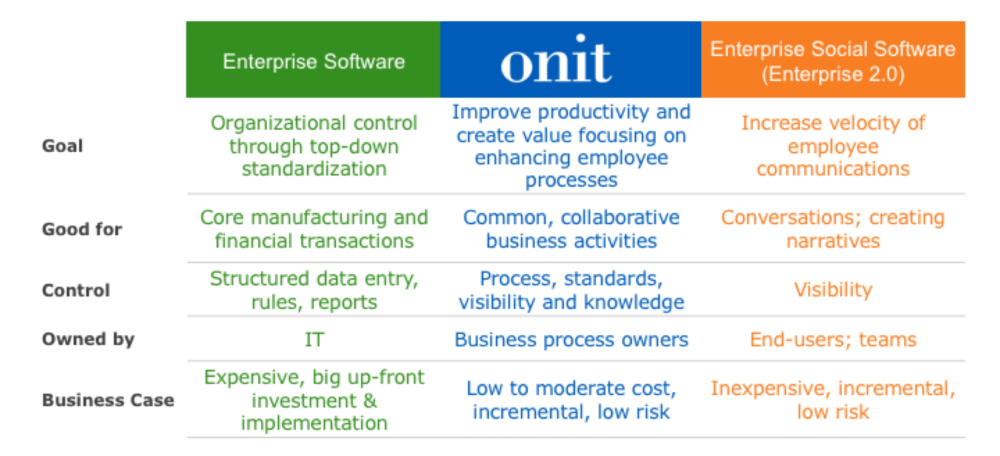
On the left side (in green) is enterprise software, which attempts to solve problems through top-down controls.  Although these solutions tend to be complex (requiring IT support) and expensive (big up-front fees and implementation), they hold out the promise of permanently eradicating a serious problem. The implicit assumption is that workers will use the system as designed — an assumption that, experience shows, is often unjustified and unrealistic.

On the right side (in orange) are Enterprise 2.0 tools (like Slack, Zoom, or Yammer). Individual users and work teams like these tools because they increase the velocity of employee communication.  Corporations are happy to support Enterprise 2.0 tools because they are cheap and low risk. But they also don’t produce any structured data that senior managers need to assess and improve organizational performance.

Despite billions of dollars spent on enterprise software and the hype and popularity of Enterprise 2.0, Elfman observes that “virtually all knowledge work and processes are executed outside of these systems.” Instead, in most organizations, workers try to do everything with familiar Microsoft tools:

  • Email is the intake and “collaboration” platform, within and across business units
  • Word documents are the “forms” solution
  • Excel is used for tracking and reporting
  • Sharepoint is used as a document repository

Virtually all legal operations professionals will acknowledge that these tools are breaking down as solutions. They are just not fit for purpose.

Onit (in blue) is trying to fill in the middle ground between Enterprise (green) and Enterprise 2.0 (orange). The key innovation of Onit is that it enables a business process owner to work backwards from how people work (people-centric) rather than backwards from an acute organizational pain point (problem-centric) and thereafter expecting workers to get onboard.

“Bring the work to the people”

When Cambria signed on with Onit, he had a vision to “bring the work to the people.” Where are the people in ADM’s legal department? Probably somewhere near a device where they read their email.

Onit is behind a wide range of automated workflows at ADM, including: (1) matter intake and routing, (2) early case assessments, (3) liability reserves, (4) invoice review and approvals, (5) settlement authority requests, (6) recording of matter disposition, and (7) on-demand NDAs. Yet, for most ADM lawyers, Onit is barely visible:  it’s all point-and-click tasks and hyperlinks embedded inside emails — highly natural acts for lawyers. Cf. Post 040 (per “lawyer theory of value,” lawyers have a strong preference to be left alone to do legal work).

Cambria or a member of his staff are usually the “business process owner” for each of these processes.  Onit is simple and flexible enough for them to do a fair amount of programming on their own — no need to involve corporate or department IT. This is ideal because the legal ops team is close enough to the work to gauge what the workforce is willing to accept. And If they are wrong, adjustments can be made cheaply and quickly.

Nudges and the Onit backend

One way that Cambria drives the broader agenda of the department is to include “nudges” in the Onit workflow.  A nudge makes it modestly more difficult for lawyers to override an established playbook solution. For example, if an ADM in-house lawyer wants to retain a law firm that is not on ADM’s preferred panel list (ADM winnowed 700 law firms down to a preferred provider list of 20, see “How ADM Cut Its Outside Counsel Rosters By 680 Law Firms,” Law360, June 8, 2016), a text box appears that requires a written explanation.  Because this choice requires additional work and invites scrutiny from the boss, it is chosen less often.  Explains Cambria, “I’m always mixing the peas in with the mashed potatoes.”

Although Onit is largely invisible to a substantial portion of the ADM legal department, the Onit applications demo-ed in class — i.e., the backend where David and his staff configure workflows and dashboards — is surprising clean and simple.

David shows us the main dashboard he uses monitor the legal department (16 tiles of information).  He also shows one of the dashboards he built for Cam Findlay, ADM’s general counsel, which provides real-time information likely of interest and value to the C-suite.  Some of the tiles use Tableau to display the information graphically (other data visualization programs can be used).  All of these graphics are generated from data captured by Onit workflow systems.  The data are high quality because Cambria has ruthlessly reduced the number of unnatural acts required by his lawyers.

Diffusion theory wrap-up

Eric Elfman readily admits that Onit targeted Cambria as an early adopter and opinion leader.  Cf. Post 020 (discussing the crucial role of opinion leaders in accelerating innovation adoption).  Eric comments, “David got a whole lot of software for very little money. But we wanted him as a reference client.  And frankly, it’s been worth it.”

Cambria was drawn to Onit because it offered him the possibility of improving the performance of ADM’s legal department without requiring this lawyers to learn new technology or do data entry. This is the novel perspective of a true “visionary” customer as defined in Crossing the Chasm.

These are interesting anecdotes. However, if we want deep learning from this case study, it is important to tie what we see back to the empirically validated principles of diffusion theory.

As discussed in foundational posts 008 and 011, innovation adoption — whether it happens at all, and if so, at what rate — is primarily a function of five innovation attributes. See graphic to right.

In addition, software for managing complexity requires us to evaluate these attributes from two perspectives:

  1. Managers making the purchase decision. These are folks with a serious business problem and a limited amount of time and technical expertise, at least with software.
  2. Workers asked to use a new software solution. These are busy professionals who just want to get their work done.

Arguably, legal departments have historically made the mistake of focusing too much on (1) and underestimating (2). This explains their perennial disappointment with enterprise software.

The table below scores Onit from both perspectives using the simple scoring system developed in Post 011 (fast versus slow innovations):

  • Positive numbers (+1  to +3) speed up the adoption rate
  • Negative numbers (-1 to -3) slow it down
  • Mild effect = -1 or 1; moderately strong = -2 or 2; very strong = -3 or 3
  • No effect on rate of adoption = 0
Factor affecting adoption rate Manager Worker Adoption Analysis
Relative advantage 2 3 Managers get complete, high quality data, albeit after a learning curve. Workers are not asked to perform unnatural acts; minimal change management.
Compatibility -1 3 Managers are business process owners and have to learn cloud software related to workflow; new but surmountable. Workers get to stay within email and Internet browsers; basically this is change that feels like the status quo.
Lack of Complexity -1 3 Managers have to climb a learning curve, but its mostly cloud-based drag-and-drop tools. IT support is minimal. Workers carry on business as usual.
Trialability 2 2 Managers can get started at a low cost (e.g., just one Onit application) and build it out as needed. Worker feedback enables quick and inexpensive changes in process.
Observability 2 -2 Managers can see the high quality data pile up.  For workers, there is a limited ability to observe fellow knowledge workers being more productive. This factor is hard to change. It is also why we laugh at Dilbert cartoons.
Totals +4 +9

The key insight of this analysis is that Onit is likely to enjoy rapid adoption with workers, largely because it places so few demands on them.  Although managers don’t have it so good — they actually have to learn a new technology — it’s likely worth it.  As the ADM example shows, worker adoption occurs in a low friction way; also, senior personnel in the legal department can finally see, measure, and manage essential business processes. From a big picture perspective, this is a potential home run.

During class, Eric Elfman observed that technology start-ups are essentially “a series of experiments until something works or you run out of money.”  According to Cambria, Onit works well.  That is very good news for Elfman and Onit.

What’s next?  See Legal Services and the Consumer Price Index (042)

In writing up the week 4 summary of “How Innovation Diffusions in the Legal Industry,” I discovered that it is near impossible to write about Axiom without referencing a larger change narrative.

Founded in late 1999, Axiom was likely the legal industry’s first venture-backed start-up.  Now, 18 years later, with over 2,000 employees in 17 offices in the US, Canada, Europe, and Asia, nearly 50% of the Fortune 100 as clients, and $300 million+ in annual revenue with continued double-digit growth, Axiom has become the leading exemplar of the NewLaw sector.  Indeed, in the graphic above, which is used by Axiom professionals to explain the evolving legal market, the orange in the bar on the right is what makes the “New Model” new.

Yet, here is the rub: 18 years is a long time for something to be new. And that says more about the legal industry “social system,” see Post 004 (innovation diffuses through a social system), than it does about Axiom. It also makes Axiom a great diffusion theory case study.


For summary of Week 2 guest lectures (Pangea 3, Practical Law Company, Hotshot), see Post 032. For week 3 (consultative sales at Thomson Reuters), see Post 034.

Tom Finke’s story

For the week 4 guest lecture, we were very fortunate to have Tom Finke, Axiom’s Managing Director of West Region Operations.  Tom has a JD/MBA from Northwestern, where he teaches a course called “The Evolving Role of the Law Department in the Modern Corporation and Legal Industry.”  Prior to joining Axiom in 2008, Tom spent five years as an associate at Sidley Austin LLP before switching into a series of business roles in the online media space.

Note: this is really a story about how Tom developed a very novel mindset and perspective — a combination of strategy, sales, operations, and law — and how this rare mix of talents is used by a shop like Axiom.  For those interested in having challenging work they believe in, this is not a trivial narrative.

Used cars

Tom Finke is very funny and self-deprecating, attributing much of his career to lucky breaks, starting with a summer stint as a 17-year old used car salesman in Phoenix, Arizona.  Since Tom knew very little about cars, he had to fall back on simple questions like, “what are you looking for?” After that, his only tool was listening.  Eventually he realizes that if you’re sincerely trying to be helpful, a reasonable number of customers will talk themselves into a sale.  Indeed, there are few better ways to qualify a customer than their willingness to walk around a car lot in 110 degree heat.  You just need to walk with them.

Tom’s first big break in law comes with his job at Sidley.  He interviews in the fall of his 1L year. Fortunately, the partner he interviews with loves the used car stories, and Tom gets an offer — before 1L grades come out and anyone from Sidley can review his less-than-Sidley first-semester transcript. Another break was getting into the MBA program at Kellogg, as Tom applied as the law school and Kellogg were expanding the joint program.  As the years unfolded, the training and connections of the dual degree enabled Tom to credibly wear both a business and legal hat.

“It’s hard to escape law”

After five years as an associate at Sidley, Tom decides to transition to a business role.  After a year of searching for high quality opportunities, he discovers that “it’s hard to escape law,” as the corporate world has a limited appetite for experienced lawyers working in business roles.  By then, it’s 1998 and internet is exploding as a new business platform with companies like Yahoo, AOL, and Excite.  The tight labor market creates an openness to less conventional sources of talent, and Tom finds an opportunity with an online classified ads company called Classified Ventures, a joint venture of major U.S. newspaper companies.  He joins as Director of Business Development, not as a lawyer. Later, he becomes president of a separate business unit focused on online auctions.

Repeating advice he received as a young lawyer, Tom tells the class that the early part of your legal career is about “brand building.”  Credentials and reliably good work are what matter for developing a reputation at the firm and with clients.  Yet, when Tom leaves Sidley, a firm client pulls him aside and says, “Now that you are in the business world, it’s all about track record.” In other worlds, to steadily advance, Tom has to put up outstanding numbers over a period of years.

After serving as CEO of an online business that fell victim to the Internet crash, Tom takes a job at the Tribune Company right before 9/11.  Despite the business upheavals of the early 2000s, the Tribune continues to do well as a newspaper publisher and broadcast conglomerate.  Moreover, Tom’s unit, Tribune Interactive, enjoys explosive growth that eventually reaches more than 30% year-over-year. With the passage of time, however, the decline of print journalism accelerates. These challenges coincide with a plan to turn the publicly held Tribune Company into one of the world’s largest ESOPs.  That transaction ultimately puts a crushing debt burden on the company’s balance sheet.

As the entire economy drifts into a tailspin in the fall of 2008, Tom sees the writing on the wall and contacts one of his best friends from Kellogg, who is running the Chicago office of McKinsey & Company. The colleague passes along a tip that a company called Axiom was looking for someone to start their Chicago office.  Tom applies and in December of that year gets the job. A week later, the Tribune Company files for bankruptcy.

The early days of Axiom Chicago

When Finke joins the Chicago office of Axiom in December 2008, the office had two full-time employees — one attorney along with a junior analyst — and roughly $10,000 in booked revenues.  His second day is the office holiday party, which includes 15 attorneys on Axiom’s “wait list” — i.e., approved for assignment to Axiom clients but without a current match.  Ironically, the sole actively engaged Axiom attorney is working onsite in Des Plaines (a suburb of Chicago) and hence couldn’t attend.

Despite the stark imbalance between qualified attorneys and paid client work, Tom remembers going home that night and telling his spouse, “I think this company has a chance.”  Why? Because he is blown away with the quality of lawyers/people that Axiom has managed to recruit.

Tom comments, “I was very lucky to start in 2008, as general counsel were looking for something different.  Because of the financial crisis, they had budgetary pressures and no ability to hire additional in-house attorneys.” Relatively quickly, the office added three powerhouse Chicago clients: Accenture, Baxter, and Wrigley.  “Because our attorneys did a great job for them, they allowed us to use their name as a reference client.  I often joke that I said the names of those clients more often than my children’s names in 2009 and 2010, but it might be true.”

Obviously, this is a key diffusion theory point, as these clients were viewed by in-house peers in Chicago as early adopter/opinion leaders, see Post 020, signaling that Axiom is a credible supplier of high-quality legal talent.

Tom is very direct on this point. “When you have no brand of your own [like Axiom in Chicago in 2008,] you have to leverage off of someone else’s.”  In diffusion theory, this connects to the “cultural compatibility” factor for innovation adoption.  See Post 008 (discussing key factors related to rate of adoption). Axiom attorneys had the same educational credentials and work experience as a law firm associate, yet they were 40-50% less expensive and had in-house experience. By the end of 2010, sales for the office exceed Tom’s long-term projections by several million dollars. Indeed, Axiom total revenues as a company went from $25 million in 2007, to $50 million in 2008, to more than $300 million in 2017.

Axiom’s evolving business model

As we make our way through life, most of us want to conserve our mental energy by putting things into familiar boxes. Because Axiom doesn’t neatly fit within any established box, accurate categorization has long been a challenge for the company, albeit the effect is often an underestimation of the company’s capabilities, growth, and client base.

Since its founding, Axiom has curated a highly credentialed and experienced legal workforce that can be used to cost-effectively manage peaks, surges, or temporary gaps in corporate legal departments. This is the Axiom’s secondment (or talent platform) model. It continues to generate significant revenues and growth.  However, since just after the financial crisis of 2008, Axiom has been building out large teams of lawyers and other professionals in several “centers of excellence.”  For this workforce, which focuses on large-scale specialized projects and managed service engagements, the value-add for clients comes in the form technology, process, and data analytics that drive up quality, predictability and transparency of the delivery of legal services while driving down per-unit cost.

Depending upon the engagement, the talent platform and service delivery models can be paired together.

An example: The Kraft/Mondelez spinoff

To illustrate how the key pieces of the business work together, Tom picks up a grease marker and begins diagramming a corporate transaction.

A publicly held company — in this case, Kraft Foods, Inc. —  wants to spin off approximately 1/3 of its business into a new publicly-traded entity that focused on the North American grocery store business.  But here’s the problem — to enable this transaction, Kraft Foods has thousands of contracts with customers and suppliers that need to be identified, organized, and evaluated so the in-house lawyers can develop a game plan for assignment, termination, buyouts, and renegotiations, etc.  Kraft identifies 40,000 documents that are potentially relevant to the transaction. For cost reasons, having a large law firm manually review and abstract the contracts is off-the-table.

Looking for a solution, the Kraft legal department contacts Finke at the Chicago office of Axiom. By 2011 (the year the transaction got underway), Axiom had developed expertise in process-driven document review for litigation.  Drawing upon the resources and capabilities of its service delivery center in Chicago, Axiom retooled its Relativity platform so it could efficiently and reliably identify and eliminate duplications and other extraneous documents. After the service delivery unit does its portion, the 40,000 documents yields 10,000 contracts. Then, leveraging process and project management skills, attorneys in the delivery center review the 10,000 contracts to determine the impact of the spin-off.  The final step in the project is to obtain consent from counterparties and re-negotiate many other counterparty contracts, which is legal work  completed over a period of months by more than 10 Axiom lawyers from the talent platform.

The combination of Axiom’s talent and service delivery platforms was a significant enabler of the Kraft/Mondelez spinoff and subsequently became the basis for Axiom receiving a 2013 ACC Challenge Award. It is worth noting that Kraft’s strategic counsel for the transaction was Cravath Swaine & Moore.

Where things are going

The Kraft/Mondelez transaction was a major milestone in Axiom’s history, as it marked the beginning of a new line of business to enable major corporate transactions. This new area of emphasis in 2012/2013 substantially coincided with a decision to get out of the litigation document review business, which Axiom’s leadership concluded would need a massive investment in technology to remain competitive.

During class, Tom shows a slide that summarizes of Axiom’s recent deal work:

  • 80+ corporate transactions completed over the last two years
  • Specific examples of M&A support, spinoffs & divestitures, reorganizations, and joint ventures for an impressive list of corporate clients
  • $400 billion in transaction value over the past four years
  • 500+ Axiom contract specialists and M&A lawyers

Axiom is also growing, likely at the expense of other service providers, particularly law firms.

With this information in mind, it is worth putting side-by-side Axiom’s evolving legal service delivery model with the Post 013 evolving litigation model created by Alan Bryan, Walmart’s head of legal ops and outside counsel management. [click on graphic below to enlarge.]

It is obvious that both graphics are signaling the identical future — one where law firms are called upon for strategic and exceptional events and the balance of the run-the-company work is split between in-house departments and outside service providers based upon efficiency and value.

A changing talent market

According to Finke, the evolution of the legal market over the last decade has created significant industry-level pressures on talent.  Since 2008, major law firms have hired significantly fewer entry-level associates, which in turn impacts Axiom’s traditional talent pipeline.  Although Axiom’s flexible work model and blue-chip client base remain highly attractive for many law school graduates, higher student debt-loads affect the timing of when lawyers can make the jump.

Tom notes that over the last decade, in-house lawyers have become “the owners of core operating functions” and that “BigLaw is competing for marketshare with their clients’ legal departments and losing.”  Cf. Post 003 (showing rapid increase in in-house lawyering over last 20 years). At present, over 70% of the lawyers on Axiom’s talent platform have in-house experience, which clients generally find more valuable than law firm-only experience, at least for work that supports a company’s business units. Thus, in recent years, consolidated legal departments following a corporate merger have become an important source of talent for Axiom. Yet the market overall is tightening for the right kind of experienced lawyers.

The key takeaway is that the traditional law firm apprentice model is breaking down. The incoming numbers are lower; and from the client perspective, the law firm skill set has become less valuable.  Ultimately, these economic realities impact law school applications and enrollment, particularly as student debt loads remain at historical highs.  Tom noted this was a industry-level problem with no easy or risk-free solution.

An focus on technology

Recent additions to Axiom’s leadership arguably signal the company is positioning itself for a future where technology will be a major differentiator.   In the fall of 2016, Axiom’s co-founder and CEO Mark Harris recruited Elena Donio, former CEO of software giant Concur, to replace him.  Furthermore, Axiom recently hired a chief technology officer, Doug Hebenthal, who formerly served as Director of Engineering at Amazon and held numerous technical positions at Microsoft.

Referring to Hebenthal, Finke observed, “If someone had told me in 2008 that Axiom would one day hire a CTO of that caliber, I doubt I would have believed them.  But our business has evolved in response to a changing market. And tech-enabled delivery of legal services is clearly where things are headed.”

Diffusion theory takeaways

The methodology of the class is take in take a deep dive into examples of legal industry innovations — always a combination of people and organizations — and to examine relative successes and failures through the lens of diffusion theory.  In most cases, we are referencing Everett Rogers’ rate of adoption model, which was covered in foundational post 008 and summarized in the figure below [click on to enlarge].

Within this model, the “Perceived Attributes of the Innovation” category tends to be the most important.  Without a sufficient quantum of these factors, the social system adoption process will not get triggered.

Applying the rate of adoption model to Axiom’s 18-year track record of growth, the combination of three factors appears to be key:

  • Relative advantage: 50%+ cost savings over law firms.
  • Cultural compatibility: work done by attorneys with BigLaw training and in-house experience.
  • Trialability: giving Axiom small, low-risk projects until the client obtains confidence in the lawyers’ ability.

The 50% cost saving by itself would have been insufficient for Axiom’s adoption. Further, the financial austerity created by the 2008 financial crisis was a key factor in changing the relative advantage calculus. 50% saving post-2008 was a lot more valuable than 50% pre-2008. Cf. Post 032 (David Perla also acknowledging that the financial crisis was a major accelerant for Pangea3).

Likewise, Axiom invests heavily in “Efforts of Changes Agents” by fielding a large team of consultative salespeople.

In the fall of 2016, I had the opportunity to participate in a meeting of Axiom’s Western Region sales team. Basically, to handle sales in the Midwest (Chicago, Minneapolis, Detroit, St. Louis, and Ohio), Axiom employed 15 full-time sales professionals.  Of the group, the vast majority were MBAs; only two had law degrees, and only one had practiced law.  I asked why Axiom had built out the sales team in this way.  Tom acknowledged the advantage of the JD credential.  Yet, experience revealed that it was easier to get an MBA to acculturate into the legal world (such a Rebecca Thorkildsen from Week 3) than to get a lawyer to (a) feel comfortable providing pure business advice and know-how to prospective clients, and (b) deal with the frequent rejection that comes with a sales role at a company seeking to disrupt the industry.

By necessity, law is ceding ground to various allied professionals. Because this brings new perspectives, this bodes well for future innovation.

What’s next? See The Decline of the PeopleLaw Sector (037)


On the occasion of his Lifetime Achievement Award, Legal Evolution is pleased to republish Mark Chandler’s 2007 speech, “The State of Technology in the Law.” This speech arguably marks the beginning of the current era of law practice in which large corporate clients assert more power and authority within the relationship.

At the time, the Chicago IP Litigation blog commented, “Anyone involved in the private practice of law should take the time to read it. … I can assure you your clients are reading it.”  Likewise, the prominent law firm economics blogger, Bruce MacEwen, wrote, “I’m quite confident I’ve never used the phrase ‘must-read’ on ‘Adam Smith, Esq.,’ but this is my first nominee.” The headline for the WSJ Law Blog read, “Law Firms: ‘The Last Vestige of the Medieval Guild System.” 


Mark Chandler:

I hope to offer a somewhat informative perspective on the effect that changes in technology will have on the practice of law.

I offer you three questions for our discussion today.

  • First, how is technology driving change in knowledge-based industries?
  • Second, what are the key areas of vulnerability in the legal services business to these technological changes?
  • And third, what will it take to succeed in this changed environment?

Now as you can imagine, I have my own ideas on these questions. I don’t pretend to be unbiased.  Where you sit does affect where you stand.  You may profoundly disagree with my conclusions about these three questions. But they are questions that need to be grappled with by anyone who is in the business of providing legal services.  Once again,

  • How is technology driving change in knowledge-based industries?
  • What are the key areas of vulnerability in the legal services business to these technological changes?
  • And finally, what will it take to succeed in this changed environment?

Let me tell you a bit about my company and why these questions are so interesting to me.  Cisco sells products and services which connect people around the world, from home networking products, such as the iPhone series, to the core routing and switching systems used by the world’s largest telecom companies.  We do so at an annual run rate of $32.8B, which would place us at about number 60 in the 2006 Fortune 500.  Our operating expenses are about 35% of revenue and falling. Our gross margin is close to 65%, and we bring nearly 22% of our revenue to the bottom line, before interest and taxes. Nothing that would make a large law firm envious, but we’re proud of it. We have $19.5B in cash, generate over $2B of cash flow from operations each quarter, and have bought back $37B of our company’s stock in the last 5 years. We have about 51,000 employees working in 80 countries.

I offer these data points from the perspective of a general counsel who is required to run his department just as other corporate departments are run.  This is more and more the case in American industry.  The legal department in Cisco is as metrics-driven as manufacturing, HR or sales. I have 4.7 employees in my department per billion of revenue, total legal spend is about .38 percent of company revenue, and non litigation spend about .16 percent.  I spend $34M internally, and about $75 million per year with outside counsel.  I know just where I stand on these metrics vs. my peers, because we share the data.  My numbers are pretty good, but I still don’t know how to be as efficient as Larry Tu at Dell.

The bottom line is that I’m driven by the same need for productivity and scale improvements as is the rest of the company.  It’s simple. As Cisco gets bigger, the share of our revenue devoted to legal expense needs to gets smaller.  Letters from law firms telling me how much billing rates are going up next year are therefore totally irrelevant to me, or as we say in Silicon Valley, orthogonal to my concerns.  Think about it: not one of the CIOs of your firms expects to get a letter from Cisco explaining how much more our products will cost next year.  And not one of our suppliers comes to us to tell us how much their prices will go up next year.  Well, that’s not quite true.  The law firms try.  But from my perspective, I don’t care what billing rates are. I care about productivity and outputs.

Turning then to the first of the three questions, how is technology driving change in knowledge-based industries?

My core message is that access to information is being simplified.  The price of information is being driven toward its marginal cost of production.  Disintermediation is occurring at the fastest pace since Martin Luther proposed that a Catholic priest wasn’t a necessary part of a relationship with God. Traditional command and control organizations – think of the US Army and the record labels – find themselves outmaneuvered by small decentralized organizations who know how to build networks – think of Al Qaeda and the Iraqi insurgency, and Kazaa and eMule.

How many people here have read Tom Friedman’s The World is Flat?  Friedman is right.  Easier access to information, symbolized by the Internet, is revolutionizing the global economy.  I was at a community lecture a couple of years ago by Michael Spence, who won the 2001 Nobel in Economics.  He described the networking of computers as the most important development in economic history since the opening of trade routes from Europe to Asia in the late Middle Ages.  The reason: because where work gets done, and how it gets done, is being radically altered.

Those who thought they had a corner on information find that’s no longer the case. I was talking with a friend recently who is a senior technology officer at a large high tech company. She’s from India and was describing a problem a friend of hers in India was having — the friend’s son wanted very much to go to one of the IITs, or India Institute of Technology campuses.  They were so oversubscribed, with the emergence of 300 million middle-class Indians seeking advancement, that he was rejected.  The parents were complaining that because of that, their son was forced to go to Cornell.  Now everyone I tell that story to laughs at first.  But there’s a moral there – the corner on information, on knowledge, on the transmission of knowledge, that we think we have in this country, that we think we have in this profession, just isn’t there any more.

What’s happened in the recording industry provides a great example.  Tower Records’ liquidation is the end of an era.  iTunes, to say nothing of eMule and Kazaa, represent the beginning of a new one.  Recording industry revenues are down 25% in the last five years.  The ability for any centralized organization to dictate how information will be packaged and delivered is going to zero, as individuals take control of how information and knowledge is generated and offered.

With Trip Advisor and ePinions, what is the role of Fodor’s and Frommer’s? With Wikipedia, what is the role of Brittanica? With Amazon and reader reviews and blogs, what is the role of the bookstore? Did you know that the membership in the American Booksellers’ Association has declined from over 4,000 to about 1,800 in the last twelve years. There was no law of nature dictating that this would happen between 1994 and 2006.  It happened because of technology.  One bookseller said he knew it was over when he saw the mailman delivering packages from Amazon to the tenant upstairs.  With eBay and craigslist, what is the economic model for daily newspapers?  From printing boarding passes to tracking packages, to repairing complex software to deciding where to dine and stay and how to buy a plane ticket, tasks previously undertaken by human beings – and often highly trained human beings at that – are now accomplished through well designed expert systems.

I recommend you check out a fascinating new book called The Starfish and The Spider by Rod Beckstrom and Ori Brafman.  They very succinctly trace the power of decentralized, knowledge sharing technologies to undermine enterprises and industries which are based on a command and control approach to information. Simply stated, people around the world are building their own communities to connect with each other and share knowledge.

Political leaders recognize the fundamental nature of this transformation.  I saw in the paper two weeks ago that the acting President of Turkmenistan kicked off his election campaign with a call for greater Internet connectivity.  Put that in the time-warp category: how would you have reacted if twenty years ago someone told you the acting President of Turkmenistan kicked off his election campaign with a call for greater Internet connectivity? I was at a dinner several weeks ago with Alejandro Toledo, who until July of last year was President of Peru.  Toledo had grown up as one of 16 children in a destitute village in the Andes highlands.  Thanks to having met Peace Corps volunteers at the age of 14 he got a scholarship to the US.  He has two graduate degrees from Stanford, and is the first person of native American descent to lead his country. 46% of Peruvians live on less than $2 per day. Toledo is passionate about helping the poor in Peru.  He told me his first priority is education generally, and his second is getting the people of his country connected to the Internet.

So for question number 1 — how is technology driving change in knowledge-based industries? — my answer is that the networking of computers is transforming the nature of knowledge accumulation and distribution.

So let’s turn to question 2: what are the key areas of vulnerability in the legal services business to these technological changes?

At a famous presentation at Black and Decker, a consultant held up one of these, a drill, and asked the Black and Decker executives if this is what they sold. They all recognized the product and answered “yes”.  He then suggested to them, that from the customer’s point of view, what they are selling is this, a hole in a board.

From the law firm think perspective, “sales” too often means a one to one relationship with a lawyer who bills by the hour.  As a client, I can tell you what I want to buy is access to information, strategy, and negotiation, and, in the case of litigation, to courtroom skill as well.

There’s a fundamental misalignment at work here.  Law firms cannot afford to own the business risks of their clients, have a lot of employees to pay and also have to allocate the limited resources of extraordinary star partners.  On the other hand, clients want access to information and counseling and want to pay for value received. Put more bluntly, the most fundamental misalignment of interests is between clients who are driven to manage expenses, and law firms which are compensated by the hour.

The current system also misserves the lawyers themselves, particularly the associates, also known as the next generation of partners.

In most of my major law firms, I see more and more problems retaining associates.  I am inundated with resumes of top notch associates who don’t want to work in large law firms any more. The chairman of one firm told me that only people in their 50s and 60s are willing to put in long hours these days, that associates regularly turn down the chance to work on major deals if it interferes with social plans or a vacation.  He finds a lot of younger lawyers self-centered and self-indulgent. Since I’m 50, I wasn’t  personally insulted.  But this reminded me of something I read recently, a complaint that “affluent parents have become role models for luxury and licentiousness, and have moved far away from caring about whether their children develop habits of discipline and self-restraint.  As a result, young people are increasingly impudent and have a total disregard of the respect they owe to themselves and others.”  Pretty strong stuff. This was written by Tacitus in 75 AD.

Those who grew up with the Internet just view the world differently than you and I do.  I’d like to ask everyone to raise your left arms. Go ahead. Left arms up.  Now, everyone who is wearing a watch, put your arm down.  I will tell you, that if all of us were under 30, the results would be the reverse. People under 30 do not wear watches. They use their cellphones.  My college senior daughter wants a wristwatch to wear exclusively at job interviews, since she thinks she’s supposed to.  My friends, we are dinosaurs, we don’t get it.

The difference in outlook goes deeper than that of course.  Some of you may know Dick Gross, a mathematician who is Dean of Harvard College. I once heard him tell a group of parents that if they want to communicate with college-age kids, they better learn Instant Messaging.  He told of coming into his 16 year old son’s room while the son was doing homework, and finding five IM conversations going at once on the computer. He asked, “How can you get work done when you have five conversations going?” His son answered, “Dad, you don’t understand, this is how we communicate. For us, IM is like email was when you were a kid.”  I must ask, “If five conversations are open at once, how do you bill the time?”

This generation, brought up on Wikipedia and Kazaa, believes that information should be free.  Upending one’s life to support inefficient means of communication, driven by a billable hour system, to maintain a relatively slim chance of making partner, is antithetical with that upbringing.

But if the economic system of the firm is frustrating to associates and even some partners, I can tell you that from the standpoint of a metric driven general counsel, it is more than incomprehensible.  It looks like the last vestige of the medieval guild system to survive into the 21st century.

About a year ago, I testified before a House subcommittee regarding the Internet in China. It was a lengthy hearing, and it was grueling.  I was pleased with the results, largely because I’d spent two days beforehand being prepared by Ambassador Charlene Barshefsky at WilmerHale.  If you shouldn’t leave home without American Express, you shouldn’t go to the House without Charlene.  At the risk of mixing my credit card metaphors, her help was priceless.  The total bill for her services was about $10,000.  I have spent 300 times that amount to get mediocre assistance in patent disputes.

The legal industry has spent millions on IT, largely to speed access to information. Yet the only way I can get that information is through an individual billing me by the hour.  In many cases, my in-house team has more sophistication than the highly-paid associates who mine the knowledge management system to generate a memo.  I’m just not allowed to access the information without paying for someone’s time.

The systems exist today to change the delivery of legal information to clients.   But that change would challenge a model that today delivers high profits.  Every big company, including Cisco, is using those systems to make our support services more effective, and to drive down the costs of providing service. Law firms are not doing this as effectively to drive savings to the customer.  Clay Christensen of Harvard Business School has written, and I quote, “Large American law firms are just about the most profitable businesses in the world.   Speedier information-gathering capabilities allow large law firms to increase utilization of less experienced lawyers without passing cost savings on to their customers.”  So changing the service delivery model will be disruptive, and not just because associates are kept busy doing work that a machine might be able to do better.  Changing that model will also cut into the effectiveness of cross-selling.  From a client’s point of view, cross-selling is an effort of star partners to leverage the loyalty they have earned to drive hourly work to other parts of the firm.  Today, there is little incentive for law firms to apply risk-reward logic to the amount of legal services provided.  And General Counsel know that.

The growing scope of knowledge availability will endanger this system.

When technological change comes, it is easy to get left behind.  Richard Susskind, who’s a brilliant English commentator on the legal profession, and who gave me the Black and Decker example I offered earlier, observes that when law gets standardized, it can be outsourced, co-sourced, integrated,aggregated, syndicated and sharedOne-to-one consultative advice gives way to one-to-many information services. And the client becomes empowered.

My contention is that the very source of success for firms today – the ability to manage client access to information and require clients to use bespoke 1:1 systems – will be the source of failure in the future.

So my answer to question number two is that the greatest vulnerability of the legal industry today is a failure to make information more accessible to clients, to drive models based on value and efficiency.  The present system is leading to unhappy lawyers and unhappy clients. The center will not hold.

And that brings me to the third  question: What will it take to succeed in this changed environment?

Clay Christensen got it right when he said of our industry, “the forces that act upon service sector businesses are the same that act upon all companies.”  And he predicted that a new class of providers will “develop new delivery models that will be highly disruptive to established firms.”

My answer to this question is therefore simple: first, winners will be those who are able to standardize services to meet clients’ cost management and predictability needs where very good is good enough.  Second, those who can differentiate themselves by providing the top notch of customized services, where that is needed, will also win.  In some cases, one firm may be able to do both.  But my bet is that despite the consolidation trend we’re seeing today, top quality boutiques will thrive while the cost structures of larger centralized firms will put them at risk.

All around the periphery of the legal industry, standardization of information is happening.  Check out www.taxalmanac.org, which uses wiki to create sophisticated, easily-searchable on-line discussions, and ultimately counseling, by tax professionals on a variety of topics.  The legal work of generating residential leases and individual tax returns is now largely done by software.

Let me give you a few examples of the way this is now spreading to first tier corporate legal work.  Let’s start with patent prosecution.  At Intel, Bruce Sewell bundles patent disclosures and prosecution of the applications is awarded based on a reverse auction.  The most successful firm is in Australia.  At GE, Brackett Denniston has over 60 patent lawyers and agents, US trained and supervised, working to prosecute patents at GE’s Global Research Center in Bangalore.  At Cisco, we pay a fixed fee for patent prosecution, and advise our firms to find ways to lower costs, since the amount we will pay will go down by at least 5% each year. We also have a fixed fee arrangement to review unsolicited offers of licenses which seem to arrive quite regularly these days.  Bart Showalter, the partner at Baker Botts who leads that effort for us, said the fixed fee scared them at first, but over time they developed a systematic approach to the work, and as he put it, “the system made us more efficient.” To get the measurable results we need, we are driving the use of knowledge sharing technology throughout the process.

In the corporate secretarial arena, at Cisco we got tired of the choice between the overhead of dealing with a hodge-podge of local firms and high billable hour rates from so-called global firms.  So we are working with one firm on a solution. We’re aiming for a 20% cost reduction compared to our current global costs.  Now this firm doesn’t have a huge global network of offices – but are ready to revolutionize the way information is processed and shared.   Our goal will be accomplished by standardization of forms and open interfaces, making a smooth multi-vendor operation out of what had been a series of job shops.  And we want to help them to sell this approach to other companies and other law firms.

In contract processing, we have an online contract builder that allows our employees globally to build their own NDAs  and other contracts.  With electronic approval and digital signature, they can go from creation to execution to archiving.  Five years ago, Cisco had to build its own system. Today we’re buying off the shelf.  Within the next five years, a substantial proportion of the Fortune 500 will be doing the same.

Counseling will be the next frontier, as tools like taxalmanac spread to other legal areas, from sweepstakes rules to export regulations to human resources to securities law compliance. We’re working with eight other Fortune 500 companies, and a number of law firms, to create a site called Legal On Ramp.  Legal On Ramp will allow direct access to knowledge management systems of law firms. The site will organize information and allow collaboration using Wiki technology.  If you don’t know what a wiki is, I suggest you learn very quickly. Sites will be segmented by company to protect privilege.  It will also help drive follow-on questions to firms for fee generating work.  And you can bet securities work, especially ’34 Act and Section 16 compliance, will be one of the first targets for providing standardized information and shared experience.

Today, all of Cisco’s US corporate, securities and M&A work is done superbly by Fenwick and West operating on a fixed fee, based on an expected number of transactions, with fixed prices for extra transactions.  Gordy Davidson came to me recently and offered to keep the fixed fee the same next year, despite rising hourly billing rates.  He thought he was being generous, or at least practical.  I turned him down.  I told him I wanted a 10% cost reduction.  But my goal was not to reduce my costs while hurting Fenwick’s profitability.  I suggested he propose a service level agreement for me, his client, to fulfill.  The SLA will oblige Cisco to take on lowest -value-add tasks that were consuming 15% of Fenwick’s total lawyer costs, and that we can do ourselves with our administrative staff.  I told him I expected only a 10% fee reduction, however, and that he could keep the remaining 5%.  In this way, we become a better client, and we both win.

We are doing the same thing in litigation. We have a fixed fee with Morgan Lewis  for all of our US commercial litigation.  Not surprisingly this has made Cisco litigation avoidance a key goal of Morgan Lewis.   We’re driving down the time that human beings have to spend reviewing electronic documents.  We bid out discovery work based on cost per gigabyte.  In some cases we’ve outsourced document production to a different law firm than the firm that is providing counseling or other support.  But what we had to build ourselves five years ago is now becoming the norm.

Now as I said at the outset, you may disagree completely with my analysis, with my prescriptions, or both.  You might even think I’m just trying to sell more networking equipment.  But I ask each of you to grapple with the three questions I posed and come to your own conclusions.

How is technology driving change in knowledge-based industries?  What are the key areas of vulnerability in the legal services business to these technological changes?  And what will it take to succeed in the new environment?

The opportunity is there to recognize the business realities that will be driven by new technology. We can seize the chance to offer more value to clients. We can seize the opportunity for our own employees to be more engaged and productive.

Our mutual success depends on it.  I’m fortunate to have great counselors like Gordy, Charlene, and Bart.  They’ve helped ensure, through past practice and good preparation, that my company has no issues with its stock options, minimal comments on our 10-Ks, and only one piece of litigation listed in the last 10-Q, and that one has subsequently been resolved.  I need those counselors to themselves have healthy businesses. Successful outside counsel is an integral part of Cisco’s success.

We should all be very proud of our profession.  We help drive compliance with the democratically-enacted laws of our country.  In the last five years, we’ve accomplished extraordinary things. Since the dark days of the Enron collapse and the advent of Sarbanes Oxley, we’ve restored credibility to the institutions that are the backbone and the motor of the greatest economy in the world.  We defend those who have done the indefensible, even when the government threatens us for those efforts. We work to preserve the rule of law.  In our daily work we do not fear, in fact it is our obligation, to speak truth to power.

We are in the midst of an economic  revolution that is the most important event in economic history since trade routes opened from Europe to Asia.  We must reach out and seize the golden ring that is just within our grasp.

Thank you for your attention today.


What’s next? See A Deep Dive Into Axiom (036)