
A level set for future posts.
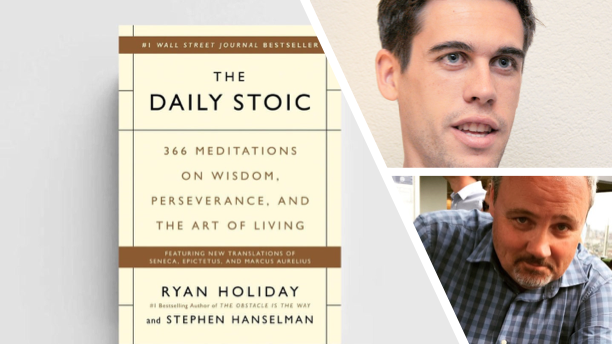
If you wake up each day disturbed by the unraveling of the world around you, and you question whether another day at work is the most rational, constructive, and moral use of your time and talents, consider starting your morning with The Daily Stoic: 366 Meditations on Wisdom, Perservance, and the Art of Living (2016).
I cracked open this book for the first time on September 17, 2023, and was immediately struck by its relevance (and practical guidance) to the present day:
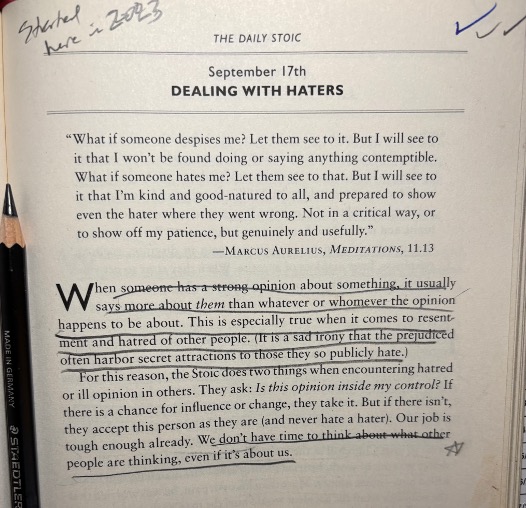
I’ve been reading it daily ever since.
For the last several months, I have been thinking about the restart of Legal Evolution. Not if, but how.
My biggest worry is that I repeat myself—specifically, that I attempt to explain why I stopped publishing, but in a shorter format, so readers can get the top-line takeaways from several long, meditative, long-form posts. That would take a long time to write and accomplish nothing. Clarity comes slowly, if at all, from deep, ongoing reflection. That act of writing forced me to complete my work. By publishing my work, it might become an input to your work. But it’s not a substitute.
Further, it’s time to move on. Instead of struggling to connect the past and future of Legal Evolution, The Daily Stoic can be our level set.
What is Stoic philosophy as presented by Holiday and Hanselman? In brief, it directs us to focus on what we can control, which is our own beliefs and actions. Further, the most valuable tool at our disposal is our own reasoned choice, which we refine through ongoing study and reflection. Obviously, we can’t control the beliefs and actions of others. Thus, we acknowledge what is happening in the world around us but allocate our time and attention so we don’t become cynical, overwhelmed, or panicked. Stay calm and effective today. Do your most important work. String the days together. In the long run, this creates the strongest possible foundation to help yourself and others. The daily reader helps you stay on track.
Many readers have likely heard of Ryan Holiday, who has written numerous popular books, including Ego is the Enemy (2016) and The Obstacle is the Way (2014). More recently, he published a four-volume series on the four cardinal virtues: wisdom, self-control, courage, and justice. His co-author, Stephen Hanselman, is a long-time bookseller, publisher, and literary agent. He is also a graduate of Harvard Divinity School, where he studied philosophy. Based on the detailed background material at the end of the book, it appears that Hanselman translated and curated the quotes (a truly masterful job), with Holiday connecting them to the daily lives of 21st-century readers.
The Daily Stoic is divided into three “Disciplines” that span the calendar year.
- Part I: The Discipline of Perception (January to April)
- Part II: The Discipline of Action (May to August)
- Part III: The Discipline of Will (September to December)
The Disciplines are further divided into four monthly themes. For example, I just finished October, which emphasizes the importance of virtue and kindness. This month (November) is acceptance / amor fati, which translates to “love of one’s fate.”
Although the volume includes numerous Stoic philosphers, the majority of the quotes come from three sources: Seneca (c. 4 BC – AD 65), a philosopher, statesman, and playwright who served as tutor and advisor to Emperor Nero, ultimately falling from favor and being compelled to take his own life; Epictetus (c. 50 – 135 AD), a former slave who became a philosopher and taught that true freedom and happiness stem from mastering one’s own mind, desires, and responses rather than external circumstances; and Marcus Aurelius (121 – 180 AD), Roman Emperor during a period of immense turmoil and decline, who wrote his famous Meditations as a private exercise to strengthen his character, guide his conduct, and remind himself how to live wisely amid power, stress, and mortality.
As disordered and chaotic as things seem today, these figures had it worse yet found effective ways to push through. Reviewing my own heavily marked-up copy, here is a sampling of quotes, one from each “Discipline”:
I. Discipline of Perception, January = Clarity
Jan. 1, Control and Choice: “The chief task in life is simply this: to identify and separate matters so that I can say clearly to myself which are externals and not under my control, and which have to do with the choices I actually control. Where then do I look for good and evil? Not to uncontrollable externals, but within myself to the choices that are my own … ” — Epictetus, Discourses, 2.5.4-5
The authors continue, “The single most important practice in Stoic philosophy is differentiating between what we can change and what we can’t. … If we can focus on making clear what parts of our day are within our control and what parts are not, we will not only be happier, we will have a distinct advantage over people who fail to realize they are fighting an unwinnable battle.”
II. Discipline of Action, June = Problem Solving
June 19, Stay Focused on the Present: “Don’t let your reflection on the whole sweep of life crush you. Don’t fill your mind with all the bad things that might still happen. Stay focused on the present situation and ask yourself why it’s so unbearable and can’t be survived.” — Marcus Aurelius, Meditations, 8.36
The authors comment, “A character in Chuck Palahniuk’s novel Lullaby says, ‘The trick to forgetting the big picture is to look at everything close up.’ Sometimes grasping the big picture is important, and the Stoics have helped us with that before. A lot of times, though, it’s counterproductive and overwhelming to be thinking of everything that lies ahead.”
III. Discipline of Will, September = Fortitude & Resilience
Sept. 4, How Can You Know If You’ve Never Been Tested?: “I judge you unfortunate because you have never lived through misfortune. You have passed through life without an opponent—no one can ever know what you are capable of, not even you.” —Seneca, On Providence, 4.3
The authors continue, “Most people who have gone through difficult periods in their life come to later wear these experiences as badges of honor. … As tough as those periods were, they were ultimately formative experiences. They made those people who they are. … So today if things look like they might take a bad turn or your luck might change, why worry? This might be one of those formative experiences you will be grateful for later.”
Following the 366 meditations is a glossary and background on Stoic philosophy, including a useful model of late Stoic practice:
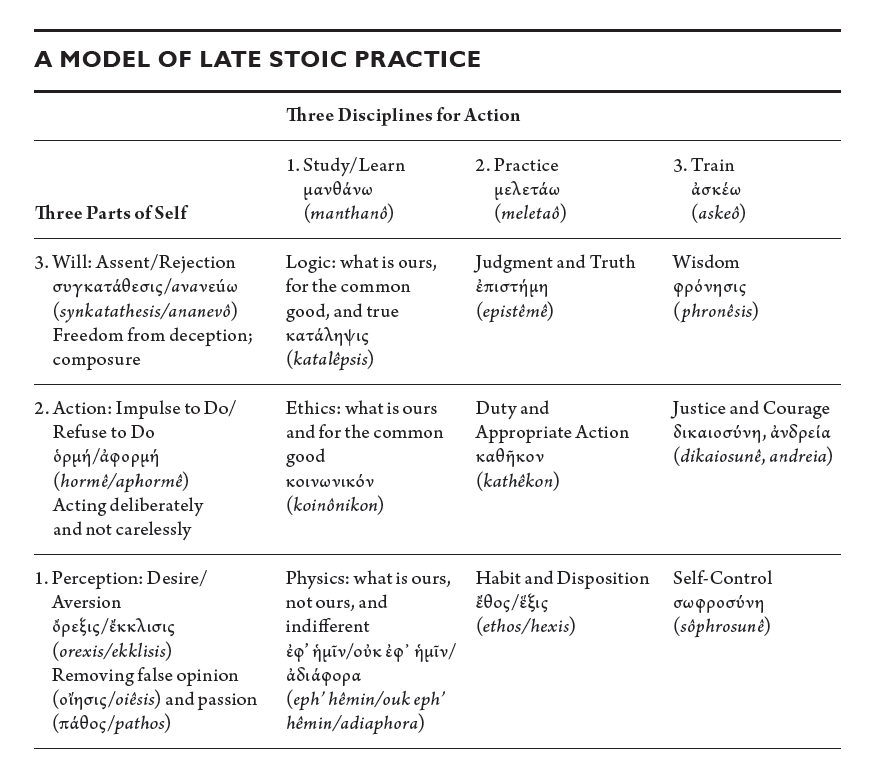
Note how the “Three Parts of the Self” are “trained” by the four cardinal virtues of Wisdom, Justice & Courage, and Self-Control. This is a compact yet comprehensive system of personal development. In my view, it’s also a highly effective way to navigate external chaos and hardship.
In the coming months, I will be publishing several updates on Legal Evolution about my work on access to justice in Indiana. I can’t control the madness in Washington, nor can I curb political polarization, wealth inequality, the destabilizing effects of AI, or the pernicious effects of social media. Yet, thanks to the leadership of the Indiana Supreme Court and a relatively small and collegial bar, the reform environment in Indiana is outstanding. Furthermore, Indiana University has proven to be an ideal platform for conducting valuable applied research.

In Post 350, I discussed the work of Notre Dame political scientist Patrick Deneen, who argues that a plurality of the electorate has become disillusioned by smug, out-of-touch political, economic, and cultural elites who are wielding power in ways that disrupt and disrespect the lives of ordinary people. “Arising outside of the official corridors of power, this largely unguided movement has been indifferent to the scornful disdain of both right [classical] and left [progressive] liberals.” Deneen, Regime Change at 150. Over the last eight years, all of this energy has consolidated within the Republican Party, albeit “without offering clarifying articulation of their grievances” or translating “their resentments into sustained policy.” Id. This is a profoundly unstable situation. Until the root causes are forthrightly addressed, the American experiment is in grave danger.
One tributary to these discontents is a legal system that doesn’t work for ordinary people. At least in Indiana, this is an area where I have some agency. Over the long run, we can improve the system, making it both more affordable and accessible. We have what we need to get started. So that is where I am focused.
In my next post, I’ll bring you up to date on what we are doing.
If you are interested in why I stopped publishing Legal Evolution, the meditative thread runs through the following posts:
- The original Gilded Age lawyers (312), June 26, 2022
- The end of the “End of History” era (319), July 31, 2022
- Three empirically based theories of national decline (book review) (321), Aug. 7, 2022
- Mindshare matrix for legal professionals (349), Jan. 15, 2023
- Period of discernment (350), Dec. 31, 2023
It’s good to be back. WDH.