Norma Rae (1979), 20th Century Fox.  Photo from The Hollywood Archives, Alamy.

Higher profits come at a cost.  Be careful what you wish for.


As a multiple-decade veteran of Big Law, I vividly remember the many debates about whether practicing law was a profession or a business.  I was often leading these discussions as the firm-wide managing partner of operations of a global law firm.  How could a firm with over 1,000 lawyers, over $1 billion in revenue, and over 20 offices be anything but a business?

In an attempt to gain the latest insights on strategy, finance, human resources, outsourcing, and IT, I eagerly read every issue of Harvard Business Review.  I remember years ago having to overcome the partners’ resistance to being paid only by direct deposit and to increasing the partner-to-secretary ratio beyond 1-to-1.  Now that I am gone from Big Law and managing a law-school legal clinic where I am still practicing law (but with startups and other micro businesses), I frequently question whether being so focused on productivity and efficiency in my former life was worth the price.  Perhaps giving up a few ticks in profits per partner (PPP) would have made my firm a better place.

In this Labor Day essay, I’ll offer some second thoughts on the business of law, Continue Reading Labor Day reflections, including some second thoughts, on the business of law (327)

The main residence of Veraton, Paul Cravath’s country estate, circa 1907. Source: “Veraton,” Old Long Island, Oct. 31, 2011.

Creating a baseline to measure the wealth, and building turmoil, of the current Gilded Age.


It is hard to imagine a more stark and tangible manifestation of the original Gilded Age than the large estates built along the Long Island Sound in the region that would later become known as the Gold Coast.  Yet, you may be surprised that such opulence was not limited to robber barons or captains of industry.  In fact, some of the very best real estate was owned by their lawyers.

Above is a photo of the main residence of Paul Cravath’s Veraton estate, which was built in 1905.  Shortly after completion, the lavish property was profiled in Town & Country magazine, which noted that Veraton “consists of over 600 acres of lawn, gardens, woodland, farmlands and paddocks. … The residence and outlying buildings are so placed that every advantage of beauty and utility has been obtained.”  See “One of Long Island’s Stateliest Homes,” Town & Country (Nov. 30, 1907) at 12. Continue Reading The original Gilded Age lawyers (312)


Several in-house innovators are converging on a set of best practices.


In Competition based on better commercial contract terms (211), I reviewed the current norms surrounding commercial contracting and postulated that the growing transparency regarding what is market for a particular term would cause the market for contracts to evolve from its current souk-like state to something that more closely resembles a modern e-commerce marketplace.  Since that post came out in December 2020, numerous companies have been employing AI tools such as TermScout. and crowd-sourced data such as Bonterms, to make their contracting practices more data-driven. Continue Reading The emergence of data-driven contracting: notes from the field (292)


Improving the legal system requires state supreme courts to fully accept their role as regulators.


For the sake of this post, let’s assume the following statement is true:  Once every 100 years or so, the jurists who preside over the highest courts in the land are obligated to evaluate the functioning of the legal system and, if necessary, make structural changes that will improve access, efficiency, and justice for the citizens they serve.

Two interrelated challenges follow.  First, how do the jurists decide if structural changes are necessary?  Second, how do the jurists find the time and acquire the expertise to carry out such a large and complex project? Continue Reading State supreme courts and the challenges of PeopleLaw (287)

Legal professional skepticism of the future value of change investment leads to underinvestment.


A first-pass look at our future.


In earlier Legal Evolution posts, I’ve shared reflections upon my career journey (080), professional evolution (143), and current area of focus (159).  This article describes an investment hypothesis for the upcoming decade focused on building the future of the practice of law [hereafter, “future practice”]. The conclusions are inaccurate, which obviously requires some explanation.

The goal of this essay is to frame the problem, describe the starting direction, and share updates as we get smarter.  Indeed, what we are trying to solve is what policy analysts call a “wicked problem”— a problem so complex that it is highly resistant to resolution.  Because “[t]ackling wicked problems is an evolving art,” Australian Public Service Commission, “Tackling wicked problems: A public policy perspective,” June 12, 2018, we must give away the playbook so that the entire ecosystem can evolve to support our adaptation.


[Editor’s note: This is a dense essay that’s worth your time.  If Susskind gets credit for the concepts, Barnwell is the practice master who can draw the blueprints. wdh]


Society needs better legal infrastructure

Legal systems matter because they are infrastructure for civil society. We all share these roads. Our current legal infrastructure was designed for the pre-industrialized 19th century. See Gillian Hadfield, Rules for a Flat World (2016) (history of the development of legal infrastructure); see also Post 207 (discussing Restatements of Law as a prime example of shared legal infrastructure). But we live, work, and play in a world with far more volume and types of interactions. Our legal infrastructure’s systemic lack of process rigor, information, and adaptability will produce consequences with increasing frequency and systemic outcome severity. See Chris Clearfield & András Tilcsik, Meltdown  (2018) (when complex, tightly coupled systems fail, they do so spectacularly).

Source: HBR.org [click on to enlarge]
The implication is as obvious as it is hard:  We must evolve our legal systems and how we perform legal work within them to provide speed, scale, quality, and access. See Daniel W. Linna, “Evaluating Legal Services: The Need for a Quality Movement and Standard Measures of Quality and Value” in Research Handbook on Big Data Law (Ronald Vogl, editor, forthcoming 2021)(law needs standardization, empiricism, and data to evolve). The emerging dynamics that require these changes are being examined with more rigor and provide investment targets. See Nathan Bennett & G. James Lemoine, “What VUCA Really Means for You,” Harv Bus Rev, Jan-Feb 2014 (offers general approaches to volatility, uncertainty, complexity, and ambiguity, referred to as “VUCA”).

Legal Infrastructure’s change resistance was a feature and is a defect

Legal infrastructure is built upon institutions, systems, and culture that change slowly. This inertia insulates the participants from capricious change. It also limits the system’s ability to react to necessary beneficial change. Society’s accelerating evolution makes systemic non-reactivity to change more of a liability than an asset. These systemic traits devolve from us as legal professionals.

The legal profession has long selected for, trained, and rewarded narrowly focused subject matter experts who draw from the past to build the future.  Cf. Post 043 (reporting on launching of IFLP as a vehicle for training T-shaped lawyers with process and design complements). This backward focus has been rational behavior that has launched many successful careers. But it also carries downside risk, particularly for the profession as a whole, such as an underinvestment in assets that could prepare us for a future that looks very different from the past.

In the famous “multi-armed bandit” resource allocation problem,  the agent seeking to maximize her chances of survival has to allocate her finite attention between acquiring new knowledge (exploration) versus deciding based on existing knowledge (exploitation). If the maintenance of civil society depends upon redesigning and upgrading legal infrastructure, what is the optimal mix of our attention between exploration versus exploitation?

As this essay’s lead graphic suggests, if we are paying any attention at all, it’s obvious that our profession’s skepticism toward change affects our change investment.  See, e.g., Post 160 (per Randy Kiser, lawyer attitudes toward “non-essential” learning limits profession’s adaptability); Larry Richard, “Herding Cats: The Lawyer Personality Revealed,” Report to Legal Management, Aug 2020 (attorneys average 90th percentile for skepticism); Ron Friedmann, “Our Perception of Change,” Prism Legal, Dec 2019 (perception of change is relative to observer’s career starting point).

In turn, this underinvestment exposes all of us–lawyers, clients, and broader society–to potentially large system-level risk.  Below is a graphic that models the career investment behaviors of the typical legal professional. Note how our exploration tends to flatten out shortly after becoming a minimum viable lawyer (MVL).

Legal professionals invest less in exploration investment behaviors as their careers progress.

Modeling future behavior on past behavior without revision becomes irrational following system inflection points. Reshaping career investment patterns is just one small part of the overall wicked problem of legal infrastructure upgrade and adaption.

We are at a system change inflection point

People have predicted radical shifts in the delivery of legal services for decades. Pioneers have been doing the heavy lifting to prepare the market. See, e.g.,  “How to Run a Legal Department Like a Business,” Business of Law Podcast, July 2, 2020 (Jeff Carr details systematically creating a business-adaptive legal department). In my work for Microsoft I see signals in the commercial legal market that predict system change.

One of the most significant is that more legal professionals with elite executive and business management skills are ascending to leadership roles at enterprise legal services buyers and driving value-focused approaches to their business. Commercial engagement models among enterprise legal services buyers and sellers were historically driven by two primary factors: relationships and outcomes. The emerging breed of leaders are adding a third factor of how the work is done to maximize value for the business. Because they have executive leadership capabilities, they’re able to drive behavioral change at-scale within their organizations.

We also see legal executives who are data fluent. We will see far fewer senior legal leaders proudly proclaim they went to law school because they do not like math. Everyone who reports into the C-Suite will bring data that supports their story for the value their organization brings to the enterprise. See Corporate Legal Operations Consortium, “From Global Pandemic to Inspiring Innovation,” CLOC Global Institute, November 19, 2020 (General counsel share professional executive approaches to transformational leadership during a pandemic).

Enterprises are creating demands and constraints that require us to change how we deliver legal services.  As they invest in growth businesses, they are driving more work through their business capabilities, which in turn generates increased legal demand.  Yet, as the business value chain tightens, that work must be done more quickly. Businesses are simultaneously holding all functions more accountable for their resources and creating constraints that make it harder to service increased demand with conventional approaches. If capacity must increase by 10x, our current approaches breaks, as the option of a 10x increase in hiring is simply off the table. We will continue to see these demand/constraint pressures amplified as other parts of businesses make smart investments that force adaptation by their internal and external partners. See Walter Frick, “The Real Reason Superstar Firms are Pulling Ahead,” Harv Bus Rev, Oct 5, 2017 (outperforming firms holistically build business systems powered by IT investments).

Technology that can transform legal work has been available for decades. Unfortunately, it has not taken hold because it required too much specialized expertise to put into production and it required the people who do legal work to change too much to use the systems.  Yet, in recent years, the adoption costs have plummeted:

  • Cloud services ease the burden of acquiring new technology;
  • No/low-code application development platforms reduce dependencies upon scarce development talent; and
  • Natural language machine learning models create software powered experiences that do not require legal professionals to change much about how they work.

Indeed, low-code is akin to adding moveable type to the printing press—you no longer need a scarce expert to produce something good enough that scales. See Annie Keating, “Low-Code Automation and the Future of Work,” Forbes, Apr 28, 2020 (low-code software solutions bridge the divide between business needs and solutions).

Early career legal professionals are acquiring skills that complement their substantive legal capabilities that will let them leapfrog their conventional peers. People like Cat Moon, Dan Linna, Gabriel Teninbaum, and Houman Shadab are imbuing legal professionals with design and technical skills that change how they can solve problems.

This influx of skills changes the scale of the problems we can address. It also radically reduces the effort required to produce a solution because you do not have to attract skills that don’t normally interact. The combination of some system thinking and process skills (perceive the problem), some design skills (envision a potential solution), and some technical skills (implement the potential solution) converges to produce a legal architect who can make an alpha release product with little support. In small steps, this convergence is already happening. See, e.g., “Design Thinking,” Business of Law Podcast, Sept 3, 2019 (Microsoft partnered with Bold Duck Studio to catalyze innovation with basic business design skills).

In 2017 we ran an experiment in our productivity hacking community to empower anyone in the Microsoft Legal Department who wanted to create a bot to make a bot. See “Orrick and Microsoft Legal Productivity Hackers discuss innovation and Microsoft Teams,” Business of Law Podcast, May 23, 2019. We produced several simple bots that did basic things, but the real value was acquiring know-how and activating our people. One of those intrepid bot builders was not satisfied with his out-of-office bot and partnered with an engineering team to produce an enterprise-scale bot that supports the commercial legal team. See “Building an Enterprise-Ready Bot,” Business of Law Podcast, July 11, 2019.

Indeed, in 2020, people can build useful bots very quickly.  In part, this is because the required technical effort is now a fraction of what it was just a few years.  Another part is the combination of low/no-code and off-the-shelf machine learning services, which results in tools that are truly useful to the sophisticated tasks of in-house lawyers.

Indeed, these building blocks are available now. What is missing, however, is the cultural and technical capabilities to deploy them—which is why we need to invest now.  We can build or buy technology, but culture is always a nonnegotiable build.  At Microsoft, our know-how on this is hard-earned.

The future practice is in production at enterprises

Microsoft’s Open Source and Standards practice demonstrates a pattern for delivering legal services at massive scale. See “How to Scale a Practice,” Business of Law Podcast, July 20, 2020.

The open source practice has scaled to service 1,000 times the starting request volume over the last decade, yet the legal team has not grown. Scaling support for orders of magnitude of growth requires rebuilding the processes from the ground up, building optimized machine support, and a ruthless focus on conservation of human attention.

The open source practice built an extensible model for identifying the type of issue they were facing (e.g., a given open source family type applied to a given business motion) and what to do about it (e.g., ask these questions of the business, and if within specification, deliver this guidance). They built a systematic process for identifying the gaps in their data and processes and created mechanisms to constantly convert their known-unknowns to known-knowns. They also partnered very closely with their business clients to develop a shared taxonomy and set of procedures that work across internal organizational boundaries.

The open source practice’s common taxonomy process and framework was the basis for creating tooling that scales and accelerates the business and legal processes. It pushes as much work as possible into rule-driven workflows that meet the end-user customers where they are. The first two generations of open source tools pulled engineers out of their native tools and created friction. The third generation was built by the business with constant input from the legal team and was native to the engineer tool space, but still had substantial manual elements. The fourth generation turned the tool into a background process analogous to other standard elements of the build and testing process for most scenarios. It runs with minimal human intervention unless there are exceptions.

The success of the open source practice required business investment to solve the system-level problem.  It took years to create buy-in that (a) the work had value, and (b) needed to be a business native solution that includes continuing architecture and expertise input role for legal. Yet, the result was a 1000x gain in productivity.

Today, the open source team spends most of their time looking for unknown unknowns and working on known unknowns. They are a small team that supports the work of tens of thousands of engineers. This leverage is built upon a disciplined approach to avoiding duplication of effort. They structure the way they ask for work and the delivery form of work product from outside counsel to ensure optimal re-use with minimal work translation effort by their team. They spend more of their time policing the frontier because they did the foundational work of installing traffic lights in town. They are simultaneously pioneers and town planners. See Simon Wardley, “Pioneers, Settlers and Town Planners,” Pieces or Bits, June 4, 2012 (role archetypes for scaled value creations); Simon Wardley, “On Pioneers, Settlers, Town Planners and Theft,” Pieces or Bits, Mar 13, 2015 (how to foster the archetypes).

Some believe this scaling model cannot be applied to other types of legal work. They presume the nature of the open source pattern’s legal work creates implicit work standardization, and the interaction with engineering clients increases tooling automation potential. But the pattern can be applied to so many kinds of practices if the legal professionals can get past two challenges.

  1. Status and identity.  Some legal professionals view these implications of process and mechanization as a threat to their status and identity. Many legal professionals take pride in being craftspeople with the exquisite capability to deal with nuance, context, and ambiguity. And they should. But being able to describe the decision tree and operations that produce an outcome does not diminish the impact of the outcome produced. Some of those operations are complex and can only be performed by skilled experts. Some of those operations are highly context and judgment dependent and can only be performed by experienced experts. It is often the most adept who can describe complicated things in simple terms, and sort matters as novel or routine.
  2. Critical thinking swamps system thinking. Some legal professionals struggle to see the patterns in their work because they developed strong critical thinking skills to the exclusion of system thinking skills. They are so adept at distinguishing and advocating for why things that seem the same other are different that they are challenged to observe and describe patterns based upon similarity. See Post 080 (discussing tension); see also Herman Kahn, “The Expert and Educated Incapacity,” Hudson Institute, Jun 1, 1979 (expertise can blind us to solutions outside our own discipline). Design thinking exercises that bring together groups of experts facilitated by allied professionals can be invaluable. Exposing legal professionals to these ways of thinking and skills earlier in career changes their potential to create an impact because it accelerates their progress to change-makers. And because most legal work is a form of knowledge work, see Post 159, we can import and build upon general knowledge work concepts to build an investment strategy that can balance cost, risk, and talent over the long term.

The graphic below attempts to summarize the enormous skills and mind shift needed for us to transition to big-picture systems-level thinking and problem-solving.

A learning and development process that helps people embrace systems thinking.

Because of a lack of investment in foundational training, we often get stuck at the “collaborate effectively” phase. Obviously, this is a transition destined to last a full generation or more.

System dynamics shape investments that create the future practice

The environments in which legal services will be delivered are increasingly volatile, uncertain, complex, and ambiguous (VUCA).  Building upon the Bennett and Lemoine VUCA approach, we can create an investment framework that helps our organizations and institutions systematically adapt

We can define a problem space that describes the characteristics of legal issues in relation to how much we know about an issue (information) and what we know to do with an issue (approach). These defined spaces for volatility, uncertainty, complexity, and ambiguity produce a prototype virtuous cycle solving sequence that can be used to develop and sequence a strategy for systematic adaptation. Such a prototype might look like this:

  1. Take what you know how do to, identify and extract the processes, refine them, and instrument them to start producing data from the work.
  2. Feed the data from your upgraded processes into an intelligence mechanism that classifies, derives insights, and shares information broadly with your organization and partners.
  3. Build processes that influence the behaviors of your people and collect data on the outcomes, and feed what is learned into process redesign and intelligence mechanisms.
  4. Use the efficiencies gained from optimizing activity for impact to redeploy resources as reinvestment, and offer your investment to others who have resources deployed to underperforming assets.

The graphic below is a visual depiction of this suggested prototype:

An investment cycle framework for addressing volatile, uncertain, ambiguous, and complex issues.

The path to structure and process invites thinking about scale with the premise that expert human attention is the primary constraint on scaled legal work. [emphasis added by editor. Go ahead and read it a second time. It’s that important. wdh]

The future practice scales

Growing demands for legal services can be satisfied by using approaches that scale, which in turn manages the problem of growing complexity by applying structure. This typically means providing services that deliver adequate quality, faster, using techniques that consume fewer scarce resources, such as the time of experts.

A conventional approach to scaling a practice by applying structure might look like this:

  1. Experts teach novices enough about what to look for in the work and what to do when found to make them generally work-capable within mostly known scenarios with continuing expert oversight. This might create 10x leverage on the expert.
  2. Expert and capable workers partner with process experts to produce instructions that allow humans with very limited understanding of the subject matter to operate within fully known scenarios with continuing expert and capable oversight. This might create 100x leverage on the expert.
  3. Process experts partner with the expert workers, capable workers, and tools experts to build machine powered capabilities based upon the information observed through the instructable workers with continuing expert, capable, and process oversight. This might have no upper bound on the expert leverage.

We need to get from expert-delivered to machine-delivered experiences faster. The conventional approach is challenging because it has high coordination costs and often requires selling the experts on the value of investments that may not be aligned with their personal interests (subject matter interest and prestige) or economic incentives. See, e.g., Post 051 (Jae Um noting that legal innovation is hard because the ecosystem is complicated and actors are obscured); Post 010 (discussing how professional service firms, even in the managed services space, must balance interests of clients and talent to achieve both profit and long-term stability).

Organizations that want to accelerate legal innovation with a radical approach will hire and/or retain subject matter experts who have some process and tool capabilities that tighten the innovation loop. The graphic below provides a preliminary sketch of how such an approach could be conceptualized and built.

Scaling legal work requires complementary skill sets.

The above model might work in theory, but what about in practice?  Another part of our wicked problem is the alignment of both intrinsic and extrinsic incentives with innovation behaviors.  Getting this design element right is no less tricky than a complex workflow or a sophisticated piece of technology. Cf. Post 203 (noting how one-to-many solutions require the creation of new business models, as the technology already exists).  William Henderson, “The Legal Profession’s Last Mile Problem,” May 26, 2017 (same).

That said, in pursuit of scalable legal work, we should not try to turn legal professionals into software engineers. Success is producing legal professionals capable with basic process and design thinking approaches and the emerging set of tools that can produce software solutions without writing code. We are capable of learning new tools when we have proper incentives and support. Indeed, there was a time most attorneys relied upon secretaries to type for them.

Organizations that make these investments create an option to disrupt existing businesses, including their own. See Clayton M. Christensen, Michael E. Raynor, & Rory McDonald, “What Is Disruptive Innovation?,” Harv Bus Rev, Dec 2015 (addressing the underserved bottom of a market creates growth trajectory that can reach upmarket and dislodge entrenched providers). But this “disruption” does not have to be destructive for the value or experience of experts. Rather, it can give them more of what they want.

The future practice explores

Most attorneys probably went to law school seeking an aspirational career outcome. They wanted to be intellectually stimulated and produce work that creates a beneficial impact. They did not seek a practice of repetitive tasks, acting as human information routers and middleware, and otherwise spending their time on the realm of known-knowns that do not demand their analytical skills.

Experts spending so much time with the known is a perverse outcome of needing more information to adapt to increasing uncertainty. The tedious gathering of that information by lawyers is justified (or rationalized) based on reducing or managing risk, albeit framing it this way does not make the work more enjoyable for the lawyers.

We spend more of our time on this mundane work because we do not wrap our work in structure, systems, and tools that shape work and feed back refined information. Instead, we become the system that constantly translates inbound and outbound work, even when that work is well known for type and context. Attorneys will try to push the work they do not want to do to other humans with different skills. Delegation is critical. But the delegation must happen in a way that supports the future practice.

Work and information must land in a machine-supported state that creates shared knowledge. When we transact information solely with humans, we are subject to the limits of our collective human cognition. This includes our limited abilities to reason across massive amounts of information, the speed with which we can service requests, and our limited capacity to switch across information formats and experiences. We see the normal human response to these burdens when people do not share information and do not consume information.

The graphic below depicts the system friction inherent in our information flows.  Along the left and right sides are four hypotheses that illustrate some possible reasons why this is a very wicked problem to solve.

A surface plot highlighting communication switching costs.

We can frame the investment pattern for systematic adaptation that builds the future practice in a way that (a) elevates the work legal professionals crave and (b) creates less identity threat and incentive misalignment.  Indeed, we want legal subject-matter experts exploring the frontier of their practices looking for unknown-unknowns and solving for known-unknowns. See Post 071 (Bill Henderson describing investment in substantive law (Type 0) and service delivery (Type 1) and how rarely new opportunities are pursued);  “Clive Gringras discusses an International Legal Practice Built for the Future,” Business of Law Podcast, Apr 2, 2020 (how to learn clients’ business and preferences to identify work and shape innovation investment).

The investment pattern asks experts to do something that is both unnatural and difficult for them:  work within a process that reduces the concepts that identify issues and the principles that govern how they address issues into increasingly concrete and granular descriptions that can be handed off to actors with decreasing context and judgment capacity.  In its highest form, work is delegated into the machine realm. This investment pattern and evolution gives experts more time to roam the frontier pursuing the most interesting work and brings them data-powered insights that help them cover more ground faster. This systematic approach also unlocks a higher tier of the future practice that takes it from data-informed to data-driven.

Below is a graphic that illustrates how this type of systematic adaptation might work in practice.

Creating scale on legal work involves systematic adaptation that focuses on conserving the attention of the most skilled humans.

The future practice experiments

The future practice will support organizations that systematically adapt to pursue ambiguous opportunities using experimentation.  Indeed, these experiments are, in essence, how the organization (i.e., our client) gathers the data necessary to develop a high-value/low-risk strategy. Below is a graphic that illustrates the competitive advantage inherent in this approach.

Legal work can be scaled with the combination of knowledge management and systematic experimentation.

It is unrealistic to conclude that experimentation will not diffuse into the legal function. To prepare the way,  we need to adopt and support similar frameworks. A knowledge management (“KM”) process and system that builds upon machine intelligence are required to make this performant (computer jargon for “good enough”) and scalable.  In turn, by solving individuals’ problems, these systems will earn the access necessary to create collective knowledge. See, e.g., “Ballard Spahr’s COVID-19 Legal Response with Digital Transformation,” Business of Law Podcast, June 22, 2020 (practical approach to creating a scaled information resource).

In the years to come, we will see KM blossom as machine learning reduces adoption costs by meeting people where they are—in the communication layer. What does this mean? The ground truth of what is happening in an organization is probably best defined in the communications that flow among the organization’s people. Systems of record and formalized documents often reflect dated information because they require a person to break out of the inner loop and tools that power their work. Working in these secondary systems is expensive because they require an additional layer of skills to use them and context switching to access them. People minimize their tax by batching their engagement, which in turn creates delay and inaccuracy.

To operate within the communication layer, we must invest to build domain-specific, natural language, machine learning models. Legal professionals use a combination of practice, customer, and organization-specific jargon in their work. Unsupervised learning (a specific type of machine learning) offers promise for the future, but without help, current off-the-shelf models may not work well in these specialized environments. To bridge the gap, we will use commodity tools to train models that can operate in subject-matter experts’ native tools and perceive intent and signal accurately enough to act with confidence. See “Tagulous Demo for CLOC Las Vegas Institute 2019,” Business of Law Podcast, May 14, 2019 (prototype approach to capturing actionable signal from email using machine learning that supports KM built on commodity cloud services). Earning the privilege to act within the expert’s primary toolset is necessary to transition from data-informed to data-driven.

The future practice is elegantly data-driven when supporting systems of intelligence inform an actor with the least amount of information necessary to make a better decision before they are committed to a course of action.

My commute provides an example of what this looks like in real life. Shortly before I choose between two routes, I get specific information on a road sign that updates with current commute times of my options. This is exactly what I need to make a choice with better outcomes. As our approaches advance and mature, we will produce more experiences that inform while also taking extreme care to preserve scarce human attention.

The future practice is fully connected

To operate at the scale that unlocks the greatest potential of our legal infrastructure, the future practice need standardization across organizations that enables more machine supported patterns that help us connect our work.

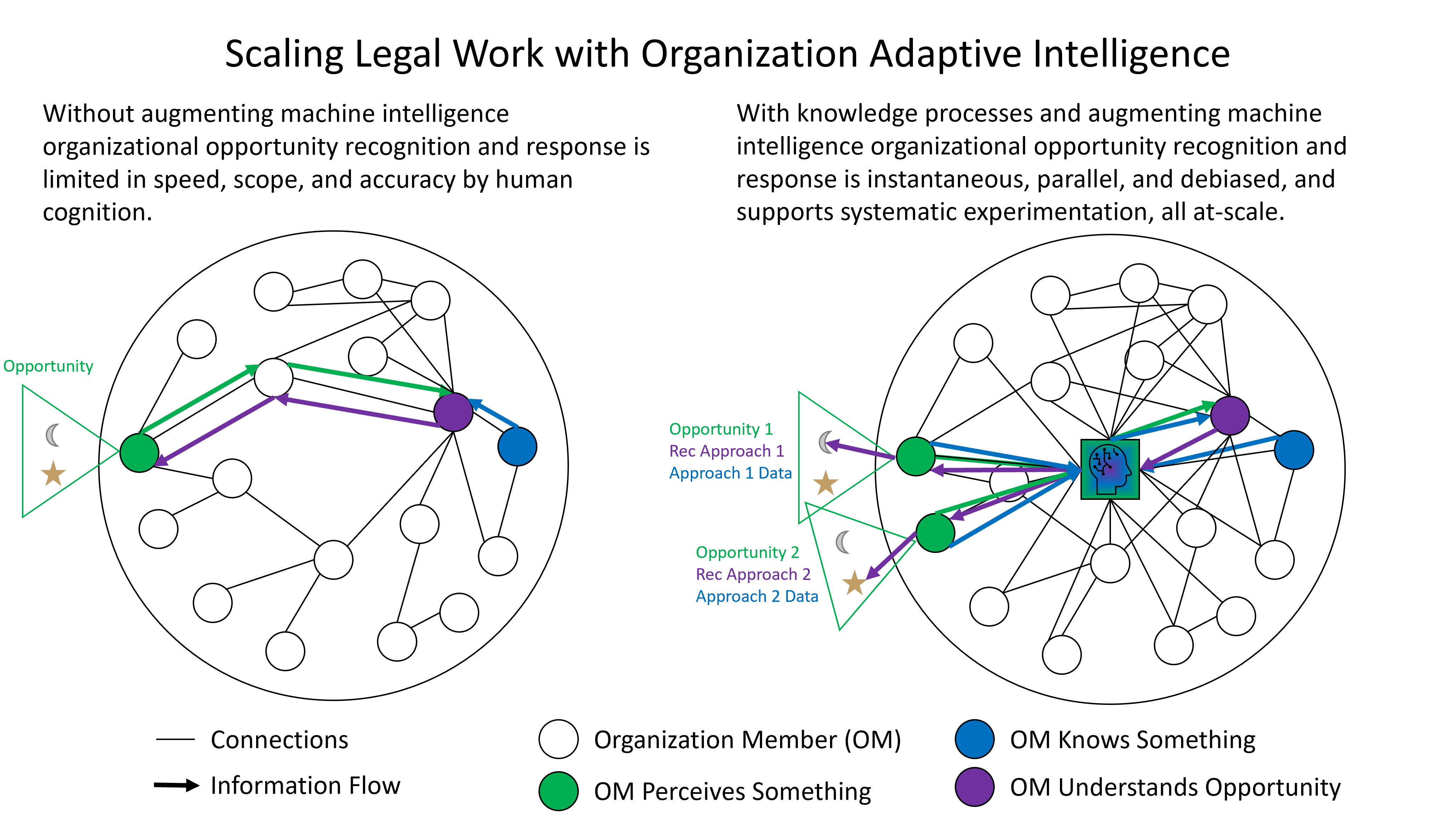
The image below models a standard interaction pattern for legal work. Imagine a basic request for some form of contract review. It begins with a business customer, migrates through internal counsel, emigrates to outside counsel, and ultimately round trips back to the customer. This kind of interaction is typically transacted through a series of point-to-point email communications that may include attachments.

Scaling legal work with augmenting machine support.

We will build standard definitions for frequent, known-known work requests that operate inside and across our organizational boundaries. This will support the adaptation and KM investments by making it easier for machines to assist work as it moves through enterprise information systems. When we build open standards for work definitions, we can (1) transact knowledge across organizational boundaries with partners more efficiently, (2) measure work quality more easily, and (3) promote re-use by avoiding duplication of efforts. See Standards Advancement for the Legal Industry (SALI) Alliance (focused on developing open industry standards).

We also need a set of legal industry-focused application programming interfaces (“Legal APIs”) that allow us to start building machines in all parts of the ecosystem that can efficiently throw and catch work with different combinations of customers and partners. This is a critical investment that will bring speed, efficiency, and better decision-making, at-scale. And it will help our profession evolve into an industry that continues to provide the critical infrastructure society needs.

The future practice pattern will create more value through access

My perspectives are informed by commercial concerns, but the patterns can be applied to many types of legal services for many types of customers. Enterprise and consumer. Commercial, public sector, and public good. We will create more value if we can create more commonality across our respective needs. I believe we will get there. It is a question of path and pace. But the journey has already started.


Plenty. It’s our opportunity to make a quantum leap forward.


Legal Evolution readers are likely familiar with law firm competency models that define the skills and capacities of their lawyers, including the stages of development. In response to changes in the accreditation requirements, law schools have been slowly moving toward what is called Competency-Based Legal Education (CBLE). See, e.g., Michele R. Pistone, “Competency-based legal education,” Christiansen Institute, Mar. 29, 2016.

CBLE is an outcomes-based approach to the design, implementation, assessment, and evaluation of legal education programs, using an organizing framework of competencies. A competency describes a key set of abilities required for someone to do their job. As of mid-July of 2020, 186 of the 194 ABA-accredited law schools have published learning outcomes on their websites as a first step in the process of moving toward CBLE, all of which are available through a database maintained by the Holloran Center, a research center I co-direct at the University of St. Thomas School of Law in Minneapolis.

As we move into this new phase of legal education, we have an opportunity to take advantage of medical education’s “lessons learned,” as they’ve been on this journey for more than two decades.  Arguably, one of the biggest insights is that the shift from time-based to competency-based education is massive in scope and complexity and thus remains an ongoing project.  See Dr. Eric Holmboe & Dr. Robert Englander, “What Can the Legal Profession Learn from the Medical Profession About the Next Steps?,” 14 U. St. Thom. L. J.  345 (2018) (summarizing progress since the late 1990s).  Thus, the one clear lesson for legal education is that movement toward competency-based education will also be a decades-long process.

To prepare us for this journey, this post dives into the details of the medical field’s experience with competency-based education, which started with an urgent need to deal with issues of inadequate quality of care.  After reviewing the origins and maturation of the new medical education competency-based model, I explore how it might be applied to legal education.

Responding to a serious quality problem

In the 1980s and 90s, concerning signals of problems in the quality and safety of healthcare percolated through the healthcare system.

By the late 1990s, the medical education community realized that one of the root causes was the failure to sufficiently prepare students to meet the challenges of a dynamic and changing healthcare system.  Medical educators came to understand that a principal emphasis on medical knowledge and cognitive skills was inadequate to meet patient and population needs.  The earlier approach of “if you are really smart cognitively, you’ll be fine” was not sufficient.  Holmboe & Englander, supra, at 347.  Medical educators recognized the central importance of a much broader framework of patient-centered care where cognitive technical skills were necessary but not sufficient to meet patient and healthcare system needs. See Institute of Medicine, Crossing the Quality Chasm (2001).

The medical education enterprise had to start by identifying the needs of the patients and the healthcare system and then working backward to defining the critical competencies that each medical student would need to develop and demonstrate before becoming licensed.  Drs. Holmboe and Englander note:

The next stage of evolution in the thinking of the medical education community, after defining the core competencies, was to develop a model of how the learner should proceed through a series of developmental stages in each competency. The resultant strategy was to adjust curriculum and assessment to facilitate that developmental progression.

Holmboe & Englander, supra, at 350.  Fortunately, this Competency-Based Medical Education (CBME) is rapidly being adopted across the globe.  See Elaine Van Melle et. al, “A Core Components Framework for Evaluating Implementation of Competency-Based Medical Education Programs,” 94 Acad. Med. 1002-09 (2019).

Based on competency rather than time

CBME is a different model from traditional education where the emphasis has been on student completion of a certain number of exposure hours of credit (called a tea-steeping model where the student is like a teabag in a cup of hot water for the right amount of time). See Brian David Hodges, “A Tea-Steeping or i-Doc Model for Medical Education?,” 85 Acad. Med. S34 (Sept. 2010).

Table 1 below summarizes the major differences.

Evaluating the design of CBME programs has been hampered by the lack of a clear shared understanding of what are the most important components of a CBME program.

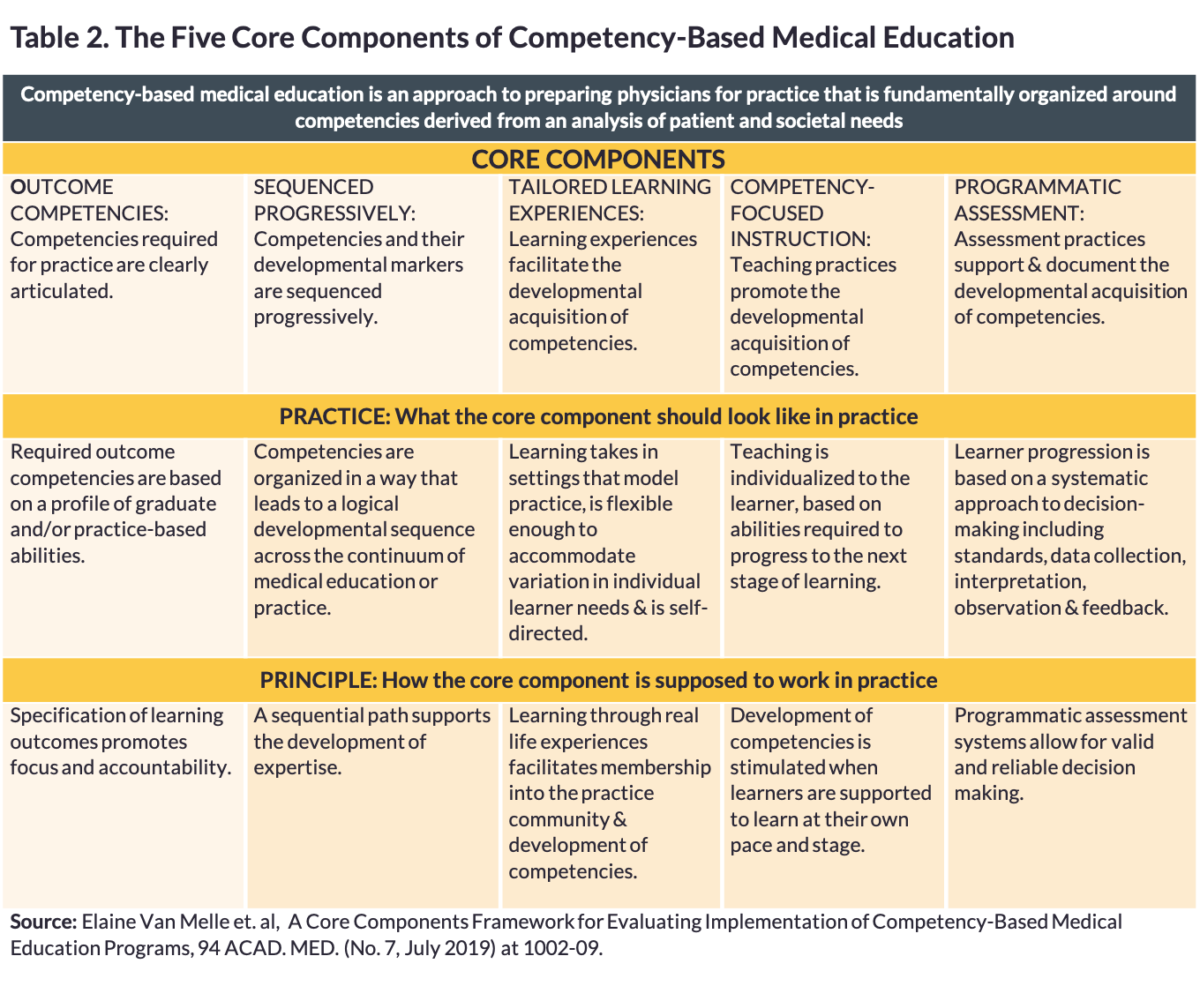
In an effort to achieve relative consensus, 59 members on an international CBME expert panel recently engaged in a multi-stage process that combined scholarship from education theory and medical education. The result was the identification and organization of CBME into five core components, which is summarized below in Table 2.

Of the five core components in Table 2, the expert panel envisioned “Outcome Competencies” and “Sequenced Progressively” as the central core components guiding competency-based medical education.  Figure 1 shows the centrality of these two components.

Applying the CBME frameworks to law

A simple and worthy thought experiment is to consider how the CBME frameworks, with very slight modifications, could be applied to the education of lawyers.

If so, the first central core component of CBLE requires identifying the needs of clients and the legal system and then specifying core-competency learning outcomes that each student must develop and demonstrate to meet these needs.  A major challenge facing law schools is the paucity of quality data on the core competencies needed by clients, legal employers, and the legal system.  See Neil W. Hamilton, “The Gap Between the Foundational Competencies Clients and Legal Employers Need and the Learning Outcomes Law Schools are Adopting,” 89 UMKC Law Rev. __ (2020). To get this right, law schools need to closely engage with those working in practice.

Continuing the experiment, the second core component of CBLE requires competencies and their developmental markers to be sequenced progressively.  Within the medical community, sequenced progression has taken the form of a narrative model that tracks the developmental stages from novice to competent graduate. This led to what CBME calls Milestones, which have been built out by the Accreditation Council for Graduate Medical Education (ACGME), the accreditor for residency programs.  The ACGME continues to work closely with practicing physicians and professors to create Milestone models for all 24 medical specialties.

To date, the ABA as the accreditor for law schools has shown no interest in providing this type of support for legal education. To fill this void, the Holloran Center has formed working groups that are creating Milestone models on the most common law school learning outcomes beyond technical legal skills. They are available at Holloran Competency Milestone.

The Milestones model

Milestones on a specific competency provide a “shared mental model” of professional development from student to competent practitioner and beyond to mastery. Laura Edgar et al, “Milestones 2.0: A Step Forward,” 10 J. Grad. Med. Educ. 367–69 (2018).   The power of this approach is that it defines a logical learning trajectory of professional development and makes transparent significant points in student development.  The result is less uncertainty and more efficient communication throughout the learning process.

Indeed, once built and adopted, Milestones can be used for formative and summative assessment for students and overall program assessment. If a faculty and staff adopt a Milestone model for a particular competency, they also are building consensus on what competent performance looks like, which in turn fosters better inter-rater reliability. Finally, Milestones describe what a trajectory should look like so that learners can track their own progress toward a particular competency and programs can recognize which students are in need of extra help.

Figure 2 depicts how Milestones work within the well-known Dreyfus model of development from novice to expert.

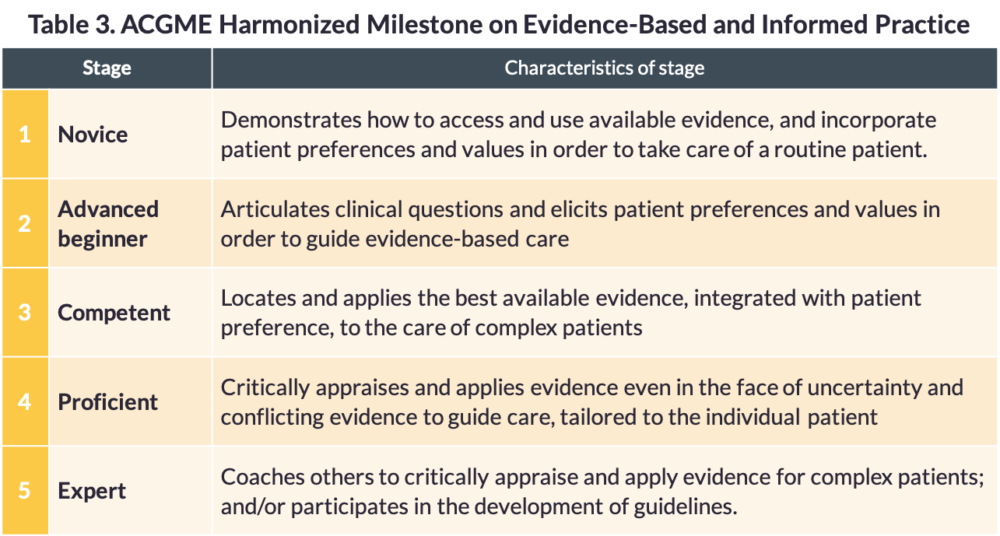
What does this look like in the field? Table 3 presents an ACGME Milestone on patient-centered problem-solving.

Source: Arthur Ollendorff et. al, “Harmonizing the Practice-Based Learning and Improvement Milestones,” Accreditation Council for Graduate Medical Education.

Inherent in the Dreyfus and Milestone models is that learners take ownership of their own continuous professional development, particularly at the latter stages of each competency. According to the Guidebook distributed to fellows and residents by ACGME, learners in a competency-based education system “must be active agents co-guiding both the curricular experiences and assessment activities.”  Eric Holmboe, MD, et al., The Milestones Guidebook (ACGME 2016) at 15.

What does it mean for a student to be an active agent in her own learning and assessment? “Learners must learn to be self-directed in seeking assessment and feedback.” Holmboe & Englander, supra, at 350. Learners should ideally:

  1. Be both introduced to the overall competency-based education curriculum at the beginning and engaged in dialogue about the overall program on an ongoing basis;
  2. Actively seek out assessment and feedback on an ongoing basis;
  3. Perform regular self-evaluations together with feedback from external sources;
  4. Direct and perform some of their own assessments such as seeking out direct observation of the learner by an experienced professional and creating portfolios of evidence regarding specific competencies; and
  5. Develop personal learning plans that students revisit and revise at least twice a year.

Preparing students to enter practice

Medical education has also emphasized the importance of providing coaching and guided reflection at significant transition points for students. This approach is grounded in the belief that new entrants to a profession should be growing, step by step, from being an outsider with a stance of an observer to an insider who has absorbed valuable tacit knowledge.  See William Sullivan, “Foreword,” in Teaching Medical Professionalism at ix, xii (Richard Creuss et al. eds. 2d ed. 2016)

Medical professors Lockyer, de Groot and Silver observe:

Generally, transitions are critically intense learning periods associated with a limited time in which a major change occurs and that change results in a transformation. During transitions, people re-form their way-of-being and their identity in fundamental ways. Thus, transitions represent a process, which involves a fundamental reexamination of one’s self, even if the processing occurs at a largely unconscious level. In transition periods, people enter into new groups or “communities of practice.” This involves adopting shared, tacit understandings, developing competence in the skilled pursuit of the practice, and assuming a common outlook on the nature of the work and its context.

Jocelyn Lockyer, et al., “Professional identity formation: the practicing physician, and continuing professional development,” in Teaching Medical Professionalism, supra at 186-88.  Medical educators note that these transitions are often characterized by anxiety, stress, and risk for the developing professional.  As a long-time legal educator, I believe the same dynamics apply to law students.

So, how do students themselves assess the important transitions in their journey from novice to competent learner/beginning practicing lawyer?

To start answering this question, I developed a Qualtrics survey for law students in September of the 2L year asking them to reflect on the transitions of the 1L year and the summer between the 1L and the 2L years. The survey focused on transitions regarding ownership over continuous professional development. At the University of St. Thomas School of Law, all 2Ls take Professional Responsibility in the 2L year; so, 62 of the 62 2L students in my Professional Responsibility class filled out the survey.

The key survey question read: “In the context of the self-directed learning stage development model, what is the impact of each experience in this survey on your transition from thinking and acting like a student to thinking and acting like a junior lawyer?” The respondent could choose among the following: no impact, some impact, moderate impact, substantial impact, great impact. There was also a question where the respondent could add additional experiences that were significant with respect to this question, but none of the added experiences had more than one respondent.

Figure 3 indicates the experiences that had the greatest impact.

[click on to enlarge]
Figure 3 makes clear that 2L students reflecting on the major transitions in the 1L year and the summer following the 1L year rate professionally authentic experiences (real-life or mimicking the real-life work of a lawyer) as having the greatest impact on their growth toward later stages of ownership of their own continuous professional development. This is evident from the high proportion of students who rated the most impactful experience in summer employment (59%) and paid or unpaid summer employment generally (52%) as having a great impact on their transition. Although there is enormous drop-off in experience warranting a “great impact” designation, it is noteworthy that the third (Received graded memo from lawyering skills class) and fifth items (mentor externships) are both strongly connected to practice.

Summer employment experience (paid or unpaid) after the 1L year is a singularly important professionally authentic transition. Note that summer employment is currently completely outside of the formal curriculum, but the law school should provide some coaching and guided reflection and guided self-assessment for each student about the summer employment transition experience.

Law schools should also provide some coaching and guided reflection at other significant transitions where student have authentic professional experiences (real-life or mimicking real-life) in the 2L and 3L years like: (1) all work experiences, paid or unpaid, especially the summer work experiences; (2) clinic and externship experiences; and (3) simulation experiences.

Conclusion

Over 20 years ago, medical education embarked upon a mission to upgrade the quality of its education, primarily because a large number of patients were being put in harm’s way by young doctors who were graduating underskilled from medical school.  What are the odds that legal education does not suffer from similar deficiencies?

Fortunately, our peers in medical education have provided us with a valuable roadmap for how to navigate our journey toward competency-based professional education.

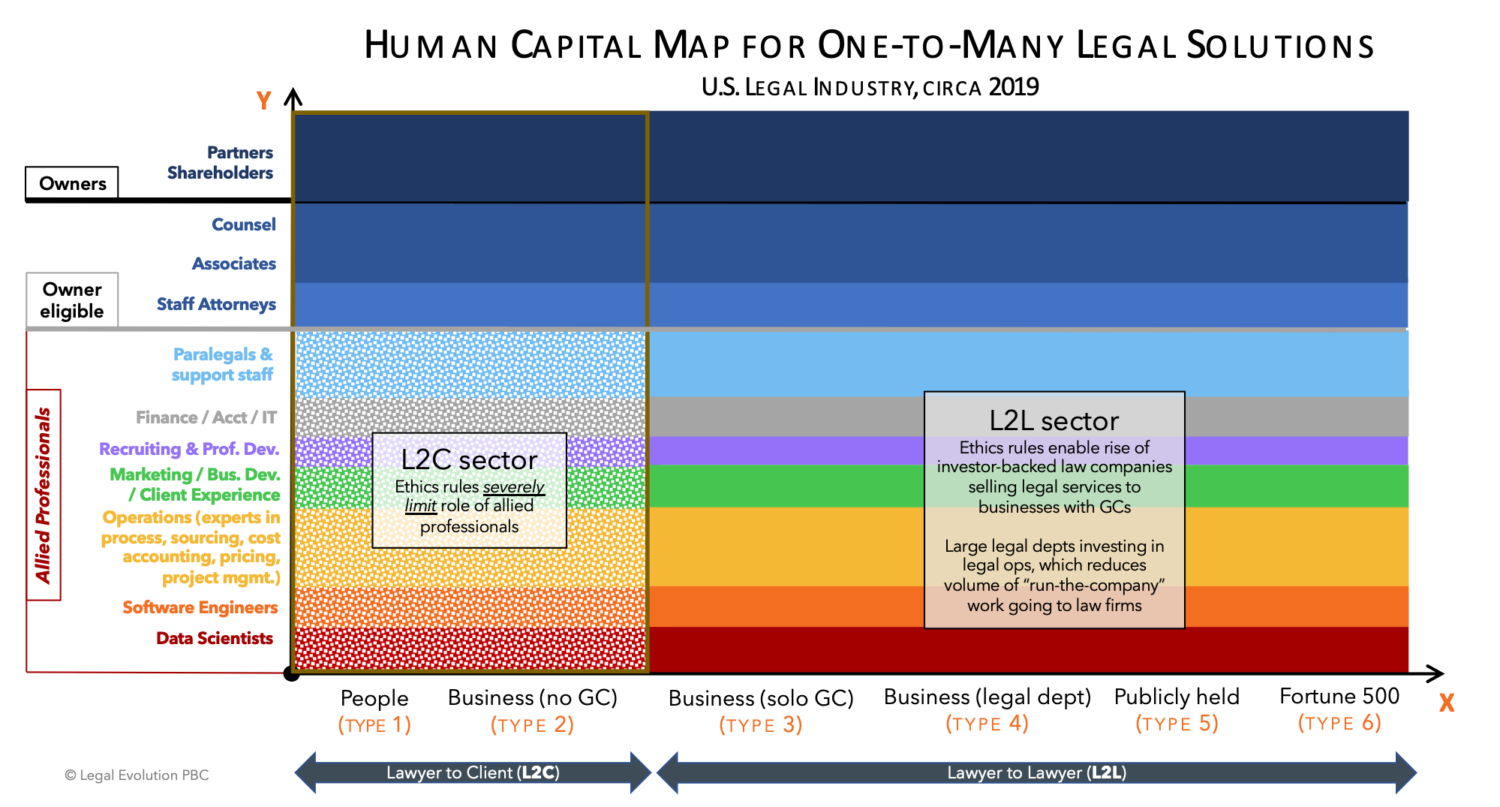
[click on to enlarge]

One-to-many legal solutions are built by teams of multidisciplinary professionals. It’s time to build a legal talent supply chain.


The above graphic is a map of the human capital needed to create “one-to-many” legal solutions (Human Capital Map).  It’s a dense graphic on a complex topic. To explain its structure and the key insights it provides, I’ll cover the following topics: Continue Reading Human capital for one-to-many legal solutions (126)

First Six Years: Tech Lawyer Accelerator / Institute for the Future of Law Practice Alumni, 2014-2019

Our challenges will be solved by the next generation of legal professionals. We all become richer when we invest in them.


This pattern fits me and many lawyers I know: We applied to law school with a sincere, passionate personal statement about doing good. We worked hard to show we deserved our spot in the class. We focused on getting a job that enabled us to build our legal career while also paying back our loans and pursuing personal goals. Traction at work quickly led to long hours and growing responsibility. Then the years started flying by.

In the legal profession, we generally take care of our own careers first. And then, to the extent there’s time, energy, and resources left over, we help others. This is not a good formula for building and sustaining a vibrant profession. And frankly, it shows.  With a little bit of sacrifice and organization, however, we can do better. A good time to start is now.

The focus of today’s special three-post series is the Institute for the Future of Law Practice (IFLP, “I-flip”), an education nonprofit I have worked with since its origins as a pilot program at Colorado Law in 2014.  Post 117 shows how a group of general counsel connected to IFLP are stepping up to improve the legal supply chain. They are doing so by clearly stating what they want — more diversity, better training, less student debt — and encouraging their peers to join them. Post 118 is a data download on IFLP through Year 2, showing tremendous results on a remarkably lean budget. It also describes our plans for the coming year. Finally, Post 119 asks you to become part of the IFLP solution.

Here are three ways to do just that.

  1. Become an IFLP Patron. It’s tax deductible. Click here.
  2. Support the GC Open Letter on Improving the Legal Talent Supply Chain. You can do this by urging your general counsel colleagues to visit this webpage.
  3. Become an IFLP Employer, either for a 10-week summer internship or 7-month field placement. Click here.

For potential supporters who want a deep dive into IFLP’s strategic plan, please contact me directly.  Background on IFLP can be found in Posts 018, 043046, 064, 078, 112, and 118.  Today, however, I want to make the IFLP cause more concrete by focusing on the story of Dwayne Hermes, IFLP’s first official Patron who earned this distinction by accident and doing nothing more than living his professional values.

IFLP Patron 00001

Today is the first day of IFLP’s capital campaign. Any IFLP supporter who donates $20 or more will become an IFLP Patron and receive an official numbered IFLP Patron Card.  Into perpetuity, you’ll own that low single-digit, double-digit, or triple-digit number. However, the 00001 slot belongs to Dwayne Hermes, a lawyer who founded Hermes Law, a process-driven litigation firm in Dallas, Texas that employs a dozen-plus lawyers and nearly two dozen allied professionals, albeit everyone at Hermes Law, including Dwayne, goes by “team member.” In 2018, Hermes Law also became one of the first IFLP employers.

This past August, after Dwayne’s intern returned to law school, Dwayne reached out to make an unsolicited $5,000 donation to IFLP. When I replied that he was the first person to make a contribution to a capital campaign we were about to launch, he increased his contribution to $10,000.

I first met Dwayne in the winter of 2017 when Andy Morriss, then the Dean of Texas A&M Law, contacted me about a law firm he had just visited in Dallas that was unlike any other — heavy investments in data, process, and technology, a focus on cost accounting and alternative fees, and work space built for collaboration, including walls covered in whiteboard paint.

“This is the type of law firm that Susskind predicted,” said Andy. At the time, Legal Evolution was still in the planning stage. Thus, I was on the lookout for examples of successful innovation. When Andy said, “You should get on a plane and check this out,” I reached out to Dwayne and set up a visit.

More to the story

Andy’s description turned out to be accurate.  Yet, there was also a lot more to the story.

Prior to starting Hermes Law in 2015, Dwayne was a co-founder and partner in Hermes Sargent Bates, a litigation firm focused primarily on insurance defense. Over the course of nearly 15 years, the firm grew to nearly 100 lawyers and staff.  Yet, after nearly 30 years of practicing law, Dwayne went to his partners and told them he was tired of being in an antagonistic relationship with his clients.

“I suggested we move to a new business model that would open the door to better alignment,” Dwayne recounted. “We could reduce the total cost of a claim [payout + litigation cost] by reengineering how we did the work.”  Unfortunately, Dwayne’s partners weren’t interested.  Thus, rather than sign another lease, the partners decided to dissolve the firm.

“Think about that,” Dwayne told me. “I was the biggest rainmaker in a law firm I co-founded, and I was unable to make significant change.” Thus, after thirty years of practice, Dwayne founded Hermes Law with the goal of building a business model that would enable all stakeholders — clients, lawyers, staff — to feel that they were all part of the same team.

When I visited Dwayne and his team in February 2017, the firm was still in building mode. Thus, it was not yet clear whether clients would embrace (or embrace fast enough) this new model. Obviously, Dwayne was taking an enormous financial risk.

To better assess the viability of the model, I worked my rolodex to find two senior lawyers in insurance companies who managed claims litigation. I asked them for an in-person meeting to introduce them to Dwayne and get their reaction to his new model. (When it comes to studying innovation, the goal is often to get into the right room so you can watch and listen.)

In the first meeting, my in-house colleague revealed that he was working hard to drive the same model from the insurance side. However, not all lawyers and law firms understood his “blue ocean” strategy. Although my friend and Dwayne got along famously, my friend did not have much claims work in Texas.  In the second meeting, my in-house colleague had just left the insurance company due to a change in senior management.  He claimed that Dwayne’s model was the type of innovation he long wanted to support, but that the internal apparatus favored driving down litigation costs by pitting staff counsel against law firms.  “Our management thinking was archaic. We made it impossible to innovate.”

Through these two meetings, Dwayne became a member of the Last Miler’s Club.  These are legal innovators who have the technological know-how to solve a major problem for their clients, yet they struggle to find a business model that enables them to transition. See Post 072 (discussing Last Miler’s Club); Henderson, “The Legal Profession’s ‘Last Mile Problem,'” Law.com, May 26, 2017.

Likewise, after these meetings, it became obvious to me that Dwayne needed to go out and find the handful of early adopters within insurance companies who were willing to have a sophisticated conversation about risk and reward.

Could Dwayne get it done before his team in Dallas ran out of steam? Although I certainly hoped so, there were no guarantees.  Over the last two years, I’d periodically get updates from Dwayne, particularly as he tried to sell his vision and model to underwriters in London, who are some of the most significant opinion leaders within the insurance bar.

Then, in December of 2018, I got an email from Dwayne with the subject line, “The first Crossing of the Chasm” [a reference to Post 024]. The email read, “It happened Wed night with the formal signing of the Swain & Baldwin Value Pricing Agreement (photo attached) and then continued at a greater speed with the meeting yesterday with [a Top 3 insurer] who wants to send us as much work as we can handle.  … Champagne was popped.”

Dwayne went on to comment about the challenge of scaling the business. “Maybe we are at the end of the half marathon with half to go.”

The next generation

One of the things that stuck with me about my first meeting with Dwayne was his comment, “I want to leave this profession stronger than I found it.” If he couldn’t do that, he was going to find something else to do with the productive years he had left.

Personally, I am inspired by Dwayne, first for taking enormous personal risk to improve the practice of law and the legal profession, and second by investing some of the rewards back into the next generation. I hope readers will consider doing the same. If just a few hundred of us stand up and support IFLP, we’ll have a solution for next generation (and perhaps for us) that just might work. In the meantime, we can share the joy of living our professional values.

To become an IFLP Patron and receive your IFLP Patron Card, please visit our Support IFLP page.

Many thanks for reading. wdh.

Source: Randall Kiser, DecisionSet

American law firms are threatened by acute needs and limited capabilities in three domains: leadership, meaning, and service.


Media attention shifts rapidly from law firm profitability to gender bias and from technology to new lateral partners. Yet, if we pull back to conduct a deeper analysis, what we observe is a law firm sector grappling with three interrelated threats that are seldom the focus of sustained attention:  insufficient leadership, attorneys’ lack of meaning and purpose in their work, and client service. As shown in the above graphic, these three domains are the linchpins of law firm performance and sustainability. Continue Reading Law firm leadership (111)


Lawyers Trust Fund of Illinois has been thinking about this question for more than 30 years.  Often, the answer involves legaltech.


On the outside chance that the afterlife involves a meeting with St. Peter at the Pearly gates, those working for the Lawyers Trust Fund of Illinois (LTF) will have good story to tell.  Over the organization’s 36-year history, LTF’s leaders and staff members have demonstrated a combination of stewardship, creativity and courage that is inspiring to anyone who wants the law to work for all people, including society’s most vulnerable populations.

Today’s post is a highlights reel of this remarkable organization.

What is the Lawyers Trust Fund of Illinois?

LTF is Illinois’s largest state-based funder of legal aid, with money coming from interest on lawyers’ IOLTA accounts and an annual $95 assessment on every Illinois-licensed attorney. Since its founding in 1983, LTF has provided approximately $160 million in grants and operating funds to numerous Illinois-based legal aid organizations.  Although this might sounds like a lot of money, demand for legal aid far exceeds available funding. See, e.g.,  “The Justice Gap: Measuring the Unmet Civil Legal Needs of Low-income Americans,” (LSC 2017) (legal aid is available for only 1 in 5 low-income people in need). Fortunately, LTF has a long track record of finding innovative ways to multiply the impact of these finite dollars.

The graphic above is an amalgam of organizations and projects that LTF has funded over the last 30+ years.

Mark Marquardt

LTF’s Executive Director, Mark Marquardt, has been know to say, “I work for a nonprofit, but I don’t actually help people.”  Marquardt’s comment reflects the immense respect he holds for the hundreds of lawyers who do the emotionally taxing work that his organization is able to fund.  In lieu of directly helping people, Marquardt and his four full-time staffers try to earn their keep by efficiently gathering IOLTA funds, disbursing and administering grants, and otherwise engaging in systems thinking, including root cause analysis, what’s working elsewhere, vetting new technology, measuring impact, and overall funding optimization.

An approach based on facts and impact

Marquardt credits his predecessor, Ruth Ann Schmitt, with an approach to funding that focused on facts and finding new ways to increase impact.

According to Marquardt, Schmitt’s perspective was shaped during the early years of her LTF tenure when the organization struggled to create a stable source of funding.  LTF came into existence in 1983 in response to a 25% cut in funding to the Legal Services Corporations (from $381 million to $241 million). Under Schmitt’s leadership, between 1984 and 1990, LTF funding from IOLTA accounts increased from $100,000 to $2.5 million.

(a) 1989 Illinois Legal Needs Study

With this improved financial stability, Schmitt made it a priority to obtain a more in-depth view of the problems she was trying to solve.  Thus, with support from her colleagues from the Illinois State Bar Association (ISBA) and the Chicago Bar Association (CBA), Schmitt served as Program Director for the newly launched Illinois Legal Needs Study, which was the first statewide needs assessment and one of the most comprehensive of its kind in the country. Having recently graduated with a history degree from Northwestern University, Marquardt joined as Project Coordinator.

The Illinois Legal Needs Study had three major objectives:

  1. To quantify the legal needs of the poor throughout the state.
  2. To inventory the existing civil legal assistance resources available throughout the state, and to identify any gaps in services.
  3. To develop a set of recommendations to address the unmet needs of the poor.

The final report was an amazing compendium of facts and figures that documented the enormous gap between needs and resources.  The report estimated that approximately 300,000 low-income households in the state of Illinois experienced an estimated 3.54 distinct civil legal problems for which they had no legal help. The most common types of unmet legal need were public benefits (16.3%), problems related to housing (15.7%), family law (10%), consumer matters (14.7%), utilities (13.4%), and healthcare (13.7%).

One of the biggest impediments to legal aid, affecting 43% of all low-income household, was lack of awareness of legal aid resources.  A second major impediment was the complexity of navigating a legal system designed for lawyers and judges rather than citizens. A third major impediment was geography, particularly in rural areas where the nearest legal aid organization may be several counties away. A fourth major impediment was the needs of special population groups, including people with disabilities, immigrants, migrant workers, the mentally ill, the elderly, homeless people, the incarcerated, victims of domestic violence, and people with language barriers.

In addition to the final report, the Illinois Legal Needs Study included a shorter Plan for Action that outlined steps to be taken by various stakeholders, including funders. According Marquardt, that document was instrumental in setting LTF priorities throughout the 1990s and early 2000s.

(b) Computerizing legal aid offices

One of the recommendations in the Plan for Action was for Illinois legal aid organizations “to increase the use of office technology to improve efficiency.”

IBM Selectric

During his months of field work in legal aid offices throughout the state, Marquardt recalls tremendous unevenness in the use of technology.  “Occasionally you’d walk into a legal aid office and you’d see a lawyer typing away on a Commodore computer, which he likely brought in from home. But in most cases, the IBM Selectric was the state-of-the-art technology for those working in legal aid, which meant that all documents were constantly being recreated from scratch.”

Starting in 1990, LTF began conditioning some of their funding on the upgrade of office equipment, including desktop computer for use by lawyers. Not all legal aid organizations, however, were onboard with the change.

Marquardt tells the story of a computer technician going to a LTF-funded legal aid office to set up a new computer.  Upon his arrival, he asks one of the senior attorneys, “Where do you want this?” The senior attorney replies, “Over there, in the corner.”  Puzzled by the request, the computer guy says, “But if we put it there, you won’t be able to use it.”  To which the attorney quipped, “That’s right, because I’m a lawyer, not a travel agent.”

Marquardt gives Schmitt credit not only for her vision but also her willingness to be directive. “The legal aid organizations would say, ‘Just give us the money. We know what to do with it.  We’ll hire more lawyers and more staff.'”  But Schmitt knew that unless lawyers leveraged technology to increase their own productivity, fewer overall clients would be served. “I admire her courage in pressing ahead. It wasn’t easy.”

According to Marquardt, the biggest accelerator of computerization was shrinking budgets for clerical support. “When that happened, the lawyers had to type their own pleadings. Thus, they were very happy to have their own computers.”

(c) Coordinated Advice & Referral Program for Legal Services (CARPLS)

Another Plan for Action recommendation was for legal aid programs in the Chicago metropolitan area to “formalize the process of coordination, cooperation, and planning for the effective delivery of legal services.”  In 1993, the leadership of LTF followed through by funding the creation of CARPLS, which became nation’s first legal aid hotline.

Marquardt recently recalled the origins of CARPLS, tracing it back to the team of consultants who worked on the Illinois Legal Needs Study. “[W]e traveled around the state, going into communities, talking to their leaders, social service agency folks, judges, bar leaders, etc.  We wanted to understand how well legal aid was working in these communities. We worked our way up the state and as we got closer to Chicago there was a sense of dread. There were so many legal aid programs. It was a really confusing ecosystem, both for us and for potential clients.” See A CARPLS History Lesson With Mark Marquardt, CARPLS, Feb. 1, 2019.

By this time, the data from Illinois Legal Needs Study made clear that, when available, information and referral services usually had a significant impact on their communities. Yet, bringing these benefits to Chicago and Cook County were especially daunting, as size and diversity of need was much more complicated than any other part of the state.

“The main problem,” recalls Marquardt, “was that nothing like this existed in the country.”  Thus, in the spring of 1991, Schmitt and Marquardt traveled to Washington, DC to consult with administrators who were running hotlines for the AARP. Upon their return, they worked with Chicago Bar Foundation and the Illinois Bar Foundation to create an organization that could raise awareness and better allocate limited resources.  On May 11, 1993, CARPLS took its first client phone call. See id.

Although originally conceived as a triage and referral service for Chicagoland legal aid organizations, the CARPLS staff soon realized that available referral resources were completely inadequate to handle the enormous volume of callers with significant legal need and an inability to pay. Thus, shortly after forming, CARPLS became what it is today: a standalone service that provides over-the-phone legal advice to low- and moderate-income individuals.

[click to enlarge]
Although CARPLS provides legal advice over the phone, it does not does offer any in-court representations.  Yet, this limitation on services has not been a barrier to good results, as CARPLS is able to resolve a remarkable 85% of aid-eligible inquiries.  This is made possible by a state-of-the-art knowledge management system built out over time that enables CARPLS staff attorneys to answer questions in 1871 difference legal topics, from adoption to zoning.

Since the mid-1990s, CARPLS has also staffed a self-help desk in the basement of the Cook County Courthouse.  On any given day, between eight and ten CARPLS staff attorneys meet with clients to help them solve their legal problems, including explaining the law, document preparation, and coaching of self-represented litigants.

CARPLS’s focus on legal advice rather legal representation has resulted in remarkable record of efficiency and coverage that has served as a model for other large urban legal aid organizations. Looking back at what LTF helped create, Mark Marquardt observes, “Every now and then, it’s important to step back and look at the delivery system as a whole, look at the pieces of the puzzle, and see how you can fit them together. CARPLS is really good at that.” Id.

(d) Illinois Legal Aid Online

When the Plan for Action was published in 1989, the legal aid community was beginning to grasp the benefits of self-help materials as a way to serve a wider swath of low- and moderate-income people.  Thus, the Plan urged Illinois legal aid organizations to expand the use of “printed self-help materials.”

Although this was a wise and prudent recommendation, the rise of the Internet a few years later opened up a new frontier to help ordinary people gain the information they needed to resolve their legal problem.  With leadership and financial funding from LTF along with the Chicago Bar Foundation and the Chicago-Kent College of Law, the result was the creation of Illinois Legal Aid Online (ILOA).

During the first nine months of its existence, Lisa Colpoys (formerly a staff attorney and Program Director at CARPLS) was ILAO’s sole content manager and John Mayer of Chicago-Kent/CALI served as ILAO’s part-time chief technology officer.  Shortly thereafter, Colpoys was promoted to Executive Director and promptly hired two content managers to continue the daunting task of simplifying the law so that it was accessible and intelligible to all people, including those with low incomes. By 2005, ILAO was incorporated as its own independent nonprofit. In turn, Colpoys and her staff started making heavy use of the AJ2 Author technology produced by Mayer and his team at CALI.

Today, ILAO provides comprehensive online information and resources to legal aid advocates, pro bono attorneys, and members of the public seeking legal assistance.  These resources include:

As of the first quarter 2019, ILAO is on pace to host 3 million unique users for the year and 4 million user sessions.

According to Colpoys, the Lawyers Trust Fund of Illinois has been ILAO’s single largest source of operating funds, in most year accounting for nearly 50% of the organization’s total budget.  Why has LTF been so generous? The most obvious answer is results. Over the last 15 years, ILAO has emerged as a nationally recognized leader in the use of technology to deliver legal services.  ILAO’s industry awards include:

  • Technology Leadership Award, presented by Accenture and Lumity (2006)
  • Louis Brown Award for Legal Access (Meritorious Recognition), presented by the American Bar Association (2010)
  • Paul H. Chapman Award (for significant contribution to the improvement of justice in America), presented by The Foundation for Improvement of Justice (2010)
  • Public Interest Partner Award – IIT Chicago-Kent College of Law (2011)
  • Connection Award – LivePerson Software (2012)
  • Pro Bono Partnership Award – John Deere Global Legal Services Group (2012)
  • Technology Innovations Award – Law Technology News (2013)

The next generation of LTF leadership

In 2015, when Mark Marquardt was promoted to Executive Director of LTF. he had the benefit of intimately understanding the successes of one of the nation’s most influential and dynamic legal aid funders.  Arguably, the guiding principle of the prior 25 years had been stewardship, with Schmitt and Marquardt investing in ideas and organizations that showed the most promise for Illinois’s low- and moderate-income populations.

With the changing of the guard, Marquardt reflected upon LTF’s biggest successes.  With the benefit of hindsight, it was not hard to see that the really big wins came from investments in innovation and technology. Further, Illinois and LTF had unwittingly become one of the first movers in the legal aid space — a rare innovator who was also an opinion leader for other members of the social system.

Hanna Kaufman

Wanting to better leverage what appeared to be working, Marquardt decided to do away with his old role as deputy executive director and instead create a new position called Counsel for Innovation & Technology.

How this job got filled is an object lesson in the importance of showing up.  During her 2L law school at Chicago-Kent, Hanna Kaufman enrolled in Ron Staudt’s highly influential Justice and Technology Practicum, which that year included an opportunity to volunteer for a symposium on law and the future.  “Because I loved the class and loved the topic, I was happy to volunteer,” recalls Kaufman. “One of the sessions was a roundtable on using technology to improve access to justice, which was my passion.  So I showed up. Then, as the only student in the room, the participants cajoled me to speak up. That’s how I met Mark Marquardt. He was impressed with my interest in the topic.”

After Kaufman graduated, she went to work for a company focused on ADR.  Nonetheless, she stayed in touch with Marquardt, who let her know about a new position he was creating that would be focused in innovation and technology for legal aid organizations. When the position was officially open, Marquardt persuaded Kaufman applied. Shortly thereafter, she was hired.

According to Marquardt, “95% of LTF’s budget will continue to be devoted to direct legal aid funding.  But approximately 5% are going to be strategic initiatives where we are going to make investments with an eye toward improving what we can do in the future. Hanna’s job is to identify and oversee the most promising opportunities.”

One recent example is financial support to UpSolve, a new nonprofit start-up organization founded at Harvard Law School’s Access of Justice Lab. UpSolve provides user-friendly software to help low-income people complete the forms necessary for Chapter 7 bankruptcies. The LTF funds will be used to hire a full-time, Illinois-based attorney to review bankruptcies form, answer client questions, and collaborate with other nonprofits in the area. They’ll also be used to adapt the Upsolve system to the Northern District of Illinois local rule, forms, and exemptions.

Another initiative shepherded by Kaufman is Reintervention, a chatbot technology focused on the private-market landlord/tenant matters in Chicago. The purpose of Rentervention is the creation of a single vertically integrated path that combines automated guidance (chatbot technology, document automation, and AI-based workflow tools) with human interventions (telephone calls, clinics, limited-scope assistance, and referrals to legal aid or pro bono lawyers). Thus, rather than going from agency to agency to obtain help, the user has one starting point – accessible by smartphone, tablet, or computer – to guide them to appropriate resources. Because the marginal cost for each additional user is very close to zero, Rentervention can be widely promoted and accommodate an almost unlimited number of interactions. Development partners include ILAO, Lawyers Committee for Better Housing, and Theory & Principle, a the legal software development firm founded by legal innovator Nicole Bradick.

Rentervention is now entering its soft launch.  This 1-minute video give a snappy overview of how it works.

LTF’s support of IFLP

In this post, I’ve expended 2,500+ words to describe the history and activities of the Lawyers Trust Fund of Illinois, which is, by any reasonable measure, a high-impact nonprofit organization.  Yet, what I find very humbling and heartening is that for fiscal year 2019, the Institute for the Future of Law Practice managed to make the cut for LTF funding.

Next month, LTF will fund eight mid-career legal aid lawyers to come to the Chicago to participate in the IFLP 3-week boot camp at Northwestern Law.  The grant proposal was spearheaded by IFLP’s Program Director, Lisa Colpoys, who, as chronicled aboved, worked as a legal aid lawyer and administrator at two LTF-funded organizations. As I have often joked, IFLP got formed after Henderson, Bill Mooz and Dan Linna had the foolish, impetuous thought of starting a nonprofit. But IFLP got moving when Colpoys, a tech-savvy lawyer and seasoned legal nonprofit executive, fell from the sky looking for yet another mission-based organization that she could help build for scratch.

in our earliest planning sessions for IFLP, Colpoys made the persuasive case that access to justice and the world of legal aid was converging on the same skill set as the legal operations movement — data, process, design thinking, technology, and return on investment. This was proven out in our ability to attract several public interest employers to hire rising 2L and 3L students who completed the IFLP bootcamps. See Graphic from Post 078 (listing employers by sector).

Yet, the most striking parallelism between legal aid and legal ops is the similarity between Mark Marquardt and any sophisticated law firm and legal department leader who is trying to nudge along productive change.  Foremost, Marquardt sees the world through the eyes of the legal aid worker, whom he describes as inherently cautious people who worry about the vulnerable state of their clients. “They are not interested in anything that puts their clients at risk. They don’t want experimentation,” commented Marquardt.  “The downside risk of this conservatism, however, is that legal aid lawyers struggle to see the opportunities created by newer and better processes and technologies.”

During the 3-week bootcamp, the law students and mid-career professionals will cover the following curriculum:

Marquardt is interested in IFLP because it provides legal aid lawyers with an opportunity to leave their daily caseloads and immerse themselves in new ideas and the fresh perspective of law students. Its Marquardt’s hope that when they return to work, they can soften the soil for future change initiatives that can deliver greater coverage and relief to low- and moderate-income clients.

At IFLP, we hope we can continue LTF’s prodigious 36-year stretch of wise and fruitful investments.