
Henderson residence, Bloomington, IN, Christmas 2022.

Our publication schedule landed on Christmas this year. For this Sunday, anyway, there’s nothing happening in the legal industry that justifies our attention.  Instead, I’d like to wish everyone a wonderful holiday and a happy 2023.  Sincerely, Bill H.
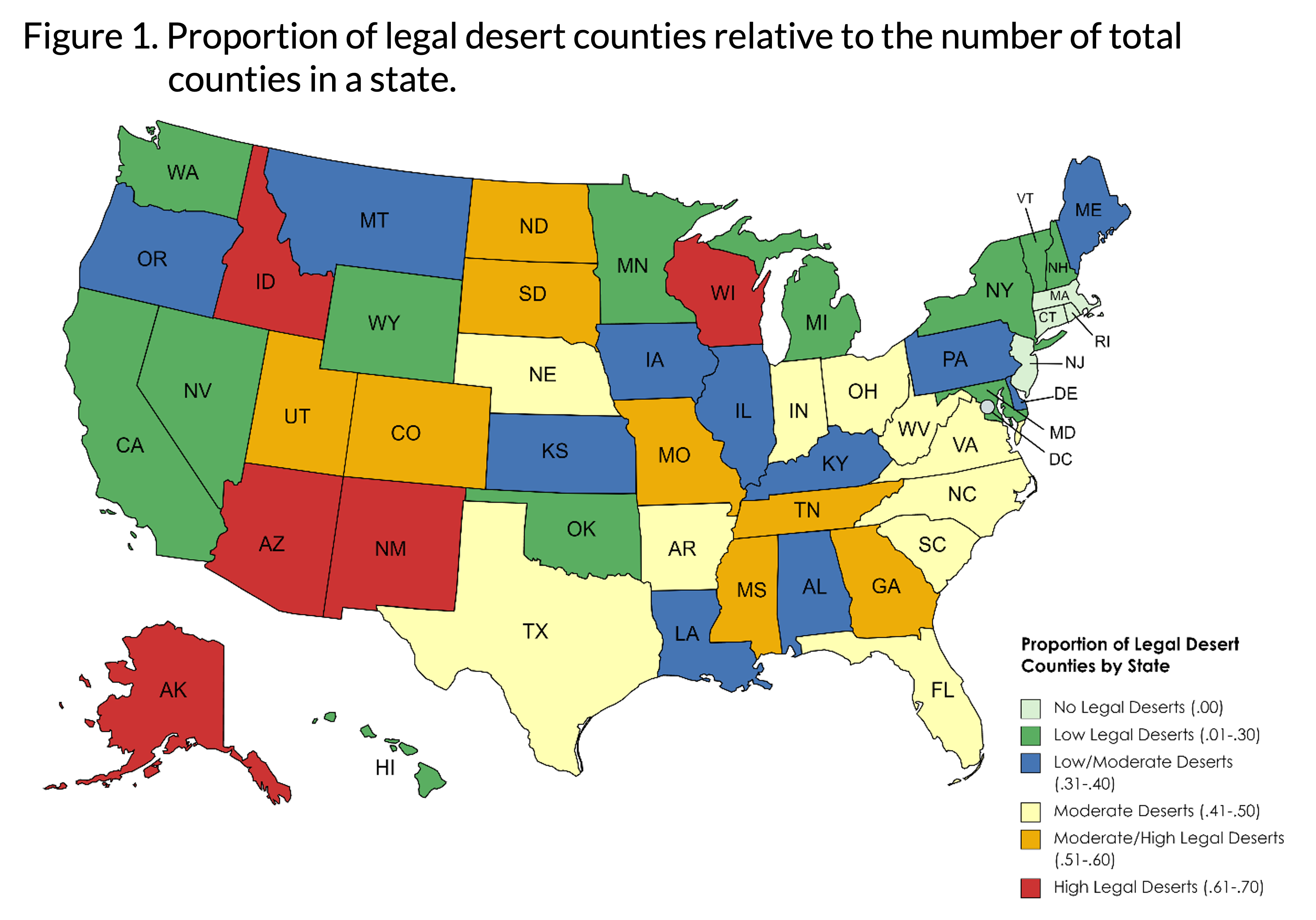

Legal deserts are a surprisingly common problem. Yet, more surprising is the relatively modest cost of a solution.


In its annual Profile of the Legal Profession for 2020, the American Bar Association defined a legal desert as a county with fewer than one lawyer per 1000 people, which is 75% lower than the national average of four lawyers per 1000.  In chapter 1 of the Profile, ABA researchers painstakingly presented the data, state by state and county by county, noting that of the 3,100 counties or county-equivalents, nearly 1,300  (41%) fit the legal desert criteria.  See id (hereafter ABA Legal Desert Report).

To place the term “legal desert” into a broader context, approximately 15 years ago, food deserts became a popular term of art used to classify low-income communities without reasonable proximity to a local grocery store.  During the 2000s, as interest in obesity and diabetes rose across the nation, US Department of Agriculture, the White House, and public health advocates became focused on the social value and importance of eliminating food deserts.

In effect, the  ABA’s legal desert term extends the “desert” concept to justice and lawyer availability within a set geographic area (in this case counties). 
Continue Reading The minimum number of lawyers needed to eliminate legal deserts in the United States (345)


Good question.  I have a few thoughts.


In recent travels, I came across a group of women who appeared Amish in dress, talking and laughing with one another, and I experienced a surprising emotion—I was jealous.

For someone who runs towards the new, always testing the capability, seeing if it improves life for myself and others, and sharing it broadly if the answer is yes, the experience of jealousy when met with a conservative crew steeped in tradition (whether fair or not, some would say “frozen in time”) was puzzling.

After some self-investigation and reflection, I realized that I was envious of their sense of community. There is safety in numbers, there is also comfort in numbers. Comfort in community.
Continue Reading Q: NewLaw is hard. Why should I stay? (344)


Strong leaders voluntarily initiate their own performance feedback. The benefits of doing so are enormous.


[Editor’s note: Given the time of year and the topic of Patrick’s essay, this monthly leadership column is being published two weeks early. Enjoy! wdh]


There is an old adage in managing a client’s expectations that states, “whether we like it or not, we are going to be measured by our clients.”  If we take a very passive approach, the measuring stick against which we will be measured will be exclusively a creation of our client.  Alternatively, we can be proactive and help identify and shape the scorecard.

The same principle is equally true for law firm leaders (FL), especially in dealing with your elected board or executive committee (EC), as the partners and the EC become your expanded client constituency.  Working with your colleagues, especially early in your tenure, to formulate a proper feedback or evaluation process presents a terrific opportunity for you to manage everyone’s expectations.

This issue is especially timely in light of predicted declines in law firm profits.
Continue Reading Should firm leaders take the lead on their own performance review? (343)


For decades, I’ve helped my clients change. Now it was my turn.


For as long as I can remember, I’ve wanted to clone myself—to create a twin that could bring my wish list to life.

Although conventional science has fallen short (perhaps a good thing), an unexpected catalyst became my genie in a bottle.

The pandemic.

Covid-19 shut down the typical version of David Freeman, the one who ran retreats, conducted live training, and provided business development and leadership coaching. It all came to a screeching halt when law firms hunkered down and delayed investing in my services.
Continue Reading A better way to teach business development (342)


Digital transformation was largely a buzzword until I saw what David accomplished during the pandemic.


For this week’s feature post (342), Legal Evolution is pleased to welcome guest contributor David Freeman, a renowned business development consultant who has trained and coached well over 10,000 lawyers in over 200 law firms worldwide.

I have known David for several years.  After reconnecting this summer, David walked me through some of the key features of his Lawyer Bookbuilder® online course.  Much to my delight, it was a fully productized version of 30 years of David’s best-in-class business development training condensed down to 4+ hours of video content, excluding exercises, homework, quizzes, worksheets, and many other downloadable practice aids.

Although David’s course is worthy of promotion, it’s equally noteworthy how a seasoned consultant who graduated from law school in the 1980s successfully engineered his own digital transformation.  Prior to the pandemic, David Freeman was the legal profession’s most successful “bespoke” BD consultant.  Now, two years later, he has a fully polished online course that arguably delivers better, more cost-effective results than David Freeman live.  How, exactly, did this happen?
Continue Reading Guest contributor David Freeman (341)


Yale has a different decision set than other law schools.


Yale Law School’s $1.2 billion share of the Yale University endowment provides approximately $63 million in operating funds, which translates into $106,000 per student, though this amount appears to be headed up due to the 40.2% increase in Yale’s endowment in 2021. See “Yale endowment earns 40.2% investment return in fiscal 2021,” Yale News, Oct 14, 2021; Evan Gorelick, “Yale’s endowment, explained,” Yale Daily News, Oct 22, 2022 (discussing Yale endowment’s 5.25% target payout and policy of smoothing returns over multiple years).

To be clear, these are the funds available before Yale Law collects its first dollar of tuition.  Nonetheless, as the top-ranked law school in the US News rankings for more than 30 years, Yale has a superabundance of highly credentialed students who would be willing to pay or borrow the current cost of attendance. For the 2021-22 admission cycle, Yale admitted only 5.6% of applicants; of those admitted, 81% enrolled, making Yale the most selective and elite law school in the nation. See YLS, “Statistical Profile of the Class of 2025.”
Continue Reading The dollars and math behind Yale Law’s withdrawal from USN rankings (340)


To break from the pack you have to be willing to break the rules.


A few years back, together with colleague David Parnell, we interviewed and surveyed 68 AmLaw firm leaders on their firm’s approach to strategic planning and their responses to 18 specific questions in preparation for a conference presentation we were delivering.

The overall results were startling in that despite months of preparation and thousands of dollars invested, less than 10% of these leaders were able to confidentially admit that they might have implemented “ALMOST all of their last strategic plan.”  Our presentation at the time was covered in Law360:  “Your Biz Strategy: Where Time and Money Go To Die” and the Global Legal Post: “Firms Spending Millions Writing Biz Plans That Just Gather Dust.”

We regrettably had to inform a room full of attendees at a New York Summit on Law Firm Strategic Planning that our research indicated that far too many firm leaders suffer an infliction that goes by the technical term of seeing SPOTS, with SPOTS being an acronym for Strategic Plan On the Shelf!
Continue Reading 10 fatal traps that explain why law firm strategic plans are DOA (339)


Legal technology is slowly becoming core to the legal business. It’s time to commit to a cross-functional team approach.


In the legal profession, attorneys with specialized subject matter expertise (e.g., discovery, trial work, corporate transactions, appellate, regulatory, and many others) provide tremendous value to their clients.  Similarly, technologists supporting the legal profession typically include accomplished programmers, skilled engineers, application experts, integration specialists, security ninjas, and the like. In both disciplines, specialized expertise is incredibly valuable.   

The premise of this post is that individual capabilities and excellence (either legal or technical) standing alone are not enough to ensure long-term, sustainable success.  No superstar technologist or lawyer is equipped to do it all, as there are too many specialties and functional roles which need to be filled.  Rather, a better approach is to construct team-based, cross-functional units that offer greater operational efficiency while building in layers of redundancy that reduce the potential for surprises, errors, or disruption.  Cf Post 323 (Patrick McKenna’s “rules of engagement” for high-performing legal teams).
Continue Reading The expanding role of technology in the law firm business model (338)


A. By embracing Adaptive Leadership principles.


[Editor’s note: Scott Westfahl and Anusia Gillespie worked together at HLS Executive Education and have been collaborating ever since.  Drawing upon Scott’s expertise in Adaptive Leadership and Lawyers Driving Change and Anusia’s perspective across organizations, their most recent effort was an online panel titled “The Resilient GC: Rolling with Disruption.”  Today’s NewLaw Fundamentals column summarizes the top five takeaways from this session, which strongly reinforce the message that NewLaw methodologies and frameworks are becoming core to legal department strategy. wdh]


Shannon Thyme Klinger, Terry Theologides, and Dev Stahlkopf

In The Economist’s recent General Counsel US Insight Hour, “The Resilient GC: Rolling with Disruption,” we heard from Shannon Thyme Klinger, Chief Legal Officer and General Counsel of Moderna, a biotechnology company that went from $800 million US in sales in 2020 to more than $18 billion US in sales in 2021; Terry Theologides, General Counsel of Fannie Mae, a government-sponsored mortgage financing enterprise with $22 billion US in annual revenue; and Dev Stahlkopf, Chief Legal Officer and General Counsel of Cisco, a digital communications technology conglomerate corporation with $52 billion US in annual revenue.

What did these three leading General Counsels from three disparate industries have to say about thriving as the clock speed of change accelerates around them and their companies?
Continue Reading Q. How do GCs thrive amid disruption? (337)