Lessons from the dot com implosion and the financial meltdown.


Henry Kissinger once observed that while history does not repeat itself it often offers useful lessons regarding the future.  With this in mind, I thought might be useful to see what lessons the last two periods of economic adversity – the dot com implosion and


Hotshot now free for law students and faculty


In the span of the last week,  virtually all of legal education has moved  to an online format. See Paul Caron, “More than 185 Law Schools (93%) Have Moved Online Due to the Coronavirus,” TaxProf, Mar. 14, 2020.   Per the above tweet from Paddy


Reflections on the connection between specialization and innovation


Your mother needs heart valve replacement surgery, and it’s time to choose between doctors. You will have to explain yourself to two siblings and a few other relatives, but as a practical matter the choice is in your hands. You interview two potential surgeons. Here’s what they have to say:
Continue Reading The Swiss Army Lawyer (138)


Without effective communication principles, advanced statistics are useless. Some of my key lessons from the field.


The graphic above provides a breakdown of 2018 law school graduates with diverse race/ethnicity backgrounds. Each hand represents 100 JDs. The colors represent four different categories in the U.S. News law school rankings. Thus, the Tier 3/4 schools have the largest number of diverse race/ethnicity graduates—4,500 JDs, or about 45% of all diverse 2018 JD grads. Likewise, only 1,300, or 13%, attended elite T-14 schools, which is clear, useful information for legal employers who have urgency regarding diversity.
Continue Reading How to talk data and influence people, including lawyers (137)


Courage + Logic + Support = Eventual success as a legal innovator


Below is an excerpt of my forthcoming book, A Simple Guide to Legal Innovation (ABA 2020), which I am very excited to share with Legal Evolution readers. 

Over the years I have had enough first-hand learnings about the challenges of trying something new that I wanted to pave the path for others to have an easier time. Specifically for law firm leaders, there is so much confusion on what corporate clients value and expect, coupled with sensational legal press, that it is no wonder there is disappointment and frustration on all sides. 
Continue Reading The Simple Guide to Legal Innovation (133)


For frustrated legal innovators, one of the missing pieces might be found in this new book on trust.


Todd Henderson and Salen Churi, two law professors, have written a deep analysis of trust — its cultural history, social mechanics, economic elements, and of course how it relates to law and regulation.  As they put it, the goal of the book is “to establish trust as a lingua franca for discussion of issues that are often thought of as discreetly political but actually needn’t be” (p. xvi).

The inspiration for their effort was Uber, which I will discuss a little more in a minute.  But while the book covers a great deal of ground — from securities regulation to dinner parties to the Hanseatic League — it does not pause to unpack the implications for lawyers themselves.  I’d like to do a little of that below, because the margins of my copy of The Trust Revolution are full of graffiti on that topic.
Continue Reading The Trust Revolution (book review) (130)


Law firm innovation takes many forms. We need a tool to de-risk and demystify the process.


The above graphic is the Maker’s Matrix©, which is a tool I created to more efficiently categorize, prioritize, and resource innovation projects.  This is because innovation in law firms is a nascent field with lots of hype and headlines but remarkably little structure.  See, e.g., Bruce MacEwen, “Who’s your Chief Innovation Officer, ” Adam Smith, Esq., Nov. 13, 2019.  That’s okay, though.  I’m happy for the opportunity to figure it out.
Continue Reading Innovation as a Service and the Maker’s Matrix (128)

[click on to enlarge]

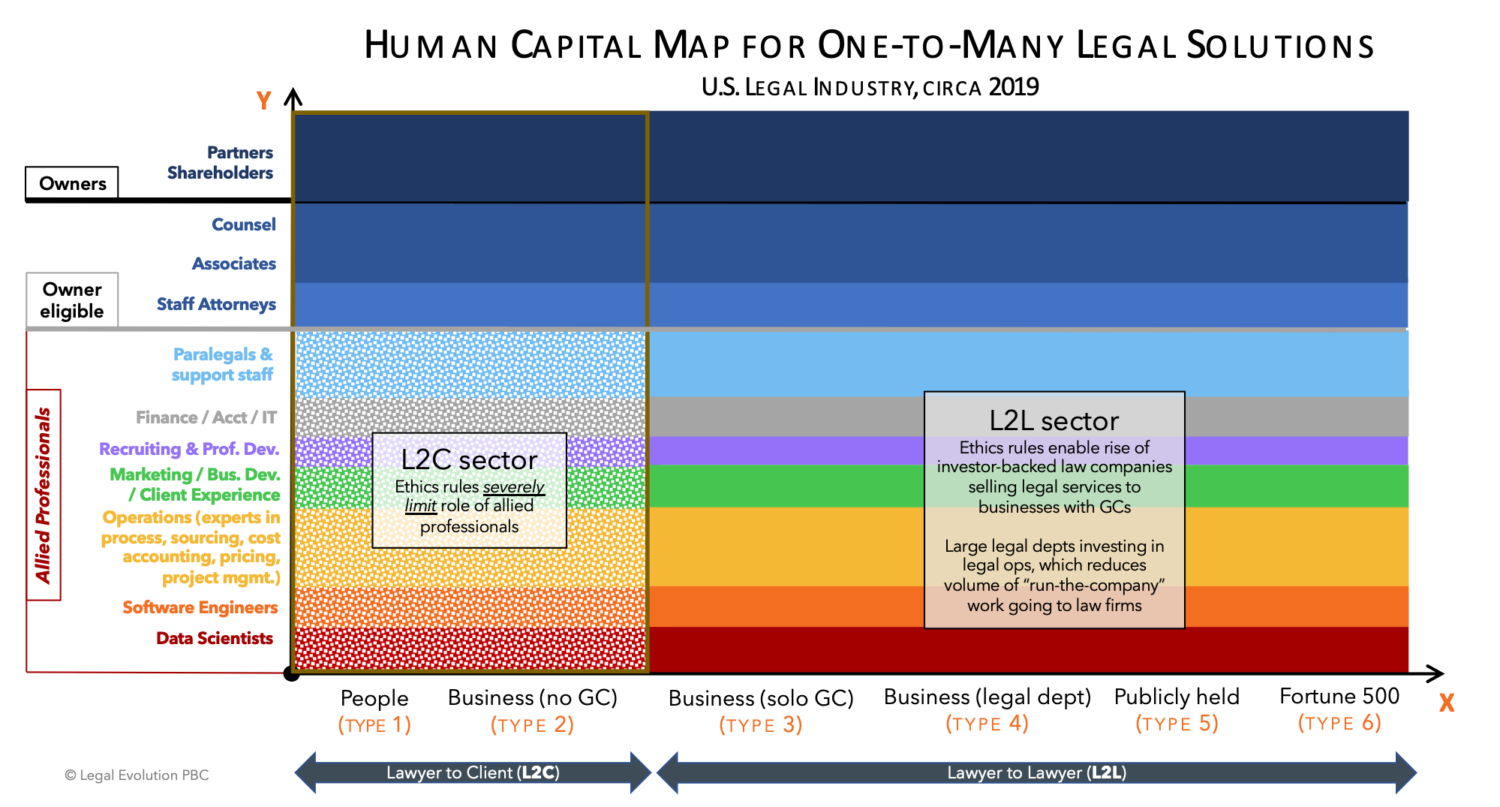
One-to-many legal solutions are built by teams of multidisciplinary professionals. It’s time to build a legal talent supply chain.


The above graphic is a map of the human capital needed to create “one-to-many” legal solutions (Human Capital Map).  It’s a dense graphic on a complex topic. To explain its structure and the key insights it provides, I’ll cover the following topics:
Continue Reading Human capital for one-to-many legal solutions (126)