If we categorize all of our business conversations into the above four buckets, which bucket is the fullest?

Unfortunately, I vote for bucket 4.  We end up in bucket 4 because we want to be perceived as being fully informed.  Yet, being fully informed takes a lot of solitary, uncompensated effort with no certain prospect of a return.  So in our business conversations with one another, we fudge how much we really know.  First to ourselves and then to others.

Everyone likely agrees that bucket 1 is where we need to be.  Yet bucket 1 is the endpoint.  We start in bucket 2 with something like this opening line:  “Our business relationship is not working as well as it should because we are not making decisions from a solid foundation of shared facts. I would very much like to change this.”  If we’re selective on how and where we begin the conversation, we have good odds at a substantive, ongoing dialogue about information gaps and how to jointly fill them.

During the spring and early summer, I wrote two pieces for Law.com that focused on the legal profession’s Last Mile Problem and Last Mile Solution. They presented examples of unproductive dialogue between clients and lawyers.  The unproductive conversations are no one’s fault, yet they are real and pervasive.  These two articles are now combine in a single PDF.  Below is a copy of a “Last Mile” slide deck that contains all the figures in the articles. Hopefully, a few innovators and early adopters use these materials for a “bucket 2” dialogue.  bucket 2 + time = bucket 1.

What’s next?  See Change Agents and Opinion Leaders (020)

Every legal innovatorearly adopter and change agent shares a common, unifying desire: To speed up the pace of innovation within their organization.

This statement is true whether the context is a law firm, legal department, government agency, bar association, or law school. Over the years, I have commiserated with them all. Although they don’t know it, their disappointment is rooted in the fact that organizations are much harder to influence than individuals. See foundational posts 007 and 008 (discussing complexity and challenges of successful organizational adoption). For better or worse, organizations are everywhere within the legal ecosystem. Thus, it would be extremely useful to understand what levers to pull that can make them more innovative.


Post 015 is part of Legal Evolution’s foundational series on diffusion theory.  Readers seeking to influence innovation within the legal industry will be more successful if they obtain and apply this background knowledge. Care has been taken to make this information non-technical and accessible.

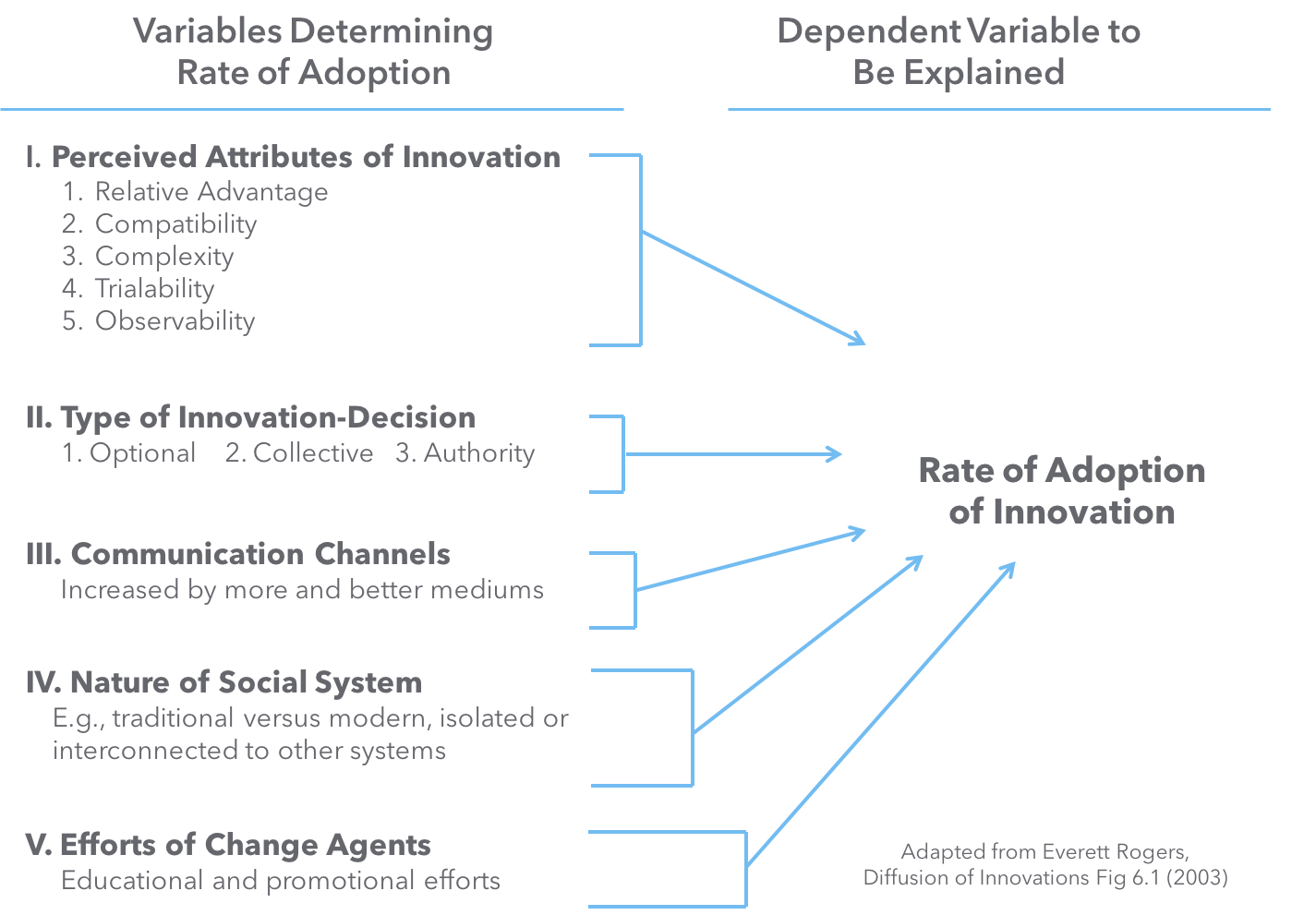
Rogers Organizational Innovativeness Model

The model above, drawn from Everett Rogers’ Diffusion of Innovations Ch. 10 (5th ed. 2003), summarizes several factors that positively or negatively affect an organization’s level of innovativeness.  The model aggregates the results of numerous empirical studies that utilize multivariate regression analysis. However, just like the “rate of adoption” model discussed in Post 008, Rogers conveys the key findings using words rather than numbers. This is because, as an applied researcher, Rogers wants his analysis to be understood and used by a smart lay audience. See Post 001 (explaining difference between applied and academic research).

To illustrate, a multivariate regression model has some number of “independent” variables that predict some outcome we care about. We call that outcome the “dependent” variable. In the graphic above, the left side lists several independent variables while the right side contains a single dependent variable.  Thus, it can be said that the level of organizational innovativeness depends upon the values of several specific independent variables. In very practical terms, the model tells us what categories of change we should focus on to increase innovativeness within our organizations. And, by implication, it tells us what not to do.  It is very hard to overstate how useful this is. In the early days of any innovation, Rogers’ models (above and in Post 008) are both map and compass. It is just plain foolish not to learn how to use them.

That said, to have a fair chance of success, readers need additional background knowledge on the challenges of organizational innovativeness.  Thus, I am breaking this topic into three parts. Part I (Post 015) reviews the reasons why organizations tend to become bottlenecks for innovations that are crucial to their long-term survival. Part II (Post 016) discusses a very counterintuitive fact — that organizational innovativeness is strongly correlated with size, even in law firms. With this background information in place, Part III (Post 017) dives into the details of Rogers’ innovativeness model (above) with special emphasis on how it applies to legal service organizations.

Brief Review of Diffusion Theory

Innovators and early adopters are very interested in speeding up the rate of adoption of innovations. Everett Rogers’ rate of adoption model in Post 008 sets forth many factors that positively or negatively influence this outcome. The model groups these factors into five distinct categories: (I) Perceived Attributes of Innovation, (II) Type of Innovation-Decision, (III) Quantity and Quality of Communication Channels, (IV) Nature of Social System, and (V) Efforts of Change Agents.

As noted in earlier foundational posts, the first category, “Perceived Attributes of Innovation,” contains the most biggest levers for change. This is because the five attributes identified in the research — higher relative advantage, lower complexity, greater compatibility, use of pilot trials, and increased observability for prospective adopters — explain the majority of variation in rate adoption.  With sufficient quantities of time, money and effort, innovators, early adopters and change agents can alter these factors in the right direction. See Post 008 (urging those favoring innovation to “focus your attention on these five factors”); Post 011 (explaining “slow innovations” based solely on these five factors).

Yet, for those of us working in the legal industry, “Type of Innovation-Decision” is equally important. This is because Type of Innovation-Decision is essentially distinguishing between individual and organizational adopters. And the latter are (a) much more common and economically influential within the legal industry, and (b) more likely to result in adoption failure, particularly in the absence of significant planning and intervention.

Innovation in Organizations

As noted in Post 008, there are three types of innovation adoption decisions: (1) optional, (2) collective, (3) authority.  If the adoption decision is optional, it’s akin to market forces: individuals are free to take it or leave it (think Smartphone, Uber, or wearables). In contrast, when an organization is the adopter, either collective or authority adoption decisions apply.

Collective is the most problematic decision type, as a collective adoption decision requires some level of group consensus (think law firm partnership or law school faculty).  Authority adoption decisions are, in theory, easier because a single authority can decide (think CEO or GC). But successful implementation still depends upon overcoming the opposition of the laggards and late majority. See Post 007 (defining adopter types).  Indeed, “massive passive resistance” (MPR) awaits the executive who underinvests in team buy-in. See Post 008 (defining MPR and discussing its pervasiveness in corporate legal departments).

In summary, if you work in the legal industry and want to bring about beneficial change, your success largely depends upon your ability to work with, or within, organizations.  This is because good ideas, unsheltered by a well-informed sponsor, are no match for the strong anti-change headwinds created by organizational decision making. This is a structural feature of the industry that consistently impedes organizational innovation, albeit innovation is never foreclosed — not unless you and others give up. For this ultramarathon journey, Rogers’ models are essential survival tools.

That said, an important caveat is in order.  The predictive power of Rogers’ organizational innovativeness model is much lower than the Post 008 rate of adoption model.  One of the main reasons for the lower predictive power is that factors that make an organization more likely to innovate are simultaneously factors that tend to undermine successful implementation.  Specifically, the likelihood of an organization deciding to adopt an innovation is positively correlated with (i) lower centralization of authority, (ii) higher complexity of work, and (iii) less formalization of procedures. Yet, these three attributes are negatively correlated with successful implementation.

Obviously, very few organizations have the level of self-awareness necessary to make appropriate mid-stream adjustments.  Instead, leaders try to power through obstacles with a one-size-fits-all management approach. In legal organizations in particular, when an innovation fails, we place the blame on lawyers’ contentious, skeptical, autonomy-loving nature. This is a bogus uninformed analysis.  Fortunately, this pathetic cycle can be broken through careful planning and leadership.

Initiation versus Implementation

Below is a graphic that summarizes the five stages of an innovation adoption process in an organization. Notice that the adoption decision is made only after a period of agenda-setting (Stage #1) and matching (Stage #2). Thereafter, the painstaking work of implementation begins.

Note also that the model above essentially assumes that the innovation process is managed by an existing bureaucracy, ostensibly just one of many managerial duties.  The process begins with “Initiation,” which consists of “all of the information gathering, conceptualization, and planning for the adoption of the innovation, leading up to the decision to adopt” (pp. 420-21). After the leadership makes the adoption decision, the organization commences the “Implementation” phase. This consists of “all the events, actions, and decisions involved in putting the innovation to use” (p. 421).  When the innovation is so integrated in the organization that it becomes routinized, it “loses its identity” as something new. In essence, the innovation has merged into the status quo.

As noted above, several organizational attributes that support successful initiation become sources of weakness during implementation. This should be very humbling to legal innovators and early adopters who likely excel at initiation but are prone to underestimate the hardships and complexities of successful implementation. This tendency is explicitly discussed in the Silicon Valley classic Crossing the Chasm by Jeffrey MooreMoore’s solution is simple: when the time comes, replace the innovator/early adopter management team with more mainstream operators whose skill set is execution rather than ideation. For the opposite situation — when an organization is very good at setting and following procedures but struggles to innovate — Rogers suggests a skunkworks as a potential solution.

Unfortunately, there is good reason to believe that law firms, the longstanding cornerstone of the legal industry, reflect the worst of both worlds. The partnership structure hinders both successful initiation and implementation, not to mention making a timely adoption decision. Cf. Bruce MacEwen, Tomorrowland: Scenarios for Law Firms Beyond the Horizon (2017) (discussing at length the business liabilities of governing a law firm as a partnership; suggesting that the partnership model will become a source of numerous law firm failures). Yet, this is less a reason for hopelessness than cause for careful study and preparation, at least among those who intend to stay in the industry beyond the short to medium-term.  Society has many hard problems. This one belongs to lawyers.

There is more to unpack in Parts II (016) and III (017), which I’ll post shortly.

What’s next? See Innovation in Organizations, Part II (016)

glasses_diffusionAre rapidly adopted innovations more valuable and important than innovations that take a long time to take hold? Not necessarily.

Post 011 is part of LE’s foundational series on diffusion theory.  Here’s the key point:  Speed of adoption is not a reliable guide for an innovation’s importance. In fact, competitive advantage is much more likely to lie among slower ideas where innovators focus on several key factors to accelerate the rate of adoption.

It is difficult to accept an insight this counterintuitive. Thus, we need an illustration. Continue Reading Fast versus Slow Innovations (011)

Rogers Figure 6-1

If you have been readings the foundational posts for Legal Evolution, this installment (Post 008) will reward you with something of clear, practical value: An empirically grounded model that identifies specific factors that influence the rate of adoption of an innovation.

What is the specific practical value?

  • If you are an innovator, this model can be used as a functional checklist to assess whether your innovation is ready for market; and if so, where to focus your limited bandwidth to maximize the odds of successful adoption.
  • If you are an early adopter, this model helps you assess whether you want to cast your lot with a specific innovation or, instead, hold your powder until the innovation is more developed or another innovator produces something better.

bookdiffusionsofinnovationsThe graphic above is adapted from Chapter 6 of Everett Rogers, Diffusion of Innovations (5th ed. 2003). As noted earlier, this is one of the most cited books in all of the social sciences.  Although the graphic does not look quantitative, it is actually a user-friendly presentation of a multivariate regression model.

The left column of the graphic lists five groups of variables that influence the rate of adoption of an innovation.  The rate of adoption is the dependent variable, which is listed in the right column. The rate of adoption is a dependent variable because its value depends on the value of the other variables. In the parlance of statistics, the other variables are called “independent” or “predictor” variables. The five groups of variables on the left have been shown by Rogers and others researchers to be valid and reliable predictors of the rate of adoption of an innovation.

If you’re investing a lot of time and money in an innovation, this is a profoundly useful model.

I. Perceived Attributes of the Innovation

Among the five categories of predictor variables, the most important is the first category, the “perceived attributes of innovation”.  Rogers reports that between “49 and 87 percent” of the variance in the rate of adoption can be explained by five attributes: (1) relative advantage, (2) compatibility, (3) complexity, (4) trialability, and (5) observability (p. 221`).

Note that this is a list of perceived attributes. Perceived by who?  The target adopter.

There are many ways to fail as an innovator, but one of the most common is failing to adopt the perspective of the end user.  Rogers begins Chapter 6 with a telling quote: “If men perceive situations as real, they are real in their consequences” (quoting W.I. Thomas Florian Znaniecki, The Polish Peasant in Europe and America 81 (1927)).  Adopting the perspective of the end user is an exercise in empathy. This can be very difficult for the innovator, who is often deeply immersed in the technical workings of the project. He or she is at grave risk of falling in love with features that are of little practical value to the target end user.  Cf. Curse of Knowledge (cognitive bias that afflicts experts).

Rogers distinguishes between “objective rationality” relied upon by the expert who carefully reviews data and “subjective objectivity as perceived by the individual” (p. 232). The latter is what is relevant to adoption. Most of us try to generalize based on what makes sense to us. Instead, we need to spend all of our time studying someone very different and seeing the world through their eyes.  Acquiring this skill set take effort, self-awareness and humility. What you think or I think literally does not matter.

Here is a summary of each perceived attribute.

1. Relative Advantage

Relative advantage is “the degree to which an innovation is perceived as being better than the idea it supersedes” (p. 229). The advantage could take the form of economic benefit, an increase in social status, or both.

It is worth reinforcing the user perspective here.  I have seen numerous legal start-ups struggle and fail because the founders were pitching efficiency to law firms.  Although clients complain about high legal bills, the law firm that makes a large capital investment in efficiency has a very difficult time capturing a reasonable portion of the value created. See Henderson, The Legal Profession’s ‘Last Mile Problem”.  When a salesperson makes the efficiency pitch, they are generalizing from their world, not the world of the prospective law firm adopter.  Quality, on the other hand, has a much stronger appeal to lawyers, primarily because it is associated with lower risk. We’ll go deeper on this point in a future post. See also the discussion below regarding trialability and Practical Law Company’s successful entry into the US legal market.

2. Compatibility

Compatability is “the degree to which an innovation is perceived as consistent with the existing values, past experiences, and needs of potential adopters” (p. 240),  The phrase “disruptive innovation” undoubtedly helped Clayton Christensen sell hundreds of thousands of copies of his famous book, The Innovator’s Dilemma.  However, it not a phrase that will endear you to the vast majority of adopters who have zero interest in having their livelihoods disrupted. The touchstone here is familiarity. The closer we hew to what is known and accepted, the lower the levels of perceived uncertainty.  That is a zone where your innovation has a chance of getting adopted.

To illustrate this point, Rogers notes that care should be taken in naming an innovation, as the name often carries influential connotations that can undermine relative advantage (pp. 250-51). Note that compatibility is often treated as an empirical question. “Positioning” research looks for optimal associations with accepted products or services in the adopters’ environment. Likewise, “acceptability” research seeks to identify factors that tend to make or break an adoption decision. Compatibility research is quantifying the emotional, subjective reactions of potential users.  The only thing close to this in law are focus groups designed to simulate juror reactions. The best trial lawyers use this methodology in preparation for trial. (E.g., Fred Bartlit once told me he used eight separate mock juries for case he was trying. No surprise — he won.)

3. Complexity

Complexity is “the degree to which an innovation is perceived as relatively difficult to understand and use” (p. 257). Whereas relative advantage and compatibility exert a positive influence on adoption, complexity has a negative effect. The higher the perceived complexity, the lower the rate of adoption.  Thus, it is not surprising that successful tech companies obsess over user experience (UX) and user interface (UI).  Design thinking often adds value by removing unnecessary and cumbersome complexity.  See, e.g.,  Design Thinking Comes of Age, HBR (Sept 2015). The graphic below illustrates this point.  The product on the left was designed for the end user; the product on the right stayed too much within the perspective of the engineer.

iphoneandremote

For the curious, the iOS Human Interface Guidelines are published online here.

4. Trialability

Trialability is “the degree to which an innovation may be experimented with on a limited basis.” Rogers continues, “New ideas that can be tried on the installment plan are generally adopted more rapidly than innovations that are not divisible” (p. 258).

Several years ago, the original US sales team of Practical Law Company (PLC) shared with me how they successfully established their US operations. PLC sells annotated forms and practice guides for sophisticated corporate work.  Although PLC had a complete lock on the UK market, they had no US customers when they landed in New York in 2007. Through trial and error, they soon discovered that the single best way to overcome the skepticism of US lawyers was to put them in front of a computer and let them use the PLC product.  After experiencing the product’s immense utility, subscriptions were relatively easy to close. By the time PLC sold to Thomas Reuters in 2013 (for a price between $300-450 million), PLC had 700 legal departments and 86 percent of the AmLaw 200 as customers.  See Thomson Reuters to Acquire Practical Law Company.

Trialability was certainly relevant to PLC’s rate of adoption.  However, the PLC product line also had a huge relative advantage over the incomplete, out-of-date, and unannotated internal forms they were replacing. Trialability enabled perspective adopters to experience the quality difference. To enable high quality decision-making, it is important to keep analytically distinct each of the five perceived attributes of an innovation. Trialability is different than overall relative advantage, though both levers are important.

5. Observability

Observability is “the degree to which the results of an innovation are visible to others.”  Observability is very much related to relative advantage and trialabilty. If an innovation is trialable for early adopters, its relative advantage can be more easily observed by other parts of the social system. See foundational posts 004 and 007.

The importance of observability is documented in an early and influential diffusion study that focused on adoption of hybrid seed corn in two communities in Iowa. See Ryan and Gross (1943). What drove adoption for the vast majority of farmers was not the technical sales pitch made by college-educated agronomists. Rather, it was the observably better corn growing on their neighbor’s land. The technical pitch was primarily relevant to the innovators and early adopters in the social system, who set the adoption cycle in motion. The average time between “knowledge awareness”  and the “adoption decision” (technical terms of art in diffusion research) was a fairly lengthy six years. See chart below.

hybridseedoption

I believe the above chart is very relevant to all the hype regarding how artificial intelligence is going to revolutionize the legal field.  AI does not have a relative advantage that is easy to observe. Mere efficiency (an obvious and potentially observable advantage) is not good enough for many lawyer-adopters, as efficiency currently creates collateral business problems that most clients fail to acknowledge. See Henderson, The Legal Profession’s ‘Last Mile Problem”. AI is also very complex.  These perceived attributes are going to impede AI’s rate of adoption in law.  Many smart people in legal start-ups are trying to use design principles to solve or mitigate these issues. Yet, the best of them know they are climbing a very steep mountain.

Summary of perceived attributes

As noted earlier, the five factors above explain 50% or move of the variance in adoption rates. Stated another way, if you have an innovation you would like others to adopt, focus your attention on these five factors. This simple, empirically derived piece of guidance is one of the reasons that applied research can be so powerful.

Four other categories of variables influence the rate of innovation adoption (II to V in the graphic above). Most of them cannot be significantly influenced by the efforts of innovators, though they are highly relevant because they enable an innovator or early adopter to handicap the odds of market acceptance. In other words, they bear on practical questions like, “should I put more money in?”; “should I sell now?”; “should I fold the business?”;  “how long is adoption likely to take compared to other business contexts?”  Thus, let’s finish the model with a eye toward how it applies to the legal industry.

II. Type of Innovation Decision

At some point after a potential adopter becomes aware of an innovation and weighs its relative advantages, a decision will be made to accept or reject.  There are three types of innovation decisions.

  1. Optional. Basically everyone in the social system is free to decide for themselves. This is market-based.  E.g., smartphones, healthier foods, Facebook.
  2. Collective. Through agreement or strong cultural norms, adoption requires a consensus of the entire group. This mechanism has the most negative impact on rate of adoption.  It is also the mechanism that best describes the typical law firm partnership.
  3. Authority.  One decision-maker makes the decision for the entire social system. E.g., corporate executive; government official. Although authority innovation-decisions are generally the fastest, they run the risk of being “circumvented by members of a system during their implementation” (p. 29).

The type of innovation decision is very relevant to the legal industry.  Back in 2015, I organized a panel of legal innovators for the ABA Center on Professional Responsibility.  One of the panelists was an venture capitalist who was an investor in Modria, an online dispute resolution service that uses an automated dispute resolution methodology similar to those used by eBay and PayPal. As a former associate at a prominent Silicon Valley law firm, the VC helped pioneer some of the early investment in legal tech, albeit not all investments worked out well. In front of an audience of 300 law firm lawyers, the VC stated that he would never again invest in a technology that was designed to be sold to law firms because “law firms don’t made decisions like rational businesses.”

Placed into the Rogers decision framework, the VC was frustrated by the collective decision-making process of law firm partnerships.  From far away, it looks irrational. Up close, however, it’s justified as culture.

That said, it is very easy to confuse the long sales cycle in law with the more fundamental issue of relative advantage. For example, many partners hear their clients clamoring for greater efficiency, and hence are willing to listen to sales pitches. Yet, the partners don’t know to how to honor the clients’ wish because it requires to them to simultaneously (a) pay for, and learn how to use, expensive, complex innovations, and (b) endure a loss in revenues because the clients insist on using hourly production to measure value. Insistence on hourly billing, or shadow billing of AFAs, is a great example of a compatibility restraint that impedes innovation.  The legal profession has a very serious last mile problem.

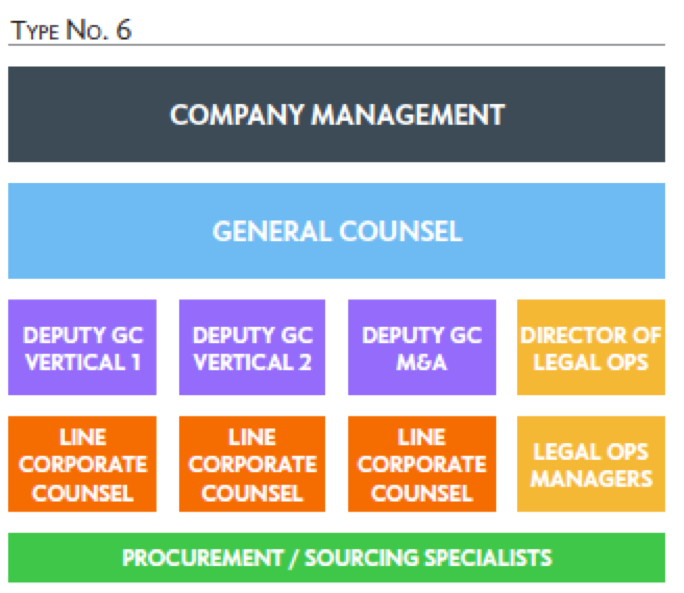
type 6 clientI am confident that the rise of the legal operations role within legal departments is substantially due to the authority innovation-decision advantages of having a single general counsel who possesses traditional executive perogatives. That authority is increasingly being delegated to legal ops professionals who have a clear directive for better, faster, less expensive. See Post 005 (discussing CLOC and the rise of the Type 6 client).

Yet, in the best of circumstances, change management in legal departments is no cakewalk. My friend Jeff Carr, formerly GC of FMC and now at Univar, acknowledged the challenge of MPR, or “massive passive resistance”, in implementing necessary change.  Having achieved remarkable financial results through his ACES model, Jeff became a fierce proponent of general counsel as leader, a discipline and topic completely foreign to most lawyers.

jeff carrIf you ask Jeff about the key to successful implementation of change — e.g., requiring every in-house lawyer in his department to regularly score outside counsel using a standard grading rubric — he is likely to point to his face:  “See this look. This is the look of me not caring. These metrics are necessary for the functioning of the company. Please do your job.”  Another prominent general counsel who successfully transitioned a large legal department away for the billable hour, and has served as an influential advisor to many general counsel, acknowledged to me that such a transition could easily entail the resignation or dismissal of roughly 30% of the department — that was the volume of turnover in his department and other successful legal department transitions he has observed.  Change is hard, even for highly educated professionals.

Suffice it to say, whether its collective innovation-decisions, or the reluctance of lawyer-leaders to stay the course because we have little training or experience as managers or leaders, the legal industry presents special challenges for innovation adoption and diffusion.

III. Communication Channels

The rate of innovation is positively influenced by the number and quality of communication channels. This is true in two ways. First, early adopters may become aware of an innovation through a new communication channel (e.g., the trade press or an industry conference).  Second, more and better communication channels make innovations more observable to the rest of the social system. Not only does this facilitate economically driven adoption decisions based on relative advantage, it also works to set and reinforce group norms. Thus, a subset of adoption decisions will be socially driven by a desire to fit in or avoid feeling left behind or out of date. Again, diffusion of innovations is a social process; incentives are present, but they are often more social than economic.

Not surprisingly, the advent of new communication channels like print journalism, radio, television, and the Internet have all increased the pace of innovation adoption.  The rise of mass media is one of the most important areas of study in diffusion research.  Following the publication of the first edition of Diffusion of Innovations in 1962, Everett Rogers, who was a sociologist by training, joined faculty of Department of Communications at Michigan State University. At the time, MSU was the leading institution in this fledgling academic discipline.

Communication channels are important to innovation because they increase the flow of information. Yet, factors that influence total flow are different than the factors that influence the persuasiveness of the information content.  For the latter, relative advantage, compatibility, complexity, trailabilty, and observability remain the touchstones.

curveLegal Evolution is designed to be a new communication channel that will help accelerate the pace of legal industry innovation.  As noted in Post 001, this publication is an experiment in applied research.  To be successful, I need the readership of legal innovators and early adopters — the light blue portion of the curve.  I hope this elite readership enjoys Legal Evolution’s clean layout and the absence of banner ads. If you have the stamina to read a 3,500 word foundational post, these niceties are the least I can do.

By the way, what is the likelihood I could adequately reach my target readership if I published this analysis in a traditional law review?

IV.  Nature of the Social System

In Rogers’ model, the nature of the social system is the fourth category of variables that can impact the rate of adoption of an innovation.

For the legal industry, the nature of the social system generally impedes innovation adoption. The most established, influential, and prestigious portions of the legal profession — large law firms, the federal judiciary, legal academia, and the ABA — tend to be traditional bound and skeptical of change that does not initiate with them.

Part of this conservative ethos may be the product of Rule 5.4, which has been adopted in some form by every state.  Rule 5.4 prohibits lawyers from co-venturing with other professionals in any business that involves the practice of law. If lawyers can’t be business partners with accountants, engineers, software developers, process experts, and data scientists, etc., that’s going to cut down on the opportunities to learn from them. This makes our social system much more isolated from other innovative parts of modern information economy.

Enough said about that.

V. Efforts of Change Agents

Chapter 9 of Diffusion of Innovations is focused on the change agent.  It begins with the following quote:

One of the greatest pains to human nature is the pain of a new idea. It … makes you think that after all, your favorite notions may be wrong, your firmest beliefs ill-founded. … Naturally, therefore, common men hate a new idea, and are disposed more or less to ill-treat the original man who brings it (p. 365, quoting Walter Bagehot, Physics and Politics 169 (1873)).

This is harsh but also has a ring of truth to it.  To avoid a hostile reception, effective change agents seek out individuals more disposed toward their message, a group disproportionately comprised of innovators and early adopters. After the change agent assists this group in obtaining a large advantage that others can observe, the change agent will become more accepted within the broader social system.  But probably not until then.

Change agents can be university field specialists trying to disseminate agricultural best practices for the good of the state economy. They might also be public health professionals seeking to curb a longstanding but harmful cultural practice that is increasing the spread of disease. The biggest challenge facing change agents tends to be “hetereophily” — i.e., they are often conspicuously different than members of the social system in terms of background and technical expertise. Hence, they struggle to communicate effectively with prospective adopters. Successful change agents find ways to overcome this hurdle. Rogers writes, “As a bridge between two different systems, the change agent is a marginal figure with one foot in each of two worlds” (p. 368).

In the legal industry, change agents are most likely to take the form of technical sales people who are trying to get onto your calendar to sell you a new technology or service.  At industry events, these folks are typically called “vendors.”  The connotation associated with vendors is often negative. In my opinion, this is a parochial way of viewing the world that cannot be squared with our poor record on client service, innovation, and access to justice.  In light of these issues, perhaps we should be more gracious and openminded to those offering tools for improvement.

That said, change agents also exist in established law firms and legal departments — they are quixotic lawyers and other professionals convinced there has to be a better way. In turn, they forge ahead without an empirically grounded theory to guide their actions.  As a result, their courage and good intentions are too often wasted.

As editor of Legal Evolution, I’ll acknowledge my own desire to serve as a change agent. After 15 years of study, it is clear to me that traditional methods of legal problem-solving are underserving clients and broader society. See Post 001 (explaining problem of stagnant legal productivity); Post 006 (connecting the breakdown in judicial system with declining legal job market and declining legal enrollment). This systemic breakdown can only be shored up through innovations that improve legal productivity — i.e., combining lawyerly judgment with better people systems, process, data, and technology. Higher productivity will enable more legal output to be afforded by more people and businesses. I realize this entails a value judgment on my part — I generally favor the innovators. But it is also a judgment informed by a lot of data and field research.  I am also motivated by the longterm welfare of my students at Indiana Law. I need to be part of a system that works for them and their clients.

My change agent role at Legal Evolution has a very simple formula. After explaining the basics of diffusion theory — through these foundational posts — I’ll present finely drawn examples of innovations that appear to be working in the field. In each case, I’ll provide as much context as possible, as the goal is to enable the success of legal innovators and early adopters.

Post 008 will be the longest foundational post by a wide margin. But this is the heart of diffusion theory and how it can be used as a tool of applied research.

Related posts:

What’s next? See Online Dispute Resolution Leader Modria Acquired by Tyler Technologies (009)

Post 007 is another building block in our understanding of diffusion theory.  This sounds like the spinach of blog posts.  And perhaps it is. To make high quality decisions in a complex, rapidly changing legal industry, we need a high quality theoretical lens.  Others have done the hard part — building and validating a useful theory over a period of decades. The purpose of these foundational posts is to understand diffusion theory well enough to apply it to the legal context.

Part I of this post covers units of analysis. Part II presents composite sketches of the five adopter types. Before getting to these new topics, however, let’s briefly review the previous foundational post.

004: Law is a Social System

Post 004 introduced readers to the key insight that innovation diffuses through a social system.  The social system has five segments: (1) innovators (~2.5%), (2) early adopters (~13.5%), (3) early majority (~34%), (4) late majority (~34%), and (5) laggards (~16%). With the exception of innovators, the decision to adopt an innovation is based upon the observed experiences of the adjacent reference group.  Imitation and copying play a much bigger role than analytical or abstract reasoning.

This raises a foundational question — does diffusion theory apply to the legal profession? The short answer is yes.  See Post 004.  Lawyers very much value the security of the pack, albeit we may be reluctant to acknowledge its influence on our own judgments. Why? Because it cuts against our self-identity as a smart person. We want to believe we are smart enough to identify the right answer ahead of others; yet we don’t want the risk and exposure of being separate from the crowd.  Hence, a heavy veneer of reason is layered onto non-adoption decisions that are primarily driven by social proof.  All of this noise invariably slows the pace of innovation for the entire profession.

Yet, here is the crucial insight: In law as in other social systems, the protestations and resistance vary along a continuum.  If you want your innovation to be adopted, don’t waste time trying to convert the early majority, late majority, or laggards.  You have only one audience that matters — early adopters.

I. Units of Analysis

Part II of this post presents composite descriptions of adopter types. Each description is written as if the adopter were a person, which makes them relatively vivid and easy to understand. Yet, in the legal industry as in other complex parts of the economy, innovation often requires the engagement and support of an entire organization. Therefore, before getting into adopter types, we need to cover a technical concept called “unit of analysis” (or, for diffusion research, “unit of adoption”).

A. Organizations

People adopt innovations (e.g., telephones, personal computers, smartphones, etc.), but other valuable innovations often depend upon successful adoption by businesses (e.g., health benefits, enterprise software, flex-time) and/or governments (e.g., seat belt laws, environmental legislation, smoking bans, gay marriage).

When the unit of analysis is an organization rather than a person, the dynamics surrounding the innovation decision (to accept or reject) are much more complex.

To illustrate, imagine the AmLaw 200 grouped along the adopter continuum. A handful of firms would be innovators (~3 – 7) while others would be laggards (~30 – 36 firms, or 1/6 of market).  Yet, the AmLaw 200 social system is dependent upon a separate social system of corporate clients who also fall into the five adopter types.  For an innovator law firm to be successful, it has to find its counterparts among corporate legal departments — i.e., clients willing to pay for something promising even though its new, novel, and relatively untested.

curveIf left to random chance, this complex dialogue will be a fairly rare event.  The 2.5% innovator law firms need an audience with the 16% innovator-early adopter clients. Without awareness of diffusion theory, the mathematical odds are bleak (2.5% x 16% = .4% of buyer-supplier relationships). Once the right pairing occurs, the parties need a dialogue of sufficient depth to plan, build, and execute a successful innovation that benefits both buyer and supplier.

After that, and only after that, will the innovation be picked up and copied by the rest of the social system. This is why the blue part of the diffusion curve is so crucial toward making everything else go.

B. Organizational Innovation is Harder

It is extraordinarily difficult to be a true innovator organization, particularly within the legal industry.  This is true for several reasons.

  • Wrong Analytical Frame. Legal organizations are social systems made up of people and subunits that track the five adopter types. Yet we lack this awareness.  So when promoting an innovation, we place excessive faith in reason and data. After all, everyone is a highly educated professional. Our lack of progress is then blamed on the lawyer stereotype — risk averse, conservative, too focused on precedent, bad at math, etc. — rather than the possibility that we are talking to the wrong group of lawyers.  If we are pitching reason and data to early adopter lawyers, things will go better.
  • Consensus Decision Making.  Legal service organizations tend to make organizational change decisions through committees. That is challenging enough. But the composition of these groups are often designed to manage prideful and contentious lawyers. Optimizing innovation is not even on the table. Think I am just talking about law firms? Not true.  David Cambria, Director of Global Legal Operations at ADM, and Jeff Carr, GC of Univar, often use the term “MPR” (massive passive resistance) to describe the most common reaction to in-house change efforts.  This is fixable, but it takes time and planning, as the politics can’t be ignored.
  • True Innovators Often Lack a Brand.  I have seen this fact pattern many times. Innovator sees a better way while working inside a large industry leader.  The better way is presented to colleagues who cannot yet grasp the advantage. Innovator leaves to form a legal start-up.   Yet, the innovator fails to fully appreciate the difficulty of making sales (or even getting a meeting) without the halo of an established legal brand. In turn, the sales cycle lasts forever plus three days. Some innovators have overcome this hurdle (e.g., United Lex, Pangea3, Axiom Law, Radiant Law), and more will in the future.  But it’s a brutal road.

There are several more challenges, but that is enough for now.  Suffice it to say, it takes tremendous knowledge, skill, persistence, and leadership to create an innovative legal organization.  What we are trying to do here is create a reliable roadmap — that is the purpose of all this empirically grounded theory.

C. The Consumer Market is Different

The market for legal services has two major segments: individual clients (people) and organizational clients (mostly corporations). See, e.g., Deborah Merritt, Two Hemispheres; Bill Henderson, Lawyers for People Versus Lawyers for Business. In the smaller PeopleLaw segment (roughly 1/4 of the US legal market), the unit of adoption is a person with a legal problem. If the person can understand the innovation and the relative benefits are fairly large, the innovation will take hold. Advertising and marketing can often speed this up. This is the market space occupied by LegalZoom, Avvo, and Wevorce.  The diffusion analysis is relatively straightforward and conventional.

However, organizational clients account for 3/4 of the legal services market. Further, the organizational market is not merely buyers and sellers — a complex supply chain is coming into being with managed service providers, legal tech companies with workflow and automation offerings, and various sourcing consultants. For now, however, it is enough to say that innovation roadblocks are more formidable when all the buyers and sellers are groups of lawyers accustomed to consensus decision making.

II. Adopter Types

The descriptions below draw extensively from Everett Rogers, Diffusion of Innovations (5th edition 2003), particularly pages 280-290.  I hope you ask yourself the question, “Within the legal social system, which adopter type am I?”


InnovatorsInnovators place a high value on venturesomeness.  Their interest in new ideas leads them out of conventional peer networks into more far-flung social and professional circles. “Communication patterns and friendships among a clique of innovators are common, even though the geographical distance between the innovators may be considerable.” This is certainly true in law.  The early days of Legal OnRamp revealed the broad geographic dispersion of legal innovators and their desire to communicate with each other.  The LOR chat boards circa 2007-2009 were routinely populated with lawyers from three or more continents.

One of the reasons for the far-flung connections is to better accumulate and understand complex technical information that can be applied to difficult problems. Rogers notes that the “innovator must be able to cope with the high degree of uncertainty about an innovation at the time that the innovator adopts” and also be comfortable with occasional failures and setbacks. Although innovators are generally viewed with skepticism by mainstream peers, they play “a gatekeeping role in the flow of new ideas into a system.” (pp. 282-83).


Early AdoptersEarly adopters are much more integrated into the social system than innovators. They are often the opinion leaders and thus are influential in getting others to act. As compared to the early and late majorities and the laggards, early adopters tend to be more intellectually curious, favorably disposed to science and data, comfortable with abstraction and uncertainty, and more socially and professionally ambitious.

The early adopter is also aware of his or her favored standing among peers. Per Rogers, the early adopter “knows that to continue to earn this esteem of colleagues and to maintain a central position in the communication structure of the system, he or she must make judicious innovation-decisions.  The early adopter decreases uncertainty about a new idea by adopting it, and then conveying a subjective evaluation of the innovation to near peers through interpersonal networks.  In one sense, early adopters put their stamp of approval on a new idea by adopting it” (p. 283).

In the logo of Legal Evolution, innovators and early adopters are both represented by the same light blue color. This is because their relationship is fundamentally different than the relationships between other adopters.  See Post 004.


Early MajorityThe early majority adopts innovations faster than the average member of the social system.  Although they interact frequently with their peers, the early majority “seldom hold positions of opinion leadership in a system.”  Yet, because of their position in the adoption process, they are the group that sets off the tipping point for eventual mass adoption. Rogers quotes Alexander Pope to describe this group: “Be not the first by which the new is tried, nor the last to lay the old aside” (p. 284, quoting An Essay on Criticism (1711)).

The journalist Geoffrey Moore has characterized the transition between early adopters and early majority as “crossing the chasm.”  Moore’s context is primarily Silicon Valley high-tech companies selling enterprise software and similar complex products to corporations.
See Geoffrey Moore, Crossing the Chasm pp. 20-23 (1st ed. 1991). Moore’s analysis is quite relevant to law.  More on that later.


Late MajorityThe late majority is skeptical and cautious.  They generally will not adopt an innovation until “most others in the system have done so” (p. 284).  By this time, the decision is likely to be either a matter of economic necessity or to avoid the discomfort of being outside the norms of the social system.

Rogers notes that socio-economic status tends to be correlated with adopter type.  Thus, the late majority may have fewer resources to take risks and thus may prefer to wait and learn from the experience of others.  Yet, the late majority’s risk averse mindset by be less an effect of fewer financial resources than its cause.  Rogers characterizes this group as followers because the “pressure of peers’ is usually a necessary ingredient to get them to adopt (p. 284).


LaggardsLaggards are traditionalists who tend to make sense of the world by reference to the past.  Among the five adopter types, they have the fewest connections to others. Many laggards are “near isolates in the social networks of their system” and “interact primarily with others who also have relatively traditional values.”  Yet, their slow adoption is not merely a function of limited connectivity. Laggards “tend to be suspicious of innovations and change agents.”  Thus, once made aware of a new idea or methodology, their time period for adoption is significantly longer than others (pp. 284-85).

Rogers acknowledges that late adoption may be rational for those in a social system who can least afford to bear the cost of failure.  Likewise, laggard “might sound like a bad name” though no disrespect is intended by diffusion researchers (p. 285). Rogers observes that a negative connotation would attach to any label associated with the last group to adopt.  This is because the rest of the social system tends to view innovation more favorably.


The next Diffusion Theory post will discuss the levers that influence the rate of innovation adoption.

Related posts:

What’s next? See Variables Determining the Rate of Adoption of Innovations (008)

The editor of Legal Evolution is Bill Henderson, Professor of Law at Indiana University Maurer School of Law, where he holds the Stephen F. Burns Chair on the Legal Profession.

Bill is a prolific author and lecturer on the legal market. His industry accolades include ABA Journal Legal Rebel (2009), National Law Journal 100 most influential lawyers in America (2013), and National Jurist most influential person in legal education (2014 and 2015). Bill is also a Fellow of the College of Law Practice Management

Bill’s academic work can be found on SSRN For additional information, please see Bill’s personal webpage

Continue Reading About


A level set for future posts.


If you wake up each day disturbed by the unraveling of the world around you, and you question whether another day at work is the most rational, constructive, and moral use of your time and talents, consider starting your morning with The Daily Stoic: 366 Meditations on Wisdom, Perservance, and the Art of Living (2016).

I cracked open this book for the first time on September 17, 2023, and was immediately struck by its relevance (and practical guidance) to the present day:

Continue Reading The Daily Stoic (book review) (354)


Smart lawyers face hard questions.


After reading the recently published Servants to the Damned (2022) by investigative reporter David Enrich, which chronicles the role of large law firms in today’s political polarization and wealth disparities, I revisited some earlier psychology materials to consider whether a lawyer could find meaning while pursuing a career in Big Law.

Servants offered two questions in the context of trying to understand a Big Law team’s sanctions-worthy, abusive discovery maneuvers on behalf of its Big Pharma client in a product liability case filed by the parents of a brain-damaged child: “Am I proud of the work I’m doing?” and “Am I the person I want to be?” Continue Reading Is it possible to find meaning in BigLaw? (336)

Source:Legal Innovation After Reform: Evidence from Regulatory Change,” Deborah L. Rhode Center on the Legal Profession (Sept 2022) at 18, Figure 1.


In the long run, however, it’s all about the data.  Initial findings from Utah and Arizona reform efforts.


[Editor’s note:  For today’s feature post, we are pleased to welcome Lucy Ricca and Graham Ambrose, two of the authors of the recently published Stanford Law report on the legal regulatory changes taking place in Utah and Arizona. Prior to becoming Director of Policy and Programs at the Deborah L. Rhode Center on the Legal Profession, Lucy Ricca was the founding Executive Director of the Office of Legal Services Innovation (the regulatory office overseeing the Utah sandbox). In addition, she remains a member of the Office’s Executive Committee.  Graham Ambrose is currently a 2L at Stanford Law and a 2022-23 Civil Justice Fellow at the Rhode Center. wdh]


The year 2020, known to most for global pandemic shutdowns, also heralded leaps and bounds in legal regulatory reforms.  Utah and Arizona approved extraordinary changes to the regulation of legal practice. Both states loosened the bans on nonlawyer ownership of legal practices and the practice of law by nonlawyers.  Further, the Conference of Chief Justices issued a resolution urging states to consider regulatory innovations regarding the delivery of legal services, and the ABA approved a limited resolution encouraging consideration of regulatory innovation.  Even Justice Neil Gorsuch weighed in with his support for regulatory innovation.

This year, on the other hand, has been more challenging.  Continue Reading The high highs and low lows of legal regulatory reform (333)


Stable, transparent, not very complicated, reasonably profitable, and often quite collegial. It also has flaws.


As noted in Part I (330) of this “learning about law firms” series, it’s taken nearly two decades in the trenches, including many years doing applied work with law firms, for a very confusing and counterintuitive insight to come into focus:  Most large firms are not “firms” in the sense of conventional business theory.  Instead, they are a confederation of individual partners building and running leveraged practices in various complementary and adjacent legal specialties.

In today’s essay (Part II), I’ll add a second counterintuitive insight:  For the most part, lawyers pay little or no financial price for organizing themselves as a confederation rather than a firm.  Even in the event of spectacular collapse, as was the case with Dewey, Brobeck, Heller, Howrey, Thelen, and many other large firms, see ALM Staff, “30 Years of Law Firm Collapses: An Annotated Timeline,” Law.com, Oct 29, 2019, there’s always a large cadre of competitor firms looking to give the partners (and their fee-generating practices) a new home.  In most cases, what provides financial security and certainty to an equity partner is seldom the quality of firm-level strategy, or the ability of firm leadership to execute, but instead the health and vitality of their own practice.

This is what distinguishes law firms from conventional businesses. Like Legos blocks, individual law practices can be removed from one law firm and snapped onto another.  Continue Reading Learning about law firms, Part II: Why confederation is our default model (332)