
 The graphic above, adapted from Rogers, Diffusion of Innovations (5th ed. 2013), shows the distribution of innovativeness among 324 German banks. The innovativeness scale is a count of innovation adoptions from a universe of 12 interactive telecom innovations that were diffusing through the German banking sector during the early 1990s. To help distinguish the early
Innovation in Organizations, Part I (015)
 Every legal innovator, early adopter and change agent shares a common, unifying desire: To speed up the pace of innovation within their organization.
This statement is true whether the context is a law firm, legal department, government agency, bar association, or law school. Over the years, I have commiserated with them all. Although they
Example of Automating Private Placement Documentation (014)
The global law firm Gowling WLG has just launched a platform that automates document production for a private placement offering. The video above does a remarkably good job of explaining how the product (called Smart Raise) works. Far from scary and technical, the innovation comes across as simple and inviting. Quite an accomplishment in
Generalizing about Clients (013)
 As a law professor, I worry about my students’ job prospects. One way to manage this worry is to study clients and to work backwards from their needs. Opportunities tend to find lawyers who follow this discipline.
Yet, making generalizations on law clients in the year 2017 is surprisingly difficult. This point was recently driven
Glass Half Full: The Decline and Rebirth of the Legal Profession (Book Review) (012)
 Glass Half Full: The Decline and Rebirth of the Legal Profession

Benjamin H. Barton, Helen and Charles Lockett Distinguished Professor of Law at University of Tennessee-Knoxville College of Law.
New York: Oxford University Press, 2015. 305 pp. ISBN: 978-0-19-020556-0.
The laws of supply and demand have finally caught up with the modern U.S. legal profession,
Fast versus Slow Innovations (011)
 Are rapidly adopted innovations more valuable and important than innovations that take a long time to take hold? Not necessarily.
Post 011 is part of LE’s foundational series on diffusion theory. Here’s the key point: Speed of adoption is not a reliable guide for an innovation’s importance. In fact, competitive advantage is much more likely to lie among slower ideas where innovators focus on several key factors to accelerate the rate of adoption.
It is difficult to accept an insight this counterintuitive. Thus, we need an illustration.
Continue Reading Fast versus Slow Innovations (011)
World Class Innovation and Efficiency, Billed by the Hour (010)
Below are two beliefs I carried with me for many years.
- In all human endeavors, incentives exert a powerful effect on behavior
- Within the legal industry, the billable hour is the primary impediment to innovation and efficiency
 Belief 1 still stands. But belief 2, which I viewed as a corollary of 1, recently fell like
Online Dispute Resolution Leader Modria Acquired by Tyler Technologies (009)
 Earlier this week, Modria (mentioned in Post 008) was acquired by Tyler Technologies, a publicly traded company that specializes in information management solutions to local governments. See press release. Tyler Technology is headquartered in Plano, Texas and has 3,800 employees. It’s total 2016 revenues were $776 million. See 2016 Annual Report. Modria’s
Variables Determining the Rate of Adoption of Innovations (008)
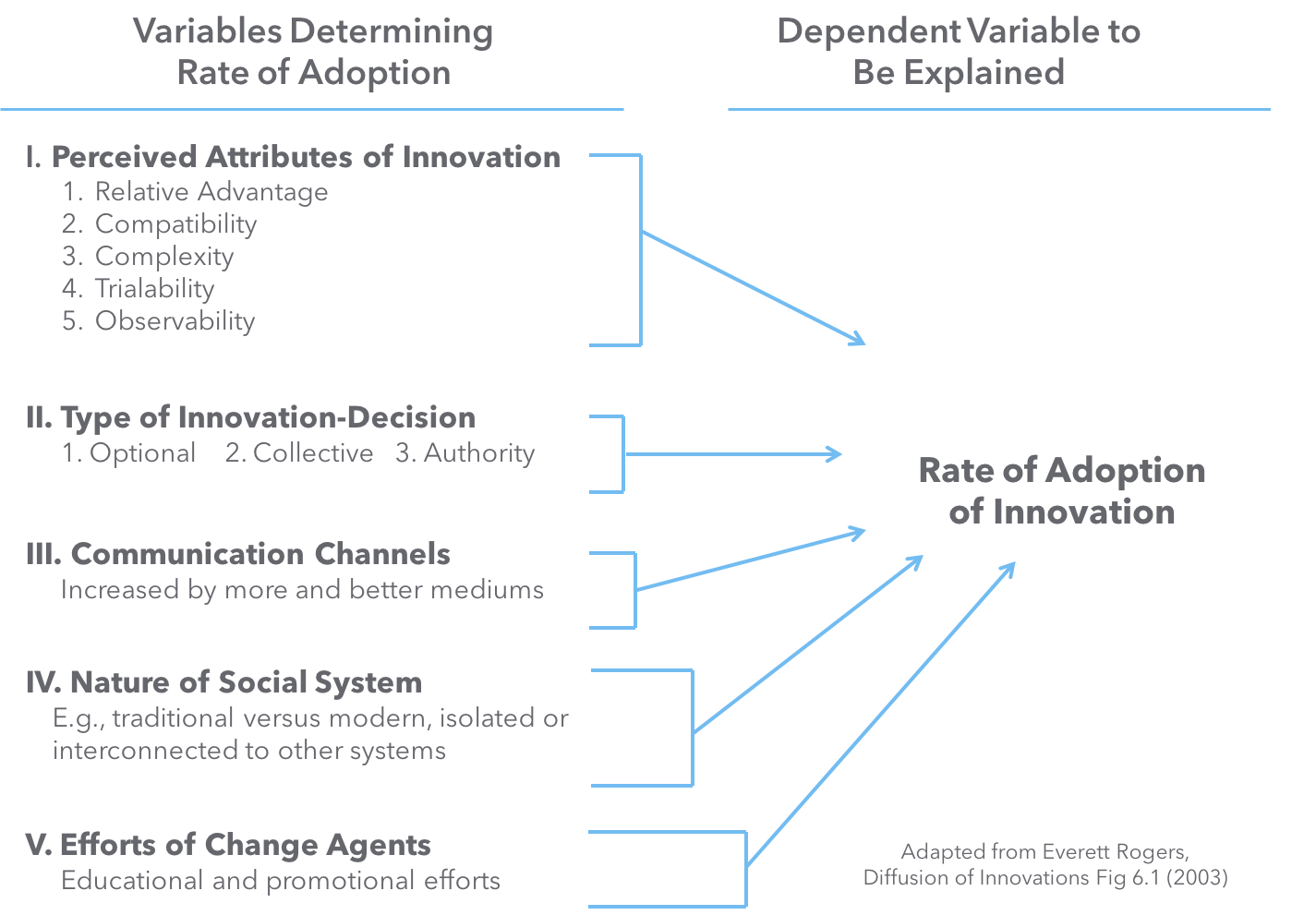
If you have been readings the foundational posts for Legal Evolution, this installment (Post 008) will reward you with something of clear, practical value: An empirically grounded model that identifies specific factors that influence the rate of adoption of an innovation.
What is the specific practical value?
- If you are an innovator, this model
Units of Analysis and Adopter Types (007)

Post 007 is another building block in our understanding of diffusion theory. This sounds like the spinach of blog posts. And perhaps it is. To make high quality decisions in a complex, rapidly changing legal industry, we need a high quality theoretical lens. Others have done the hard part — building and validating a useful