Post 007 is another building block in our understanding of diffusion theory. This sounds like the spinach of blog posts. And perhaps it is. To make high quality decisions in a complex, rapidly changing legal industry, we need a high quality theoretical lens. Others have done the hard part — building and validating a useful
Diffusion Theory
Six Types of Law Firm Clients (005)

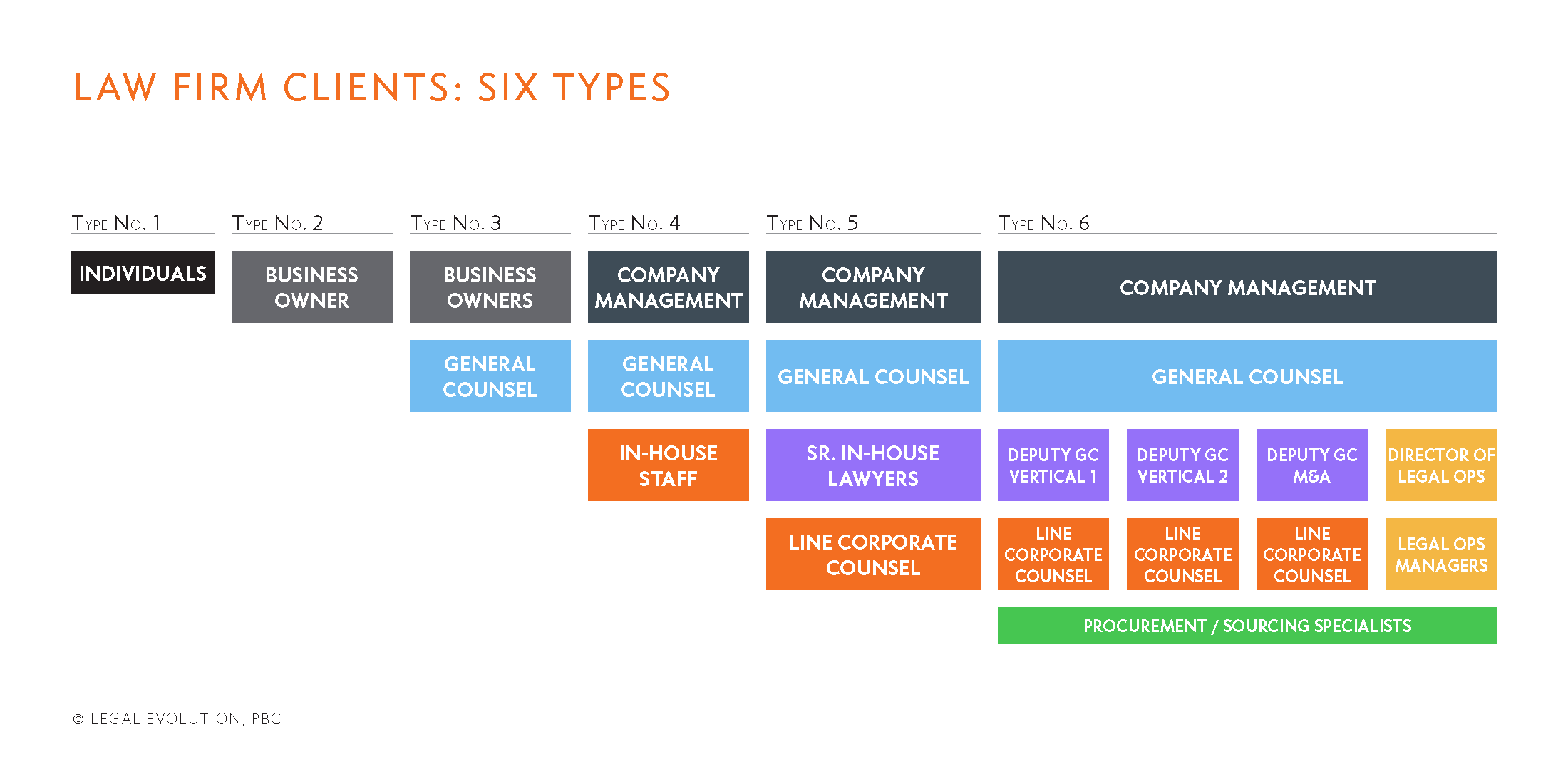
As the legal market remains flat for law firms, the focus naturally turns to clients. How they think. What they care about. How they spend their budgets. Etc. Yet, to the extent that clients vary in significant ways, the generalizations aren’t particularly helpful.
Six Types of Clients
There are many ways to categorize clients, but by my lights the most useful is size and organizational structure of the in-house legal department. As shown in diagram above, this metric varies from zero for individuals (Type 1) and business owners (Type 2), to the equivalent of a specialized law firm embedded inside a large corporation (Types 5 and 6).
Continue Reading Six Types of Law Firm Clients (005)
What is the Rogers Diffusion Curve? (004)
The purpose of Post 004 is to introduce readers to the Rogers Diffusion Curve. The Rogers Diffusion Curve was created by the eminent sociologist Everett Rogers. It was first published in his book Diffusions of Innovations, one of the most widely cited works in all of the social sciences.
Post 004 is part of
…
What is Legal Evolution? (001)
Legal Evolution is two things. First, it is an online publication that curates and compiles examples of successful innovation within the legal industry, often through a simple narrative format. This is because examples and stories tend to be the most effective way to understand and communicate inherently complex material.
Second, Legal Evolution is an experiment…

