
December 2022

Henderson residence, Bloomington, IN, Christmas 2022.

Our publication schedule landed on Christmas this year. For this Sunday, anyway, there’s nothing happening in the legal industry that justifies our attention.  Instead, I’d like to wish everyone a wonderful holiday and a happy 2023.  Sincerely, Bill H.
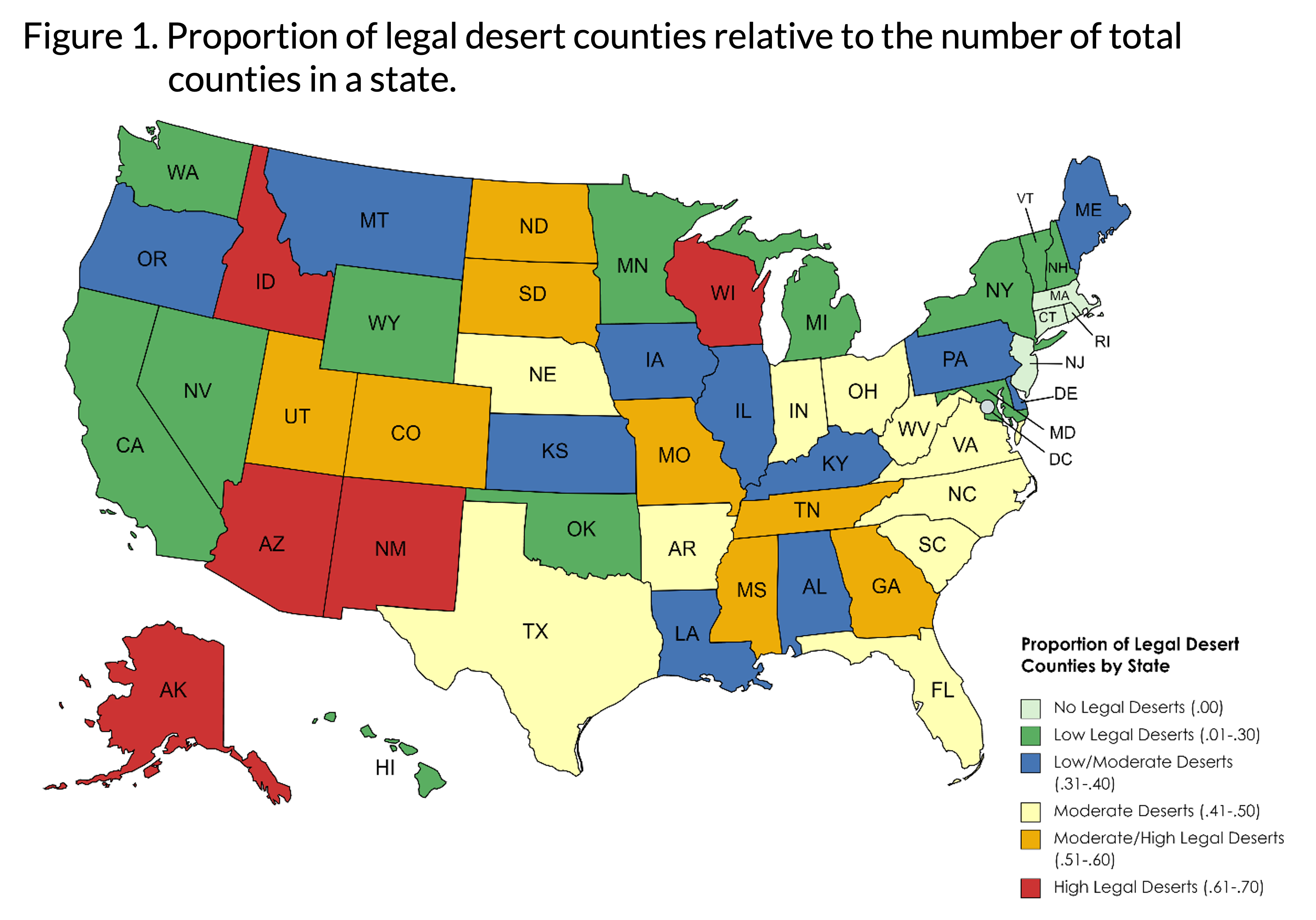

Legal deserts are a surprisingly common problem. Yet, more surprising is the relatively modest cost of a solution.


In its annual Profile of the Legal Profession for 2020, the American Bar Association defined a legal desert as a county with fewer than one lawyer per 1000 people, which is 75% lower than the national average of four lawyers per 1000.  In chapter 1 of the Profile, ABA researchers painstakingly presented the data, state by state and county by county, noting that of the 3,100 counties or county-equivalents, nearly 1,300  (41%) fit the legal desert criteria.  See id (hereafter ABA Legal Desert Report).

To place the term “legal desert” into a broader context, approximately 15 years ago, food deserts became a popular term of art used to classify low-income communities without reasonable proximity to a local grocery store.  During the 2000s, as interest in obesity and diabetes rose across the nation, US Department of Agriculture, the White House, and public health advocates became focused on the social value and importance of eliminating food deserts.

In effect, the  ABA’s legal desert term extends the “desert” concept to justice and lawyer availability within a set geographic area (in this case counties). 
Continue Reading The minimum number of lawyers needed to eliminate legal deserts in the United States (345)


Good question.  I have a few thoughts.


In recent travels, I came across a group of women who appeared Amish in dress, talking and laughing with one another, and I experienced a surprising emotion—I was jealous.

For someone who runs towards the new, always testing the capability, seeing if it improves life for myself and others, and sharing it broadly if the answer is yes, the experience of jealousy when met with a conservative crew steeped in tradition (whether fair or not, some would say “frozen in time”) was puzzling.

After some self-investigation and reflection, I realized that I was envious of their sense of community. There is safety in numbers, there is also comfort in numbers. Comfort in community.
Continue Reading Q: NewLaw is hard. Why should I stay? (344)


Strong leaders voluntarily initiate their own performance feedback. The benefits of doing so are enormous.


[Editor’s note: Given the time of year and the topic of Patrick’s essay, this monthly leadership column is being published two weeks early. Enjoy! wdh]


There is an old adage in managing a client’s expectations that states, “whether we like it or not, we are going to be measured by our clients.”  If we take a very passive approach, the measuring stick against which we will be measured will be exclusively a creation of our client.  Alternatively, we can be proactive and help identify and shape the scorecard.

The same principle is equally true for law firm leaders (FL), especially in dealing with your elected board or executive committee (EC), as the partners and the EC become your expanded client constituency.  Working with your colleagues, especially early in your tenure, to formulate a proper feedback or evaluation process presents a terrific opportunity for you to manage everyone’s expectations.

This issue is especially timely in light of predicted declines in law firm profits.
Continue Reading Should firm leaders take the lead on their own performance review? (343)